


Miranda Moore
RDA Lead Assistant, Beacon Dentistry
01/15/2026
Dental Practice Overhead Benchmarks: Are You Spending Too Much?

~ 8 minutes to read
Understanding dental practice overhead benchmarks isn’t just good accounting practice. It’s the difference between thriving and barely surviving. If you’ve ever looked at your practice’s profit and loss statement and wondered where all the money goes, you’re not alone.
The reality is stark: overhead in dental practices now averages 60-65% of collections, with many practices creeping even higher. That means for every dollar you collect, 60 to 65 cents disappears into operating costs before you even think about taking home a paycheck.
Smart dental practice owners know that managing overhead starts with accurate tracking and inventory control. ZenOne helps practices save an average of $17,000 annually through automated inventory management and real-time price comparisons across trusted suppliers.
Dental Practice Overhead Percentages: Quick Answer (2026)
Most dental practices run 60–65% overhead (everything it costs to run the office before you pay the dentist). If you’re consistently over 70%, you’re likely bleeding profit. If you’re under 55%, you may be under-investing in team, systems, or growth.
- Healthy target:55–65% total overhead (best-run practices aim lower)
- Fastest “quick win” category: supplies (prices vary a lot by vendor and waste is common)
TL;DR: Summary of Dental Practice Overhead Benchmarks
Dental office overhead percentages should ideally fall between 55-65% of total collections, with high-performing practices targeting the lower end of this range. While staff costs represent the largest expense category in absolute dollars, dental supplies present the biggest opportunity for quick savings often without any sacrifice to patient care quality. The key to maintaining healthy overhead lies in monthly tracking, strategic vendor negotiations, and ruthless elimination of waste in high-impact categories like supplies, staffing, and lab fees. Real practices like Dr. Brandon Johnson save $24,000 annually through systematic supply management, while others reclaim 12 days per year by delegating ordering to their teams with proper systems in place.
Key Points:
- Target overhead range: 55-65% of collections, with anything above 70% signaling serious financial trouble
- Supplies are your biggest leak: Most practices overspend here, but inventory management tools can save around $17,000 annually
- Staff costs threshold: Keep personnel expenses below 25% of revenue to maintain profitability
- Lab and facility watchpoints: Lab fees above 10% and facility costs exceeding 7% indicate inefficiency
- Monthly monitoring matters: Calculate your overhead percentage monthly rather than waiting for year-end surprises
Real Examples: How Dental Teams Cut Overhead Without Cutting Care
Here are practical, real-world takeaways from dental healthcare providers who focused on overhead. These are simple moves that work in real offices—not “perfect world” advice.
- Supplies: Stop “panic ordering.” Set par levels so you don’t pay rush prices.
- Staffing: Track production per team member each month so you don’t overstaff for slow weeks.
- Lab: Review your top 10 lab cases and make sure you’re not paying premium fees for routine work.
- Facility: Check if you’re paying for space you don’t actually use.
- Tracking: Calculate overhead monthly (not once a year), so problems don’t hide.
What Are Dental Practice Overhead Benchmarks in 2026?
The dental industry continues to face mounting cost pressures, making it more crucial than ever to understand what constitutes healthy overhead. According to comprehensive analysis from Overjet in 2025, “the national median sits around 62% of collections, yet high-performing practices often maintain overhead between 55-60%.” These top-tier practices achieve lower overhead through strategic technology adoption, streamlined workflows, and efficient staffing models.
Recent data from Blue & Co., a major dental CPA firm, reveals that top-performing practices navigated 2025’s cost increases with a 39% margin before debt service, significantly outpacing industry averages.
Current Industry Standards by Category
According to ADA Health Policy Institute 2023 data, staff costs represent the largest single expense at 25-30% of collections. Clinical supplies and lab fees combined typically account for 4-7% of revenue, though many practices unknowingly exceed these benchmarks.
Here’s how your dental office overhead percentages should break down:
| Category | Benchmark Range | Notes |
| Staff/Personnel | 25-30% | Largest expense; includes salaries, benefits, payroll taxes |
| Clinical Supplies | 4-6% | Controllable through inventory management |
| Lab Fees | 6-8% | Varies by case mix and volume |
| Facility Costs | 6-10% | Higher for smaller practices and urban locations |
| Marketing | 4-7% (established) 8-10% (growth) | Depends on growth phase and competition |
| Admin/Technology | 2-8% | Software, compliance, general business expenses |
Benchmarks vary by location, procedure mix, and practice size—use these as a starting point, then track monthly
The ADA HPI data also reveals significant variation by practice size: practices with less than $750,000 in collections typically experience 70-80% overhead, those generating $750,000-$1.5 million see 60-70%, while practices exceeding $1.5 million achieve overhead below 60%.
What Counts as Overhead?
Overhead includes every operating expense required to run your practice except doctor compensation. This includes:
- Personnel costs: Staff salaries, benefits, and payroll taxes for hygienists, assistants, and administrative team members
- Clinical costs: Dental supplies, laboratory fees, and any in-house lab technician expenses
- Facility expenses: Rent or mortgage payment, utilities, maintenance, equipment leases, and repairs
- Administrative costs: Accounting fees, insurance premiums, software subscriptions, professional memberships, and office supplies
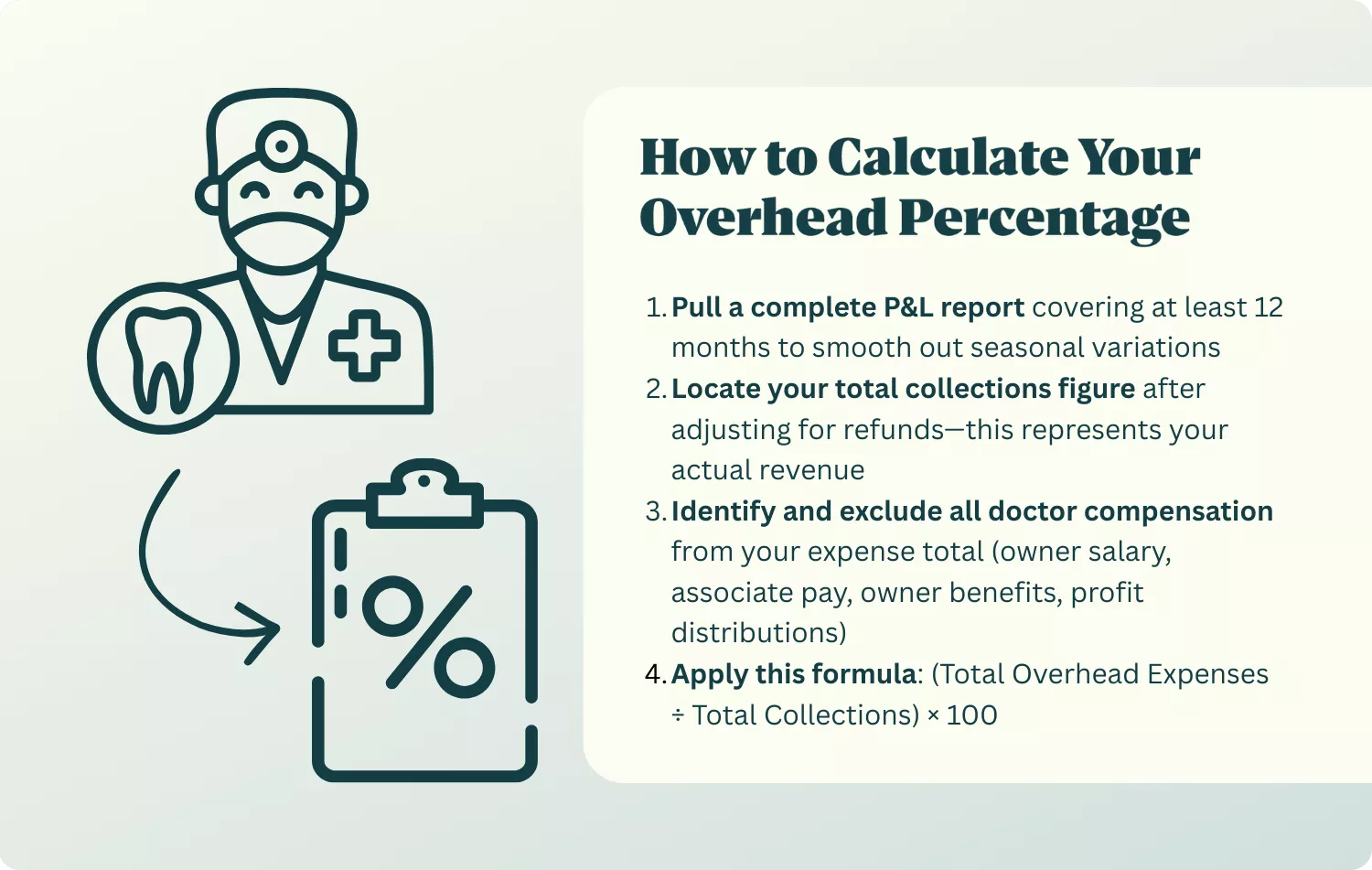
How to Calculate Your Overhead Percentage
Step-by-Step Calculation
- Pull a complete P&L report covering at least 12 months to smooth out seasonal variations
- Locate your total collections figure after adjusting for refunds. This represents your actual revenue
- Identify and exclude all doctor compensation from your expense total (owner salary, associate pay, owner benefits, profit distributions)
- Apply this formula: (Total Overhead Expenses ÷ Total Collections) × 100
Example: If your practice collected $1 million and had $620,000 in overhead expenses (after excluding doctor pay), your overhead percentage equals 62%.
What Your Number Means
- 55-60%: Top-performing practices. This range provides healthy margins for doctor compensation (typically 35-40% of collections), plus retained profits for reinvestment.
- 60-65%: Average range for dental practices. Room for improvement, but not in immediate danger.
- 65-70%: Warning territory. Practices in the 67-70% range face operational inefficiency that limits profitability.
- Above 70%: Serious problems requiring immediate intervention.
The #1 Overhead Category Practices Overspend On (And How to Fix It)
While staff costs represent the largest expense in absolute dollars, dental supplies present the biggest opportunity for immediate savings without impacting patient care. The average 5-chair practice spends $50,000-70,000 annually on supplies (roughly 5-7% of collections), but many practices unknowingly exceed these benchmarks.
Why Dental Supplies Are Your Biggest Leak
Dental supplies quietly drain profits through:
- Emergency orders at premium prices
- Expired materials that must be discarded
- Excessive safety stock that ties up cash
- Inconsistent pricing for identical products from order to order
Supply costs have risen steadily since 2020, with manufacturers passing along increased raw material and shipping expenses. When supply costs grow faster than production, it signals waste, theft, or pricing problems.
Real example: Dr. Brandon Johnson (Brushy Creek Dentistry) was “spending so many hours on eBay, Net32 and Amazon just trying to find the best price.” After implementing systematic price comparison through ZenOne, he now saves $2,000/month ($24,000/year) on his $10,000 monthly supply spend.
5 Ways to Cut Supply Costs Without Sacrificing Quality
1. Implement real-time price comparison across multiple suppliers
Tools like ZenOne enable instant side-by-side pricing across 50+ trusted suppliers, ensuring you never overpay for routine items. The platform’s AI-powered search helps practices identify the best deals on 150,000+ products without manual effort.
2. Establish strict inventory par levels based on actual usage
Track consumption by operatory to identify waste, and set automated alerts when stock reaches predetermined minimums.
3. Standardize your product formulary
Too many practices allow each dentist to specify preferred brands for every category, multiplying SKU counts and eliminating volume discounts.
4. Negotiate annual contracts with volume rebates
Join a group purchasing organization or use a centralized procurement platform to leverage collective buying power.
5. Conduct quarterly audits of high-value items
Implement variance logs to track discrepancies from theft, loss, or expired stock. These controls typically uncover thousands of dollars in annual leakage.
Start comparing prices across suppliers →
Average Markup From Dental Supply Companies (And Why Prices Vary)
Dental supply pricing includes markups at different steps in the supply chain. A common rule of thumb is that distributor markup averages around 20%, but it can range from about 5% to 40% depending on the product and market. That’s why the same gloves or composites can cost very different amounts across suppliers.
To spot markup pain fast, do this once a quarter:
- Pull your top 10 most-purchased items from the last 90 days.
- Compare the unit price across at least 3 suppliers (include shipping).
- Flag anything where the “same item” is 15%+ cheaper elsewhere.
- Set your reorder list to default to the best-price supplier.
- Re-check after 30 days (prices change often).
Other Overhead Killers to Audit Right Now
Staff Costs (If Above 25%)
According to industry benchmarks, top-performing practices generate $200,000+ per team member. If you’re significantly below this benchmark, you may have too many people for your current patient volume.
Solutions:
- Cross-train team members to match labor to demand
- Balance retention priorities with cost control through competitive compensation packages
- Track employee turnover costs (recruitment, training, lost productivity often exceed retention expenses)
Lab Fees (If Above 10%)
Laboratory fees should remain around 6-8% of revenue for general practices.
Solutions:
- Negotiate with multiple laboratories for competitive pricing
- Consolidate work for volume discounts
- Review case mix for in-house milling opportunities
- Track lab fees monthly as a percentage of collections
Some practices achieve lab cost reductions of 10-13% through systematic vendor management.
Facility Costs (If Above 7%)
While facility costs can range from 6-15% depending on practice size and location, the 7% threshold serves as a target for efficient operations in most markets.
As Overjet notes in their 2025 analysis, “high-volume practices frequently maintain overhead below 60% through operational scale advantages. Large practices distribute fixed costs across more patients while negotiating better supplier terms.”
Solutions:
- Energy efficiency upgrades for older facilities
- Negotiate lease renewals well in advance
- Evaluate whether square footage matches operational needs
Marketing (The Goldilocks Problem)
The “just right” amount typically falls between 4-7% of annual revenue for established practices, with newer or aggressively growing practices pushing toward 8-10%.
The key distinction lies in marketing ROI rather than absolute spending. Track cost per new patient acquisition and lifetime value per patient to determine whether marketing delivers profitable growth.
Red Flags You’re Overspending
Supply Warning Signs
- Supply costs above 6-7% of monthly collections
- Frequent inventory stockouts requiring emergency orders
- Expired materials discovered during inventory counts
- Multiple staff placing orders without centralized oversight
- Can’t quickly produce a list of top 10 supply expenses
Overall Practice Warning Signs
- Overhead consistently exceeding 65% of collections
- Production per dentist stagnating while expenses rise
- Cash flow problems despite adequate production
- Revenue per employee below $150,000
Real example:Miranda Moore (Lead Assistant, Beacon Dentistry) was ordering from 18 different vendors. “Each order took 2-3 hours.” After centralizing with ZenOne: “With Zen I have all my products in one place. Ordering takes 15-20 minutes (85% time reduction).”
Conclusion
The difference between operating at 55% overhead versus 70% equals $150,000 in additional profit on a practice collecting $1 million annually.
Real results from practices using ZenOne:
- Dr. Brandon Johnson: $24,000/year saved through price comparison
- Dr. Nikki: 12 days/year reclaimed by delegating ordering to team
- Miranda Moore: 85% reduction in ordering time
Start with the categories offering the quickest wins: dental supplies through better inventory management, staff costs through productivity improvements, and facility expenses through space optimization. The practices thriving in 2026 aren’t necessarily the ones with the highest production. They’re the ones maintaining healthy overhead that preserves profitability.
Ready to see where your supply costs really stand? Visit zenone.com to discover how automated inventory management helps practices save an average of $17,000 annually through smarter ordering and real-time price comparisons.
Frequently Asked Questions About Dental Practice Overhead
What is a good overhead percentage for a dental practice?
A healthy overhead percentage typically falls between 55-65% of collections, with high-performing practices targeting 55-60%. This range provides adequate room for doctor compensation (usually 35-40% of revenue) while maintaining profitability. Anything exceeding 70% requires immediate intervention.
How much should a dental practice spend on marketing?
Marketing expenses should represent 4-7% of annual revenue for most established practices, with newer or aggressively expanding practices potentially spending 8-10%. Track your cost per new patient acquisition and lifetime patient value to ensure marketing delivers profitable growth.
What is average associate dentist production per day?
Associate dentist production typically ranges from $2,500 to $4,500 per day, with new associates at the lower end ($2,000-$3,000 daily) and experienced associates at the higher end ($3,500-$4,500 daily). High-performing associates in well-managed practices can exceed $5,000-$6,000 per day.
How often should I review my overhead benchmarks?
Review your overhead benchmarks monthly for calculations and tracking, with quarterly comprehensive comparisons against annual standards. Monthly reviews enable early detection of cost trends, particularly important given the 5% annual overhead increases many practices experience.
Do startup practices have different overhead expectations?
Yes. New practices must fund substantial upfront costs including $350,000 to over $500,000 in initial investments before generating revenue. Startups typically experience overhead ranging from 70-80% during their first 12-24 months as fixed costs spread over growing patient volumes. With efficient management, startups can move toward standard 60-65% overhead ranges within 24 months.
Join 1200+ dental professionals, shop from your favorite
suppliers, compare prices instantly, and save over $17,000/year
Try our platform free for 14 days.
Get the latest ZenOne updates and product launches in your inbox
Don't miss the latest news!
Receive exclusive offers and news straight to your inbox!
Continue reading

02/19/2026
~ 13 minutes to read
02/19/2026
~ 3 minutes to read

02/12/2026
~ 8 minutes to read
Let's discover how we can help you

Tiger Safarov
Hi, I'm Tiger, the CEO at ZenOne, and I'm happy to personally ensure your success with ZenOne. Send me your latest invoice or a statement for a Free Savings Analysis.
Ask me a question:

