


Miranda Moore
RDA Lead Assistant, Beacon Dentistry
ZenOne CE Program
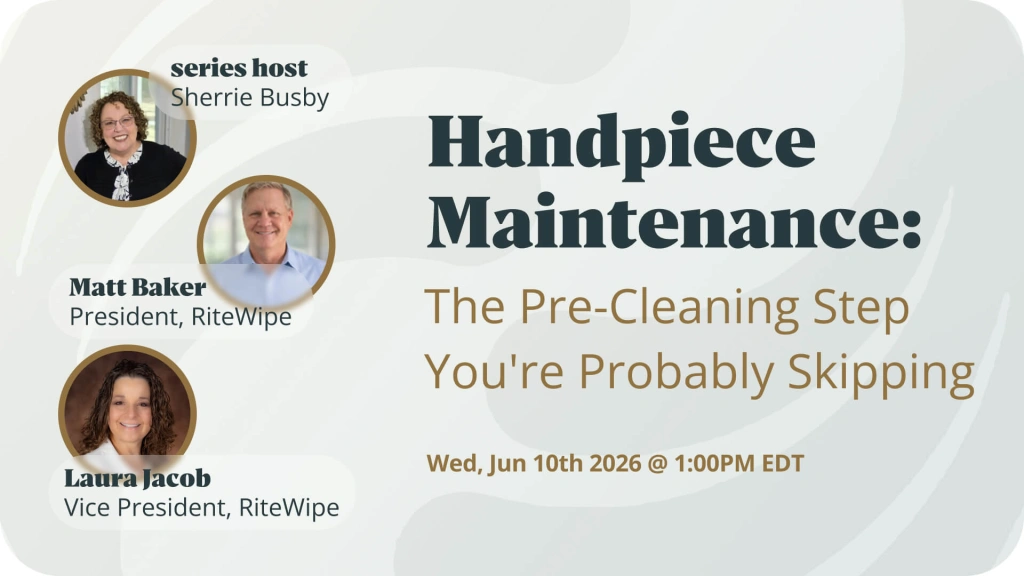
Sherrie Busby ft. Matt Baker & Laura Jacob:
Sherrie Busby ft. Matt Baker & Laura Jacob:
“Handpiece Maintenance: The Pre-Cleaning Step You’re Probably Skipping”
Dental teams often disinfect surfaces and handpieces all day – but the cleaning step can get missed or misunderstood. In this session, Sherrie Busby speaks with Matt and Laura from RiteWipe about the difference between cleaning and disinfecting, why disinfectant residue can damage handpieces and operatory equipment, and how proper pre-cleaning supports maintenance, infection control, and equipment longevity.
Originally presented live on June 10, 2026 • 30 min • Webinar Replay • Complimentary
Watch the webinar replay
Course Description
This webinar explains the practical difference between cleaning and disinfecting in dental workflows, with a focus on handpiece maintenance, upholstery care, and operatory surfaces. The discussion covers why cleaning must happen before disinfection, how disinfectant residue can contribute to corrosion, discoloration, cracking, and tackiness, and why handpiece reprocessing should follow manufacturer instructions and infection control standards.
Participants will learn how pre-cleaning fits into daily maintenance workflows, how to reduce residue buildup at the end of the day, and how to use SOPs and IFUs to support consistent cleaning, lubrication, sterilization, and documentation practices.
This program is complimentary. No fee is required to register for or view the program.
Educational Objectives
Upon completion of this program, participants will be able to:
- Explain the difference between cleaning and disinfecting in dental operatory workflows.
- Describe why cleaning is required before disinfection and how missed cleaning steps can affect infection control and equipment maintenance.
- Identify common causes of disinfectant residue buildup on handpieces, upholstery, plastics, tubing, curing lights, sensors, and other operatory surfaces.
- Describe how improper use of disinfectants can contribute to handpiece corrosion, upholstery damage, cracking, peeling, discoloration, and tackiness.
- Apply practical pre-cleaning and end-of-day residue removal workflows to support equipment longevity and infection control practices.
- Recognize the importance of following manufacturer Instructions for Use, CDC guidance, and office SOPs for handpiece reprocessing and operatory surface care.
Teaching methods

Live webinar
Structured conversation between host and subject-matter expert
Structured conversation between host and subject-matter expert

On-demand recording
Full replay available after the live program
Full replay available after the live program

Live Q&A
Real-time audience questions answered during the session
Real-time audience questions answered during the session

Session notes
Downloadable summary of the program content
Downloadable summary of the program content
Intended Audience & Prerequisites
This program is designed for dental team members involved in handpiece maintenance, operatory turnover, infection control, and equipment care, including:
- dental assistants
- hygienists
- infection control coordinators
- clinical leads
- office managers
- practice owners
Basic familiarity with dental operatory workflows is recommended. No prior handpiece repair or infection control certification is required.

About the Presenters
 |
Sherrie Busby, EDDA, CDSO, CDIPC – HostFlorida Expanded Duties Dental Assistant; Certified Dental Specialist — OSHA (Dental Compliance Institute); Certified in Dental Infection Prevention and Control (DANB DALE & ADS / OSAP). 40+ years of clinical and educational experience in dentistry. Former DA and OSHA/Infection Control Training Developer at Heartland Dental (2014–2025), supporting training for 1,800+ dental offices.
Curriculum Developer & Webinar Host, ZenOne |
 |
Matt Baker — Featured GuestDental industry professional with hands-on experience in handpiece maintenance, repair patterns, and equipment care workflows. His work focuses on helping dental teams understand how disinfectant misuse and residue buildup can affect handpiece performance, repair needs, and equipment longevity.
President, North America Sales & Marketing, RiteWipe |
 |
Laura Jacob — Featured GuestDental industry professional with nearly 30 years of experience in the dental field, including extensive work with restorative, crown and bridge, direct restorative procedures, and dental handpiece maintenance education. Her work focuses on helping dental teams understand proper equipment care, pre-cleaning workflows, and practical maintenance routines.
Vice President, North America Sales & Marketing, RiteWipe |
Q&A from the webinar
What is the difference between cleaning and disinfecting?
What is the difference between cleaning and disinfecting?
Cleaning removes debris, bioburden, oils, and residue from a surface. Disinfecting uses an EPA-registered disinfectant when required. The key point: cleaning and disinfecting are two different steps.
Why can disinfectant wipes be a problem for handpieces?
Why can disinfectant wipes be a problem for handpieces?
Disinfectants have their place, but repeated misuse on handpieces can allow chemicals to reach internal components. Over time, this may contribute to corrosion, rust, and repair issues that are not always visible from the outside.
Will purging a handpiece remove disinfectant damage?
Will purging a handpiece remove disinfectant damage?
Not completely. Purging and internal maintenance are important, but if corrosion has already started, the damage may already be done. Orange residue during purging can be a sign of rust or corrosion.
Can cleaning wipes be used on curing lights?
Can cleaning wipes be used on curing lights?
Yes, they can be used for cleaning, but they do not replace disinfection when disinfection is required. The presenters also emphasized that curing lights should be barrier protected whenever possible. Cleaning the handle and removing residue can help reduce discoloration or surface damage, but teams should still follow IFUs and infection control requirements.
Can cleaning wipes be used on curing lights and other surfaces?
Can cleaning wipes be used on curing lights and other surfaces?
Yes, they can be used for cleaning, but they do not replace disinfection when disinfection is required. Curing lights should still be barrier protected, and teams should follow manufacturer IFUs.
Why does upholstery crack, peel, or become sticky?
Why does upholstery crack, peel, or become sticky?
Repeated disinfectant use and residue buildup can damage upholstery over time. Removing residue, especially at the end of the day, can help reduce cracking, discoloration, stickiness, and surface wear.
What is the recommended workflow?
What is the recommended workflow?
Clean first, disinfect when required, and remove disinfectant residue afterward. At minimum, teams should remove residue at the end of the day from surfaces that are repeatedly disinfected.
Key takeaways from the session

Cleaning First
Remove debris before disinfecting.
Remove debris before disinfecting.
Not Disinfectant
Cleaning wipe does not disinfect.
Cleaning wipe does not disinfect.
Hidden Damage
Handpieces corrode from the inside.
Handpieces corrode from the inside.
Residue Removal
Clean residue at day’s end.
Clean residue at day’s end.
Protect Upholstery
Reduce cracking, peeling, tackiness.
Reduce cracking, peeling, tackiness.
Follow IFUs
Use manufacturer-approved care steps.
Use manufacturer-approved care steps.
Additional Resources
- CDC — Guidelines for Infection Control in Dental Health-Care Settings
https://www.cdc.gov/mmwr/preview/mmwrhtml/rr5217a1.htm - CDC — Summary of Infection Prevention Practices in Dental Settings
https://www.cdc.gov/dental-infection-control/hcp/summary/index.html - CDC — Dental Handpiece Reprocessing Guidance
https://www.cdc.gov/dental-infection-control/hcp/summary/handpieces.html - Association for Dental Safety, formerly OSAP
https://www.myads.org/ - ADA — Infection Control and Sterilization
https://www.ada.org/resources/ada-library/oral-health-topics/infection-control-and-sterilization - RiteWipe Handout
https://drive.google.com/drive/folders/103X0dNDv1qD5KmTlb9waMQeJIMqbWBEL?usp=drive_link
Disclosure of Commercial Relationships
Disclosure: This program features representatives of RiteWipe, a commercial cleaning wipe product. Product-specific examples, product claims, and workflow demonstrations may be discussed during the program. The educational content focuses on general principles of cleaning versus disinfecting, handpiece maintenance, operatory surface care, disinfectant residue removal, and use of SOPs and manufacturer Instructions for Use. No specific commercial product is required to apply the general maintenance and infection control principles discussed. Any product-specific discussion, demonstration, pricing, savings claims, or promotional information should be considered commercial content and held distinct from the educational portion of the activity. Commercial relationships of the presenters will be disclosed verbally at the start of the program.

