


Miranda Moore
RDA Lead Assistant, Beacon Dentistry
ZenOne CE Program
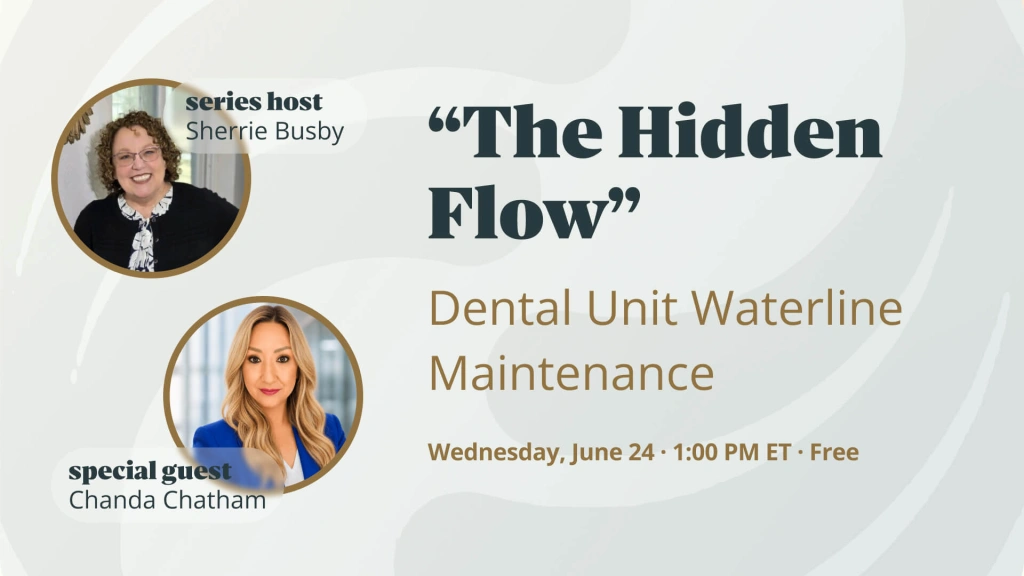
Sherrie Busby ft. Chanda Chatham:
Sherrie Busby ft. Chanda Chatham:
“The Hidden Flow: Dental Unit Waterline Maintenance”
Your dental unit waterlines may look clean, but what is happening inside them can tell a very different story. In this session, Sherrie Busby speaks with Chanda Chatham, Director of Professional Education at Solmetex/Sterisil, about biofilm, waterline testing, shock treatment, daily maintenance, and the practical steps dental teams can use to keep water safe.
Originally presented live on Jun 24, 2026 • 30 min • Replay available • Complimentary
Watch the webinar replay
Course Description
Dental unit waterlines can look clean while still harboring bacteria and biofilm inside narrow tubing. This webinar explains why waterline maintenance matters, how biofilm forms, and why clear water does not always mean safe water.
The session covers common waterline risks, CDC guidance, the EPA drinking water standard of less than 500 CFU/mL, state-level dental water quality rules, routine testing, shock treatment, and daily antimicrobial maintenance. Participants will learn practical steps to monitor, document, and maintain dental unit waterlines as part of an infection control workflow. The slide deck emphasizes that biofilm can form in dental units in as little as 72 hours and that routine testing is the only way to know whether water is below the 500 CFU/mL limit.
This program is complimentary. No fee is required to register for or view the program.
Educational Objectives
Upon completion of this program, participants will be able to:
- Explain why dental unit waterlines require ongoing maintenance even when incoming water appears clean.
- Describe the difference between bacteria and biofilm in dental unit waterlines.
- Identify common risks associated with untreated or poorly maintained dental unit waterlines.
- Recognize the EPA drinking water standard of less than 500 CFU/mL as a key benchmark for dental water quality.
- Describe the role of routine testing, shock treatment, and daily antimicrobial maintenance in a waterline safety protocol.
- Apply practical documentation and SOP steps to support consistent dental unit waterline maintenance.
Teaching methods

Live webinar
Structured conversation between host and subject-matter expert
Structured conversation between host and subject-matter expert

On-demand recording
Full replay available after the live program
Full replay available after the live program

Live Q&A
Real-time audience questions answered during the session
Real-time audience questions answered during the session

Session notes
Downloadable summary of the program content
Downloadable summary of the program content
Intended Audience & Prerequisites
This program is designed for dental team members responsible for waterline maintenance, infection control, and compliance workflows, including:
- dental assistants
- hygienists
- infection control coordinators
- clinical leads
- office managers
- practice owners
Basic familiarity with dental operatory workflows is recommended. No prior waterline maintenance certification is required.

About the Presenters
 |
Sherrie Busby, EDDA, CDSO, CDIPC – HostFlorida Expanded Duties Dental Assistant; Certified Dental Specialist — OSHA (Dental Compliance Institute); Certified in Dental Infection Prevention and Control (DANB DALE & ADS / OSAP). 40+ years of clinical and educational experience in dentistry. Former DA and OSHA/Infection Control Training Developer at Heartland Dental (2014–2025), supporting training for 1,800+ dental offices.
Curriculum Developer & Webinar Host, ZenOne |
 |
Chanda Chatham – Featured Subject-Matter ExpertChanda Chatham is Director of Professional Education at Solmetex/Sterisil. Her work focuses on dental unit waterline safety, biofilm control, infection prevention education, and helping dental teams understand practical waterline maintenance protocols. In the webinar, she explains that safe water depends not only on the source water, but also on what happens inside the dental unit waterlines.
Director of Professional Education, Solmetex |
Q&A from the webinar
Why do dental unit waterlines need continuous care?
Why do dental unit waterlines need continuous care?
Because clean-looking water can become contaminated after it enters narrow dental unit tubing. Biofilm and bacteria can build up inside the lines, so the risk is not always visible.
What is the difference between bacteria and biofilm?
What is the difference between bacteria and biofilm?
Bacteria are microorganisms that can float in untreated water. Biofilm is the slimy layer that sticks to moist surfaces and can protect bacteria inside the waterlines.
How quickly can biofilm form?
How quickly can biofilm form?
The deck notes that biofilm can form in dental units in as little as 72 hours. That is why the goal is to prevent attachment before biofilm becomes established.
What water quality standard should dental teams know?
What water quality standard should dental teams know?
Dental water should meet the EPA drinking water standard of less than 500 CFU/mL. The webinar emphasizes that testing is the only way to know whether water is safely below that limit.
Is shocking enough by itself?
Is shocking enough by itself?
No. The webinar explains that shocking alone is not the same as a complete maintenance protocol. The recommended approach is routine testing, shock treatment, and consistent daily antimicrobial maintenance.
Should teams test before or after shocking?
Should teams test before or after shocking?
Test first, then shock. Shocking before testing does not show whether the daily treatment protocol is actually working.
What if sink water does not pass testing?
What if sink water does not pass testing?
Clean first, disinfect when required, and remove disinfectant residue afterward. At minimum, teams should remove residue at the end of the day from surfaces that are repeatedly disinfected.
Why does documentation matter?
Why does documentation matter?
Documentation helps practices show that waterline maintenance is being monitored consistently. The handouts include SOP-style materials that teams can customize for their office workflow.
Key takeaways from the session

Test First
Know before you shock.
Know before you shock.
Biofilm Builds
Waterlines need continuous care.
Waterlines need continuous care.
500 CFU
Know the safety benchmark.
Know the safety benchmark.
Shock Routine
Reset bacterial load regularly.
Reset bacterial load regularly.
Daily Treatment
Prevent bacteria from attaching.
Prevent bacteria from attaching.
Document It
Keep your SOP updated.
Keep your SOP updated.
Additional Resources
- CDC — Dental Unit Water Quality
https://www.cdc.gov/dental-infection-control/hcp/summary/dental-unit-water-quality - CDC — Summary of Infection Prevention Practices in Dental Settings
https://www.cdc.gov/dental-infection-control/hcp/summary - EPA — Drinking Water Regulations and Contaminants
https://www.epa.gov/sdwa/drinking-water-regulations-and-contaminants - Association for Dental Safety, formerly OSAP
https://www.myads.org/ - Sterisil / Solmetex State Water Guidelines Map
https://www.solmetex.com/ - Dental Unit Waterline Maintenance Handout
https://drive.google.com/drive/folders/1H1YyOEb5zNY8SCF0u1dPk9P0WIWuBmAb?usp=sharing
Disclosure of Commercial Relationships
Disclosure: This program features a representative of Solmetex/Sterisil, a company that provides dental waterline maintenance and infection prevention products. Product-specific examples, treatment protocols, and testing options may be discussed during the program. The educational content focuses on general principles of dental unit waterline safety, biofilm prevention, water quality testing, shock treatment, daily antimicrobial maintenance, documentation, and SOP-based workflows. No specific commercial product is required to understand or apply the general waterline maintenance principles discussed. Any product-specific discussion, demonstration, pricing, or promotional information should be considered commercial content and held distinct from the educational portion of the activity. Commercial relationships of the presenters will be disclosed verbally at the start of the program.

