


Miranda Moore
RDA Lead Assistant, Beacon Dentistry
02/12/2026
AI in Dental Practice Management: Beyond Diagnostics

~ 8 minutes to read
AI in dental practice management is reshaping how independent practices operate behind the scenes. While diagnostic tools grab headlines, the real transformation happens in supply ordering, scheduling, billing, and patient communication. Practices using intelligent systems are cutting ordering time from hours to 15-20 minutes and saving thousands annually on supplies alone. The shift is not about replacing your team but freeing them from repetitive tasks that drain productivity and profit.
See how ZenOne consolidates supply ordering into one workflow →
Most dental practices spend 20-30 hours monthly on administrative work that AI can handle in minutes. The question is not whether to adopt AI for dental offices but which applications deliver measurable ROI first.
Summary:
Most practices bleed time and margin through supply ordering, scheduling gaps, and claims rework. AI-driven operations can cut ordering to 15-20 minutes and reduce preventable errors that slow cash flow and production. Start with inventory and ordering first, measure baseline metrics, then expand to scheduling and billing over the next 30-90 days.
Key Points:
- Intelligent supply ordering consolidates vendors and automates reordering, with practices reporting $17,000+ in annual savings
- Predictive scheduling tools reduce no-show rates and fill appointment gaps with waitlist automation
- AI-powered claims processing cuts denial rates from 15% through automated coding verification
- Automated patient communication handles reminders and follow-ups 24/7, slashing administrative time by 30-45%
- Start with one application that addresses your biggest bottleneck, measure results, then expand strategically
Why AI Matters for Practice Operations (Not Just Clinical)
Most dental practices lose 15-25% of potential revenue to preventable operational inefficiencies. Staff spend hours toggling between supplier websites, chasing down claim rejections, and manually confirming appointments. Meanwhile, inventory sits overstocked in closets or runs out mid-procedure. Artificial intelligence dental solutions tackle these hidden profit drains where they hurt most: supply chain management, scheduling gaps, billing errors, and communication bottlenecks.
A single staff member can spend 10+ hours weekly on supply ordering alone when managing multiple vendors. Multiply that across scheduling coordination, insurance verification, and patient outreach, and you are looking at 40-50% of administrative capacity burned on repetitive tasks. AI dental care platforms automate these workflows, freeing your team to focus on patient experience and revenue-generating activities.
The Problem with AI Hype
Not every AI tool delivers on its promises. The dental tech market is flooded with solutions claiming to “revolutionize” practices, but many are basic automation with minimal intelligence. Even worse, plenty of “dental AI” tools are general AI products with the word “dental” slapped on the pitch deck, which often inflates the price without adding dental-specific outcomes.
True AI in dentistry learns from your practice’s patterns, predicts needs, and adapts recommendations over time. A scheduling tool that simply sends reminders is not AI. A system that analyzes no-show patterns, adjusts booking strategies, and suggests optimal appointment times based on historical data is closer to the real thing.
You also need to watch for a DSO-first bias. A lot of tools are built for DSOs, where the priority is control, standardization, and staff efficiency across many locations. Private practices care about efficiency too, but they are usually buying innovation that drives growth, fills chairs, and makes the team more effective without adding complexity. If a vendor cannot explain how their product helps a private practice win more patients or produce more with the same headcount, it is probably not built for you.
Be wary of vendors overselling capabilities. AI cannot replace clinical judgment or eliminate human oversight, especially in patient care decisions. It excels at data-heavy, repetitive tasks where patterns matter more than nuance. Ask vendors for specific metrics from practices like yours, not theoretical ROI projections. Industry data also shows many generative AI projects are abandoned after proof-of-concept due to escalating costs or unclear business value, even when the tech works in theory.
Where AI Actually Saves Time and Money
The highest-return AI applications share three traits: they eliminate manual data entry, reduce decision fatigue, and prevent costly errors. Supply ordering platforms that compare prices across vendors save practices meaningful dollars while reducing order time dramatically. Predictive scheduling tools reduce no-shows and help practices fill chairs that would otherwise sit empty. Claims processing AI catches coding errors before submission, lowering denial rates that create rework and delay payment.
Calculate your practice’s baseline metrics before implementing any dental AI tool. Track hours spent on manual tasks, average supply costs per procedure, no-show frequency, and claim acceptance rates. These numbers become your ROI benchmarks.
Application #1 – Intelligent Supply Ordering
The Manual Problem
Most dental practices juggle 5-10 supplier relationships, each requiring separate logins, pricing negotiations, and order histories. Staff spend hours comparing catalogs, checking inventory levels against procedure schedules, and manually entering orders across multiple websites. This fragmentation leads to three costly problems: overpaying for identical products from convenience vendors, overstocking supplies that expire before use, and emergency orders at premium prices when critical items run out.
The average practice loses $8,000-$12,000 annually to these inefficiencies. Multiply that by rushed orders, staff overtime for inventory management, and procedures delayed by supply shortages, and the real cost climbs fast.
How AI Fixes It
AI-powered dental practice management systems consolidate suppliers into a single ordering interface, automatically comparing prices for identical products in real-time. These platforms analyze your historical usage patterns, predict future needs based on scheduled procedures, and flag reorder points before you run low. Advanced systems also help identify lower-cost equivalents when appropriate, capturing savings on specific items.
ZenOne exemplifies this approach by integrating trusted suppliers into one platform with side-by-side pricing, barcode scanning for instant reordering, and budget alerts per location. The system tracks spend and highlights savings opportunities.
Real Example: Dr. Justin Louie
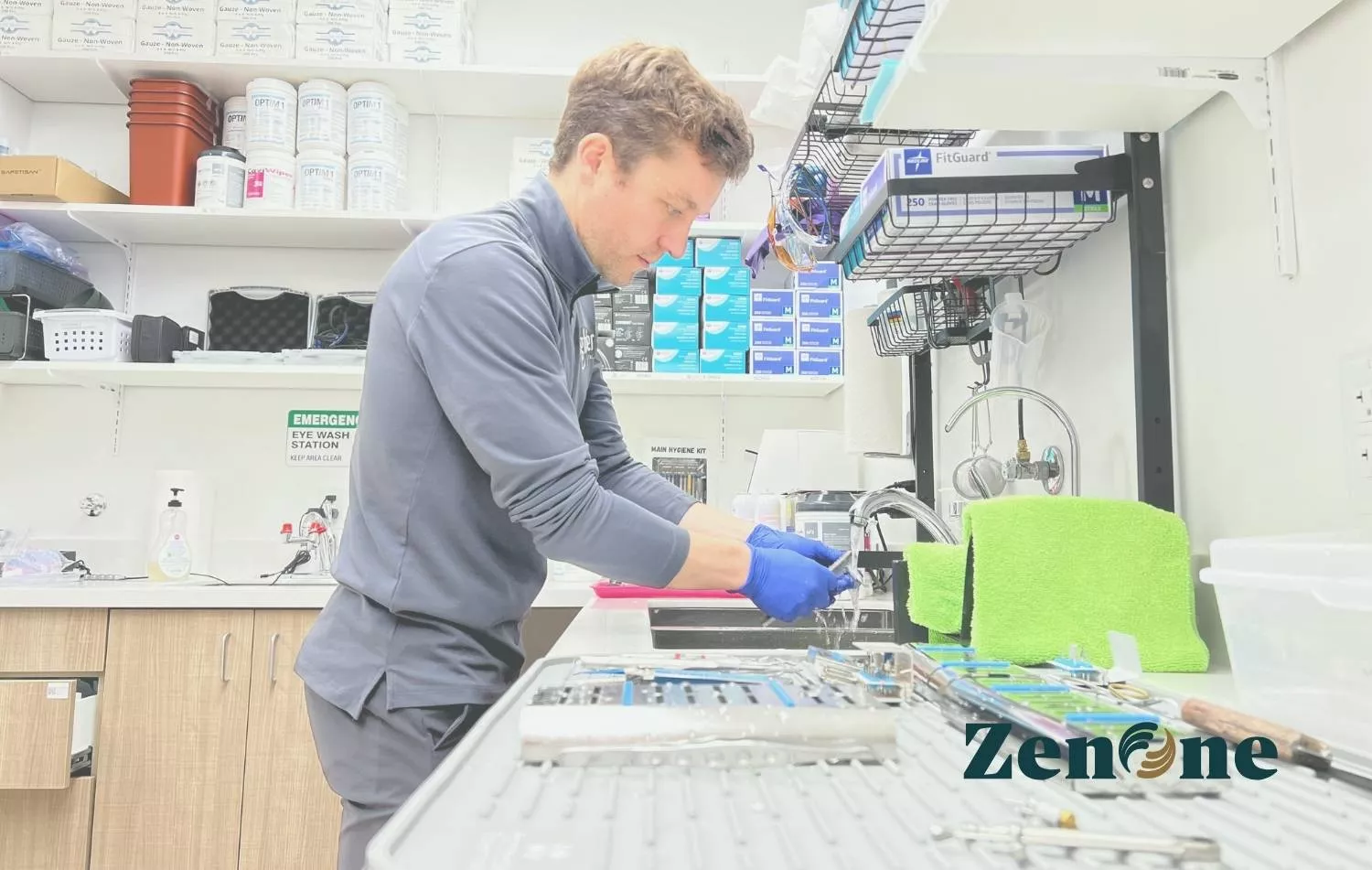
Dr. Justin Louie’s practice faced rising supply costs after COVID and needed a way to compare prices across multiple suppliers without cutting off existing relationships. After adopting ZenOne, the team could price shop inside one workflow, keep preferred supplier relationships, and lower supply spend while maintaining quality.
The operational upside was not just savings. The platform made pricing visible to the team, which improved buying discipline and reduced waste.
See how Dr. Justin Louie reduced supply costs with ZenOne →
Application #2 – Automated Patient Communication
What It Does
AI-driven patient communication platforms handle appointment reminders, post-treatment follow-ups, insurance verification confirmations, and routine inquiries without human intervention. These systems analyze patient preferences (text vs. email vs. phone), contact timing based on response history, and messaging based on treatment type. Advanced platforms integrate with practice management systems to pull real-time schedule data, ensuring reminders reflect the latest appointment details.
The best solutions go beyond basic automation. They use natural language processing to understand patient questions and provide accurate answers or escalate complex inquiries to staff. Some platforms offer 24/7 scheduling chatbots that book appointments, confirm insurance, and send pre-visit forms, capturing new patients outside business hours when practices miss a large share of inbound calls.
Time Savings and Impact
Manual patient communication consumes 12-15 hours weekly across a typical practice. Front desk staff make confirmation calls, respond to scheduling texts, and field routine questions about office hours, insurance acceptance, and appointment preparation. Automated dental AI systems handle routine interactions, freeing staff for complex patient needs and in-person care coordination.
Data comparing average practices to top performers shows a wide gap in confirmation rates and no-show performance, which is where better communication workflows pay back quickly.
Application #3 – Predictive Scheduling Optimization
The Problem
Empty chairs cost dental practices $200-$500 per hour in lost production. No-shows and cancellations create persistent schedule gaps, which forces constant rescheduling and reduces production. Industry benchmark data highlights cancellation and no-show rates that materially impact scheduling efficiency.
Poor scheduling does not just cost production. It also limits growth by restricting access for new patients.
How AI Optimizes
Predictive scheduling platforms analyze thousands of data points: patient no-show history, appointment-type completion rates, time-of-day patterns, and provider productivity curves. Using these insights, AI suggests booking strategies like prioritizing high-value appointments during peak productivity hours and maintaining dynamic waitlists to fill last-minute cancellations.
These systems learn from outcomes. If a patient consistently confirms but no-shows for early appointments, the system can flag future bookings and recommend higher-probability times.
Expected Impact
Even a modest improvement in schedule efficiency can translate into meaningful annual gains for most practices. The key is measuring baseline chair utilization, cancellation patterns, and lead time, then tracking lift after implementation.
Application #4 – Claims and Billing Accuracy
Why This Matters
Claim denials represent one of the most expensive hidden costs in dental practice management. Industry benchmarks commonly cited show a meaningful denial rate, plus long payment timelines driven by preventable errors and approval delays. The cumulative impact on cash flow forces practices to carry more working capital or absorb collections pressure.
Incorrect or incomplete information ranks among the top denial reasons, meaning a large share of rejections are preventable with better verification and documentation workflows.
What AI Does
AI-powered claims workflows scrub submissions before they leave your practice, cross-referencing codes with documentation, verifying eligibility and coverage limits, and flagging missing requirements. Better systems also predict denial likelihood by payer so you can route high-risk claims to human review before submission.
ROI Calculation
The math is straightforward. Fewer denials means less rework, faster payments, and better cash flow. Track denial rate, time to first payment, and staff hours spent on claims follow-up. If those do not move, the tool is noise, not leverage.
Application #5 – Staff Training and Onboarding
The Traditional Bottleneck
New employee onboarding often takes weeks before staff reach full productivity. Traditional training relies on shadowing, scattered documentation, and learning through repetition. This creates inconsistent training quality, drains senior staff time, and increases turnover risk when new hires feel overwhelmed.
The cost shows up as slower throughput, more errors, and more management overhead.
AI-Powered Training Platforms
AI-assisted training platforms deliver role-based learning modules, test knowledge, and standardize onboarding so training does not depend on who is available that day. They also help managers spot where new hires get stuck so coaching time goes where it matters.
Time Saved
AI-driven training can cut onboarding time while improving consistency, especially for repeatable workflows like ordering, sterilization protocols, and front desk processes.
Common Implementation Challenges
Understanding potential obstacles helps practices prepare for realistic AI adoption rather than facing friction that derails implementations.
Staff Resistance and Training Demands: Research shows job displacement concerns are common when AI tools are introduced, which slows adoption if leadership does not position AI as support, not replacement. The fix is phased rollout, staff involvement in evaluation, and training that focuses on time saved and error reduction.
Integration Complications: Data readiness and integration issues often drive timelines and adoption friction. Practices should expect real implementation work, not instant activation, especially when systems are older or data quality is inconsistent.
Cost Barriers and ROI Uncertainty: A large share of AI initiatives fail when teams skip baseline measurement and success criteria. Define the metric first, then choose the tool.
Data Quality Requirements: AI tools need clean historical data to generate accurate predictions. If your data is messy, budget time to clean it. Practices that handle these challenges with phased rollout and baseline tracking can reduce administrative burden, but only if implementation gets treated like an operational system change, not a software purchase.
How to Evaluate AI Tools for Your Practice
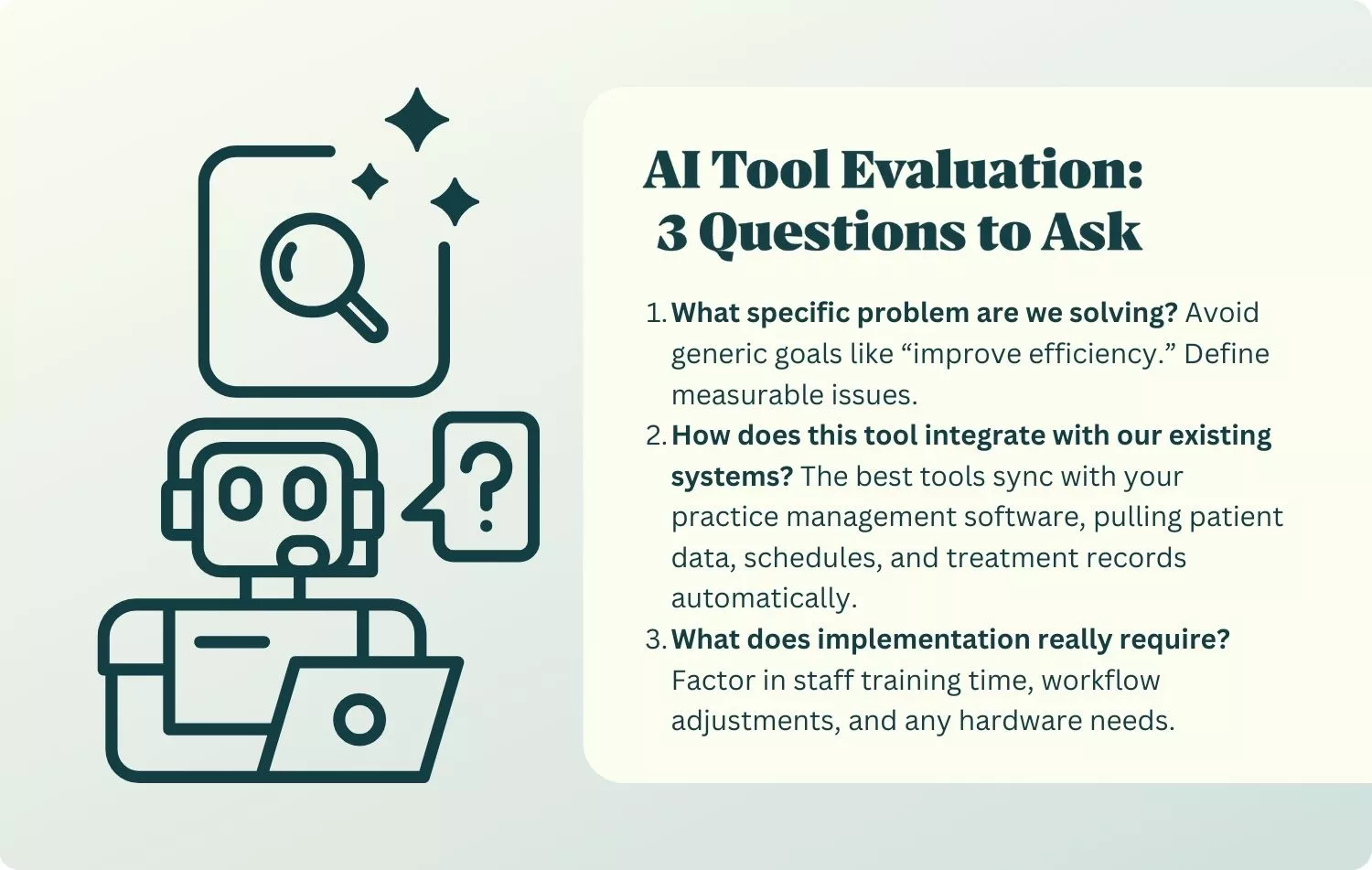
The 3 Questions to Ask
Before investing in any dental practice management solutions, answer these three questions honestly:
1. What specific problem are we solving? Avoid generic goals like “improve efficiency.” Define measurable issues: “Reduce supply spending by 15%” or “Cut no-show rate from 7% to 4%.” Vague objectives lead to disappointing implementations because you cannot measure success.
2. How does this tool integrate with our existing systems? Standalone solutions requiring duplicate data entry create more work, not less. The best tools sync with your practice management software, pulling patient data, schedules, and treatment records automatically.
3. What does implementation really require? Factor in staff training time, workflow adjustments, and any hardware needs. A tool promising “no training required” but demanding behavior changes will face adoption resistance.
Start Small, Scale Smart
Resist the temptation to overhaul everything simultaneously. Pick one high-impact application that addresses your most expensive bottleneck. Supply ordering, patient communication, and scheduling optimization offer the fastest ROI for most practices because they affect daily operations immediately.
Implement your chosen solution with clear success metrics and a 90-day evaluation period. Track baseline data before launch so you can measure actual impact. If results meet or exceed projections, consider adding a second application. If they fall short, identify whether the issue is tool selection, implementation approach, or staff adoption before expanding further.
This phased approach minimizes risk while building confidence in operational AI.
Conclusion
AI in dental practice management delivers measurable operational improvements when applied strategically to high-impact areas like supply ordering, patient communication, scheduling, billing, and training. Practices seeing dramatic results share a common approach: they identified specific problems, chose purpose-built tools, measured results rigorously, and prepared realistically for implementation challenges.
For independent dental practices, intelligent supply ordering platforms offer an ideal starting point. The combination of consolidated vendor management, real-time price comparison, and predictive reordering addresses one of the highest-cost operational areas with minimal workflow disruption.
Start with one application, prove the value, and scale strategically.Ready to transform your supply ordering from chaos to control? Explore ZenOne’s intelligent ordering platform →
FAQ
What is AI in dental practice management?
What is AI in dental practice management?
AI in dental practice management refers to intelligent software systems that automate administrative tasks like supply ordering, scheduling, patient communication, claims processing, and staff training. Unlike simple automation, these tools learn from practice patterns and adapt recommendations to improve efficiency and reduce costs.
How much can dental practices save using AI for supply ordering?
How much can dental practices save using AI for supply ordering?
Practices using AI-powered supply ordering platforms report meaningful annual savings through better pricing, reduced overstocking, and fewer emergency orders. For a concrete example, ZenOne customer Miranda Moore described cutting supply ordering time from 2-3 hours to 15-20 minutes by consolidating 10-15 vendors into one place.
Will AI replace dental staff members?
Will AI replace dental staff members?
No. AI dental software handles repetitive, data-heavy tasks to free staff for patient-focused work requiring human judgment and relationship skills. Research shows concerns about job displacement are common early in adoption, which is why change management matters.
How long does it take to see ROI from AI tools?
How long does it take to see ROI from AI tools?
Most practices see measurable results within 30-90 days depending on the application. Full deployment including integration and training can take longer when data and systems need cleanup.
What’s the best first AI application for small dental practices?
What’s the best first AI application for small dental practices?
Intelligent supply ordering offers fast ROI for practices with meaningful supply spend. It reduces ordering time, improves price visibility, and reduces emergency ordering. If you need real proof, start with ZenOne case studies like Dr. Justin Louie and Miranda Moore.
Join 1000+ dental professionals, shop from your favorite
suppliers, compare prices instantly, and save over $17,000/year
Try our platform free for 14 days.
Get the latest ZenOne updates and product launches in your inbox
Don't miss the latest news!
Receive exclusive offers and news straight to your inbox!
Continue reading
02/19/2026
~ 13 minutes to read
02/19/2026
~ 3 minutes to read

01/29/2026
~ 7 minutes to read
Let's discover how we can help you

Tiger Safarov
Hi, I'm Tiger, the CEO at ZenOne, and I'm happy to personally ensure your success with ZenOne. Send me your latest invoice or a statement for a Free Savings Analysis.
Ask me a question:

