


Miranda Moore
RDA Lead Assistant, Beacon Dentistry
01/29/2026
Sustainable Dental Supplies: A Green Dentistry Buying Guide That Cuts Costs

~ 7 minutes to read
Choose sustainable dental supplies based on clinical fit first. Then compare packaging, expected life, disposal options, shelf life and delivered cost. Start with one high-use item. Track cost and waste for 60 days before changing more products.
A lower-waste product can cost less, more or about the same as the item it replaces. The result depends on how often it must be reordered, how much expires and whether your local waste system can handle the material as claimed.
Compare eco-friendly supply prices across 50+ suppliers →
What Makes a Dental Supply More Sustainable?
A useful environmental claim tells you what was measured and under what conditions. It should also explain how the product is made, used or discarded. Words such as “green,” “natural” and “eco-friendly” mean little without that detail.
What to Verify Before You Buy
- Clinical use: Confirm that the manufacturer approves the product for the procedure or task.
- Performance evidence: Review the instructions for use, test results and certifications tied to the exact product.
- Material and packaging claims: Check what “recyclable,” “compostable,” “biodegradable” or “bio-based” means for that item.
- Disposal route: Confirm that your local waste provider accepts the material. Clinical contamination can change how an item must be handled.
- Delivered cost: Include the item price, shipping, fees, minimum order and number of usable units.
- Shelf life: Estimate whether the practice will use the order before it expires.
Ethical Sourcing of Dental Supplies
Ethical sourcing means checking where a product comes from, what the supplier can prove and whether the item fits patient care rules. Ask each supplier for the following information before adding a product to your approved list:
- Country of manufacture
- Material and packaging details
- The certificate or test behind each environmental claim
- A supplier or labor code of conduct
- Lot-tracking and recall procedures
- Storage, use and disposal instructions
Save these records with the approved product entry. Your team can review the proof before reordering instead of relying on the label.
Three Ways a Product Can Reduce Waste
Longer useful life: A durable item may replace repeated purchases of a single-use or short-lived product.
Lower resource use: Equipment may use less water or power during normal operation.
Less material or easier disposal: A product may use less packaging or a material accepted by a verified local recycling or composting program.
Don’t label a product recyclable, compostable or biodegradable unless the claim states the test, required conditions and disposal route. An item that needs an industrial facility won’t break down as promised in regular office trash.
Why Practices Are Reviewing Their Supply Choices
Patients actively seek dental offices that match their environmental values, according to one industry report. The same report describes sustainable dentistry toolkits valued at $1.2 billion in 2024. Treat market figures as signs of interest, not proof that a specific product will attract patients or save money.
Practice adoption still varies. A 2023 survey of 98 dentists found limited use of self-generated renewable energy among those surveyed. The study gives context, but its sample shouldn’t be treated as a benchmark for every U.S. dental office.
Do Sustainable Dental Supplies Cost More?
Some products cost more upfront. Others have a similar purchase price or reduce repeat orders. Compare the full cost for the period your practice expects to use the item.
Delivered unit cost = (item price + shipping + fees – discounts) ÷ usable units received
For reusable items or equipment, include cleaning, maintenance, replacement parts and expected life. For disposables, include waste charges and the risk of expired stock.
Cost Questions by Product Type
| Product type | Cost to record | Risk to check |
|---|---|---|
| Reusable instrument or tray | Purchase, cleaning, sterilization and replacement | Damage, processing time and approved reuse instructions |
| Disposable supply | Delivered unit cost and waste charges | Package size, shelf life and local disposal limits |
| Powered equipment | Purchase, power, service and parts | Expected life, warranty and repair access |
| Paper or wood product | Delivered unit cost | Source certification and disposal route |
| Clinical material | Cost per case or procedure | Clinical fit, storage and manufacturer instructions |
For example, one industry article discusses LED curing lights lasting 10,000-50,000 hours. Confirm the rated life, warranty and service terms for the model you’re considering.
Clinical materials require a different review. One practice article says zirconia implants run 10-15% higher than titanium. That figure isn’t a universal price benchmark. Compare the exact product, clinical need and supplier quote.
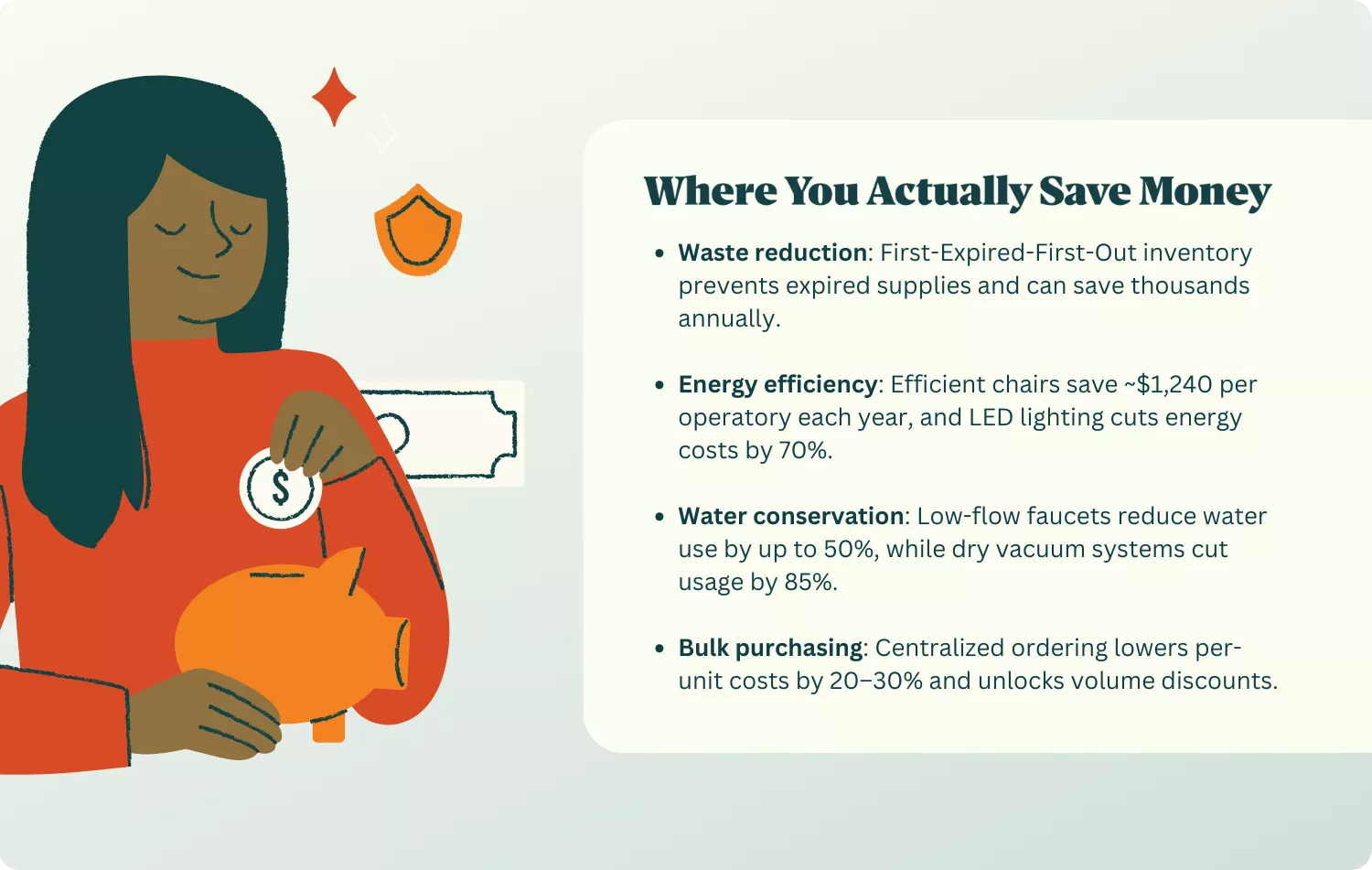
Equipment savings also vary by office and usage. Energy-efficient dental chairs save $1,240 annually per operatory, according to one vendor guide. Ask for the energy assumptions behind any estimate and compare them with your own utility rates.
Real example: Dr. Justin Louie of Advanced Dental Care of Austin was concerned about rising supply costs. After using ZenOne to compare products and suppliers, he reported finding quality materials for less. His experience shows the value of comparing sources. Results will differ by product mix, supplier access and order timing.
Find cost-effective sustainable alternatives →
10 Sustainable Dental Supply Categories to Compare
This table is a starting point, not a clinical recommendation. Check the product instructions, supplier terms and current stock before ordering.
| Product category | Clinical use | Evidence or instructions to check | Disposal route | Delivered-cost basis | Best fit |
|---|---|---|---|---|---|
| Digital radiography | Diagnostic imaging | Device requirements, image quality, training and service plan | Electronic equipment and local e-waste rules | Equipment, software, service and expected life | Practices replacing film processing or aging equipment |
| Reusable impression trays | Dental impressions | Manufacturer reuse and sterilization instructions | Metal recycling at end of life, if accepted locally | Purchase plus processing cost per use | Teams that can clean and sterilize trays correctly |
| LED curing lights | Curing compatible materials | Output, compatible materials, rated life and maintenance | Battery and e-waste rules | Equipment, battery, service and expected uses | Practices replacing an older compatible light |
| Patient bibs | Patient barrier | Barrier performance and the test behind disposal claims | Clinical waste rules and verified local option | Delivered cost per bib | Practices that can confirm the disposal path |
| Bamboo toothbrushes | Patient take-home care | Bristle material, source certification and packaging | Separate handle, bristle and packaging requirements | Delivered cost per kit | Practices reviewing giveaway materials |
| Recycled paper products | Office or approved clinical support use | Recycled content and fitness for intended use | Local recycling or waste route | Delivered cost per sheet, roll or case | Low-risk office supply tests |
| Sterilization pouches | Instrument processing | Manufacturer instructions and compatibility with the sterilizer | Local rules after use | Delivered cost per pouch and failed-cycle waste | Practices that confirm clinical and equipment fit |
| Gloves with reduced fossil content | Personal protection | Barrier rating, material claim and manufacturer documentation | Clinical waste rules | Delivered cost per usable pair | Teams that can test fit, comfort and protection |
| Low-water suction equipment | Evacuation and suction | Flow requirements, installation, service and local rules | Equipment disposal at end of life | Equipment, installation, water, power and service | Practices planning an equipment replacement |
| Solar power system | Office electricity | Site production estimate, warranty, utility terms and incentives | Panel and battery end-of-life plan | Installed cost minus confirmed incentives | Owners with a suitable building and long occupancy plan |
A Closer Look at LED Curing Lights
An industry comparison says LEDs cure composites in 10-20 seconds in the examples discussed. Actual cure time depends on the light, material and manufacturer instructions. Confirm compatibility before treating a shorter cycle as a time or energy saving.
Where to Source Sustainable Dental Supplies
Use the same proof standard across specialty vendors, major distributors and comparison platforms. A company’s name or product label doesn’t confirm clinical fit or environmental value.
Specialty Vendors
A specialty vendor may offer more product details or a narrower range of lower-waste items. Ask for the test behind each claim and confirm shipping minimums. A small product catalog can still make price comparison harder.
Major Dental Distributors
Large distributors may carry approved items from several manufacturers. Search by exact SKU and package size. Confirm whether the distributor’s environmental filter describes the product, packaging or company program.
Multi-Supplier Comparison Platforms
ZenOne lets a practice compare the same supply across multiple sellers. This helps purchasing teams check price, availability and order terms without relying on one distributor.
Real example: Dr. Jack Fan of The Dental Centre found that low prices on some items could be offset by higher prices on others. After switching to multi-vendor comparison through ZenOne, he reported that his practice could find another source when an item was out of stock.
Real example: Office manager Misti Tienda wanted more savings but didn’t have time to search and check unfamiliar websites. Her practice reported strong savings after using ZenOne. Review the full case and compare its process with your practice before setting a savings goal.
Start comparing sustainable supply prices →
Run a 60-Day Product Test
Test one product category before changing the whole supply room. Use a high-volume item with a clear count, cost and disposal route.
| Step | Action | Record |
|---|---|---|
| 1 | Choose one current item and one possible replacement | Exact SKU, package size and approved use |
| 2 | Confirm clinical requirements and supplier proof | Instructions, tests, certificates and disposal details |
| 3 | Set a 60-day test quantity | Starting count and reorder point |
| 4 | Track use, waste and staff feedback | Units used, damaged, discarded or expired |
| 5 | Compare results | Cost per usable unit and waste difference |
| 6 | Approve, revise or stop the change | Decision, owner and next review date |
A product should stay on the approved list only if it meets the clinical need and its results support the claim. A higher purchase price can make sense when the item lasts longer or cuts waste. A green label alone isn’t enough.
Frequently Asked Questions About Sustainable Dental Supplies
Are sustainable dental supplies more expensive?
Some cost more upfront. Others have similar pricing or lower long-term costs. Compare delivered cost, expected life, waste and replacement frequency for the exact products.
Which product should a dental practice test first?
Choose a high-use product with a low clinical switching risk and an easy-to-measure waste stream. Paper goods or patient giveaways may be easier first tests than clinical materials or major equipment.
How can I verify an environmental product claim?
Ask for the test, certificate and conditions behind the claim. Confirm what part of the product the claim covers. Then check whether your local disposal provider accepts it.
Are biodegradable dental supplies safe for clinical use?
“Biodegradable” describes a disposal claim. It doesn’t prove that a product is safe or approved for a clinical task. Review the manufacturer’s instructions and required performance information first.
How does inventory control reduce dental supply waste?
Accurate counts help the team avoid excess orders, duplicate products and expired stock. Reorder points and first-expiring, first-out use also reduce preventable waste.
Choose One Supply Category to Review
Start with one product your practice buys often. Check its clinical fit, supporting proof, disposal route and delivered cost. A 60-day test gives your team real numbers before a wider change.
Related Reading
- How to Save Money on Dental Supplies Without Compromising Quality
- How to Manage Dental Inventory in Your Clinic
Compare the same item across sellers before you approve a switch. Explore how ZenOne’s platform can help your team compare prices, track stock and reduce avoidable waste.
Join 1400+ dental professionals, shop from your favorite
suppliers, compare prices instantly, and save over $17,000/year
Try our platform free for 14 days.
Get the latest ZenOne updates and product launches in your inbox
Don't miss the latest news!
Receive exclusive offers and news straight to your inbox!
Continue reading
10/02/2026
~ 7 minutes to read
09/23/2026
~ 7 minutes to read
09/11/2026
~ 7 minutes to read
Let's discover how we can help you

Tiger Safarov
Hi, I'm Tiger, the CEO at ZenOne, and I'm happy to personally ensure your success with ZenOne. Send me your latest invoice or a statement for a Free Savings Analysis.
Ask me a question:

