


Miranda Moore
RDA Lead Assistant, Beacon Dentistry

03/12/2026
Cut Dental Supply Waste Cost: Find Your Burn Rate

~ 9 minutes to read
Dental supply waste cost drains thousands from your practice budget each year, yet most dental teams don’t realize how much they’re actually losing. Between expired materials sitting in storage, duplicate products cluttering your supply closet, and emergency orders that cost double, preventable waste compounds quickly. The real shock comes when you calculate your true burn rate and discover where supplies are disappearing. Understanding this metric helps you stop the bleeding before it impacts your bottom line. Ready to see how much you’re losing each month and what to do about it?
See how ZenOne helps you cut waste with smarter ordering and inventory control →
Summary: Cut Dental Supply Waste Cost
Your dental practice likely wastes 15-30% of its supply budget on expired materials, redundant inventory, rush orders, and staff time managing disorganized supplies. This article reveals the four major waste categories that inflate your burn rate, provides a simple formula to calculate your actual waste cost, and shares benchmarks to identify when waste spirals out of control. Most practices discover their waste exceeds $10,000 annually once they run the numbers. The solution starts with tightening inventory controls and making expiration dates visible before negotiating vendor prices. Consolidating your ordering workflow eliminates the chaos that creates waste in the first place, helping practices cut their burn rate by thousands without risking stockouts.
Key Points:
- Four waste buckets drain your supply budget: expiration and disposal, redundancy, rush orders, and labor costs
- Simple worksheet formula calculates total waste by adding expired inventory value, carrying costs, expedited fees, and staff time
- Benchmark indicators include supply spend exceeding credible industry targets, inventory shrinkage above 5%, and on-hand days over 60
- Control before negotiation delivers bigger savings than chasing vendor discounts alone
- Consolidated ordering cuts ordering time from hours to minutes while eliminating duplicate purchases
What “Burn Rate” Means In A Dental Supply Budget
Burn rate traditionally describes how fast startups consume cash reserves, but in dental supply management, it measures the pace at which your practice depletes inventory and budget on supplies. Your supply burn rate reveals both consumption patterns and waste velocity. A healthy burn rate means supplies turn over efficiently based on actual patient volume and procedure mix, with minimal expired materials or excess stock gathering dust.
Most practices track only total monthly supply spend without understanding their true consumption rate per operatory, provider, or procedure type. This blind spot makes it impossible to spot waste until it compounds into major budget problems. When your burn rate runs too hot, you’re overstocking and discarding expired materials. When it runs too cold, you face stockouts and expensive rush orders that inflate costs.
The ideal burn rate balances just-in-time ordering with buffer stock for critical supplies. According to DSO CFO financial benchmarks, efficient general dentistry practices maintain dental supply costs at 5-6% of revenue, while Planet DDS 2025 industry data shows post-pandemic supply costs typically run 7-10% of revenue. Practices flying blind often exceed these benchmarks significantly without realizing how much waste drives the difference.
The 4 Buckets That Create Dental Supply Waste Cost
Every dollar of dental supply waste cost falls into one of four distinct categories. Understanding these buckets helps practices diagnose where money disappears and prioritize fixes that deliver the biggest impact.
1. Expiration and disposal
Expired materials represent pure waste because you paid full price for supplies that deliver zero value. Composites, bonding agents, anesthetic solutions, and impression materials all carry shelf life limits that sneak up on disorganized practices. A sole dental practitioner using reusable sterilization pouches can divert up to 4,680 paper and plastic autoclave bags annually, but the bigger problem lies in clinical materials that expire before use.
Dr. Sami Bahri’s lean management transformation in Jacksonville revealed large stockpiles of anesthetic solutions stored throughout operatories and central storage rooms. Materials expired due to overstocking, turning inventory investments into expensive trash. This pattern repeats across practices that bulk-order without tracking actual consumption rates or implementing first-in-first-out rotation systems.
Disposal costs add another layer of expense beyond the purchase price. Biohazard waste disposal typically runs $50-200 per pickup depending on volume and container size. The real expense comes from disposing clinical materials that never served a patient, especially chemicals, disinfectants, and pharmaceutical supplies requiring special handling.
2. Redundancy (the “we have five kinds of bibs” problem)
Multiple team members ordering independently creates inventory chaos. One assistant stocks blue patient bibs while another orders lavender ones, and suddenly you have five partially depleted boxes occupying valuable storage space. This redundancy extends beyond patient comfort items to clinical supplies where standardization matters more.
Surveyed dentists reported stocking over five types of adhesives and cements on average, with 50% discarding expired resin cements due to overstocking multiple variants. Each product requires separate inventory tracking, expiration monitoring, and capital tied up in rarely used alternatives. The carrying cost of excess inventory typically runs 20-30% of the overstock value annually when accounting for tied-up capital, storage space, and insurance.
Redundancy also inflates ordering complexity. When your team shops from 10-15 different vendor websites without centralized tracking, duplicate purchases slip through unnoticed. One operatory hoards supplies while another runs short because no one maintains visibility across locations.
3. Rush orders and stockouts
Running out of critical supplies during patient appointments forces expensive emergency ordering that doubles or triples normal costs. Expedited shipping fees, overnight delivery charges, and premium prices from local suppliers all inflate your burn rate when stockouts strike.
Practices often absorb rush order costs without calculating the cumulative annual impact. Twelve emergency orders at $50 extra shipping each adds $600 in preventable waste. When these situations repeat across multiple supply categories throughout the year, the total quickly reaches thousands. The real cost includes staff time spent scrambling for emergency solutions, interrupted workflows, and potential procedure delays that impact patient experience.
Stockouts stem from inadequate inventory monitoring and reactive ordering habits. Without real-time visibility into par levels and usage rates, teams reorder only when supplies run dangerously low or disappear entirely, creating a feast-or-famine cycle where overcompensating leads back to expiration waste.
4. Labor and interruption cost
Staff time spent managing disorganized inventory represents hidden waste that most practices never quantify. Two hours weekly spent tracking down supplies, placing fragmented orders across multiple websites, and reconciling invoices translates to $3,000 annually at $30 per hour over 50 weeks. Multiply this across multiple team members touching the supply chain, and labor costs often exceed the direct supply waste itself.
Workflow interruptions compound the problem. When assistants leave operatories mid-appointment to hunt for supplies, chair time productivity drops and patient flow stalls. The opportunity cost of disrupted treatment sequences and schedule compression rarely appears on profit and loss statements, but it directly impacts production capacity.
Inefficient ordering processes create the most labor waste. Teams manually comparing prices across vendor catalogs, preparing separate purchase orders for each supplier, and reconciling deliveries against invoices burn hours that automation could eliminate.
Dental Supply Waste Cost Formula (A Simple Worksheet You Can Use Today)
Complete this in under 1 hour using your P&L, AP invoices, and a quick storage walk-through.
Step 1) Baseline numbers (from P&L)
| Input | Your number |
| Annual supply expense ($) | $________ |
| Gross collections ($) | $________ |
| Supply overhead % (Annual supply expense ÷ Gross collections) | ________% |
Step 2) Calculate annual waste across 4 buckets
Bucket A) Expiration Waste (quarterly audit)
- Do a walk-through, list expired items and replacement cost.
| Expired item | Unit cost | Qty trashed | Line total (cost × qty) |
| __________ | $_____ | _____ | $_____ |
| __________ | $_____ | _____ | $_____ |
| Quarterly expiration waste total | $_____ |
Annualize: Expiration Waste (Annual) = Quarterly total × 4 = $________
Bucket B) Redundancy Waste (overstock beyond 60 to 90 days)
- Identify items where you are consistently overstocked.
- Add up the dollar value of the excess inventory.
| Input | Your number |
| Excess inventory value ($) | $________ |
| Carrying cost factor (use 25%) | 25% |
| Redundancy Waste (Annual) = Excess value × 0.25 | $________ |
Bucket C) Rush Order Waste (track for 3 months)
Include expedited shipping, premium supplier charges, and local retail purchases.
| Input | Your number |
| Rush order costs over last 3 months ($) | $________ |
| Rush Order Waste (Annual) = 3-month total × 4 | $________ |
Bucket D) Labor Waste (supply time)
Include ordering, receiving, stocking, audits, and resolving supply issues.
| Input | Your number |
| Supply task hours per week (all staff combined) | ________ hrs |
| Average loaded hourly rate ($/hr) | $________ |
| Working weeks per year | 50 |
| Labor Waste (Annual) = hrs/week × rate × 50 | $________ |
Step 3) Total waste and benchmark it
| Output | Formula | Your number |
| Total Annual Supply Waste | A + B + C + D | $________ |
| Waste % of Supply Spend | Total waste ÷ Annual supply expense | ________% |
How To Cut Burn Rate Fast (Without Running Out Of Critical Supplies)
Reducing dental supply waste cost requires strategic action that balances aggressive waste elimination with maintaining adequate stock of critical supplies. The sequence matters because tightening controls first reveals exactly where waste occurs before attempting broader cost reduction measures.
Tighten controls before you negotiate price
Vendor price negotiations deliver minimal savings if waste remains uncontrolled. A 5% price reduction on supplies you ultimately discard through expiration still represents 95% waste. Focus first on establishing clear ordering authority, standardized protocols, and inventory visibility before approaching vendors for better pricing.
Implement designated ordering responsibility so one person or role manages all supply purchasing with oversight authority. This eliminates the duplicate orders and redundant inventory that occur when multiple team members order independently. Assign weekly or bi-weekly ordering windows rather than allowing reactive purchasing whenever someone notices low stock.
Establish par level minimums and maximums for every supply category based on actual consumption data rather than guesswork. Track usage by operatory, provider, and procedure type over 90 days to calculate realistic reorder points. Set par levels to maintain 30-45 days of fast-moving items and 60 days of slower materials, with hard maximums preventing overstocking.
Create approved product formularies that standardize materials across operatories and providers. Limiting glove types to two sizes, consolidating bib colors to one option, and standardizing composite shade kits eliminates the redundancy that inflates carrying costs and increases expiration risk.
Make expiration visible
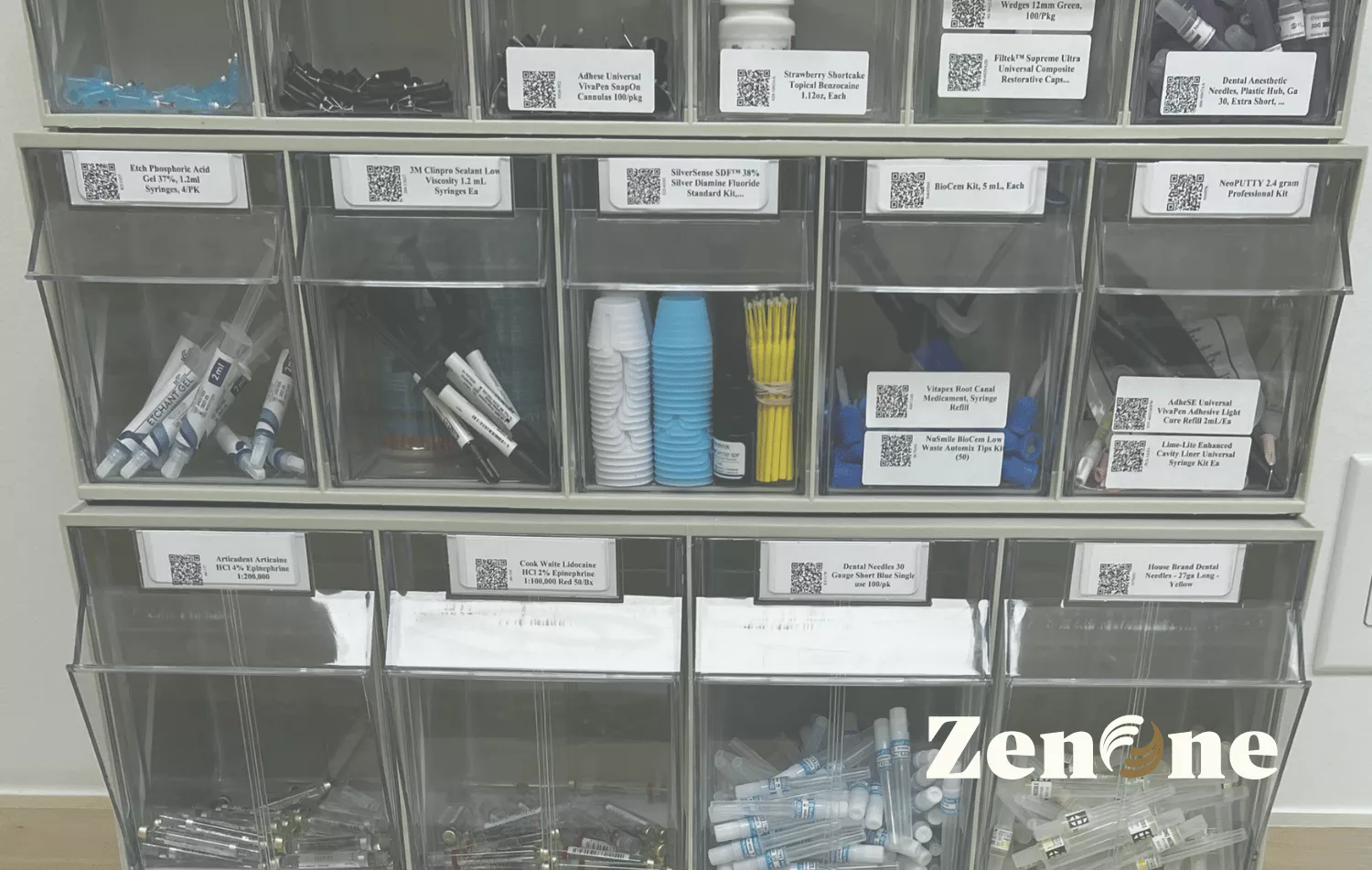
Hidden expiration dates guarantee waste because staff cannot prioritize older inventory for immediate use. Implement labeling systems that make every item’s shelf life obvious at a glance, enabling first-in-first-out rotation without requiring staff to search packaging for fine print dates.
Apply colored dot stickers or printed labels showing expiration months prominently on all supplies during receiving. Use a simple color-coding system where each quarter gets a specific color, making it instantly clear which materials need immediate attention. Place newest stock behind existing inventory systematically rather than adding to whatever space opens up first.
Digital inventory tracking through barcode or QR code scanning provides real-time expiration visibility across all storage locations. Systems that log supplies with expiration data during receiving and generate automatic alerts when materials approach shelf life limits prevent situations where expensive clinical supplies expire untouched.
Schedule monthly expiration audits where staff specifically check for materials nearing shelf life limits. Moving soon-to-expire items to prominent “use first” locations ensures consumption before disposal becomes necessary.
Consolidate ordering into one workflow
Fragmented ordering across 10-15 vendor websites creates the chaos that drives redundancy, stockouts, and labor waste simultaneously. Consolidating all purchasing into a single workflow eliminates duplicate orders, enables real-time price comparison, and slashes the time spent managing suppliers from hours to minutes.
While ZenOne consolidates ordering from up to 149 distributors into one platform with real-time price comparison, practices can achieve similar control improvements through disciplined manual systems or other inventory platforms. The key is implementing the centralized controls and visibility discussed above, regardless of which system you choose.
Centralized order history and inventory tracking prevent the redundancy that occurs when team members lack visibility into what colleagues already purchased. Whether through software or systematic spreadsheets, maintaining current par levels, monitoring consumption patterns, and flagging reorder needs before stockouts trigger expensive rush orders makes the difference.
The 90% reorder rule built into systematic inventory monitoring prompts just-in-time ordering when supplies hit 90% depletion. This balance maintains adequate buffer stock without overstocking that leads to expiration waste.
Top 3 Places Dental Supplies Go To Die
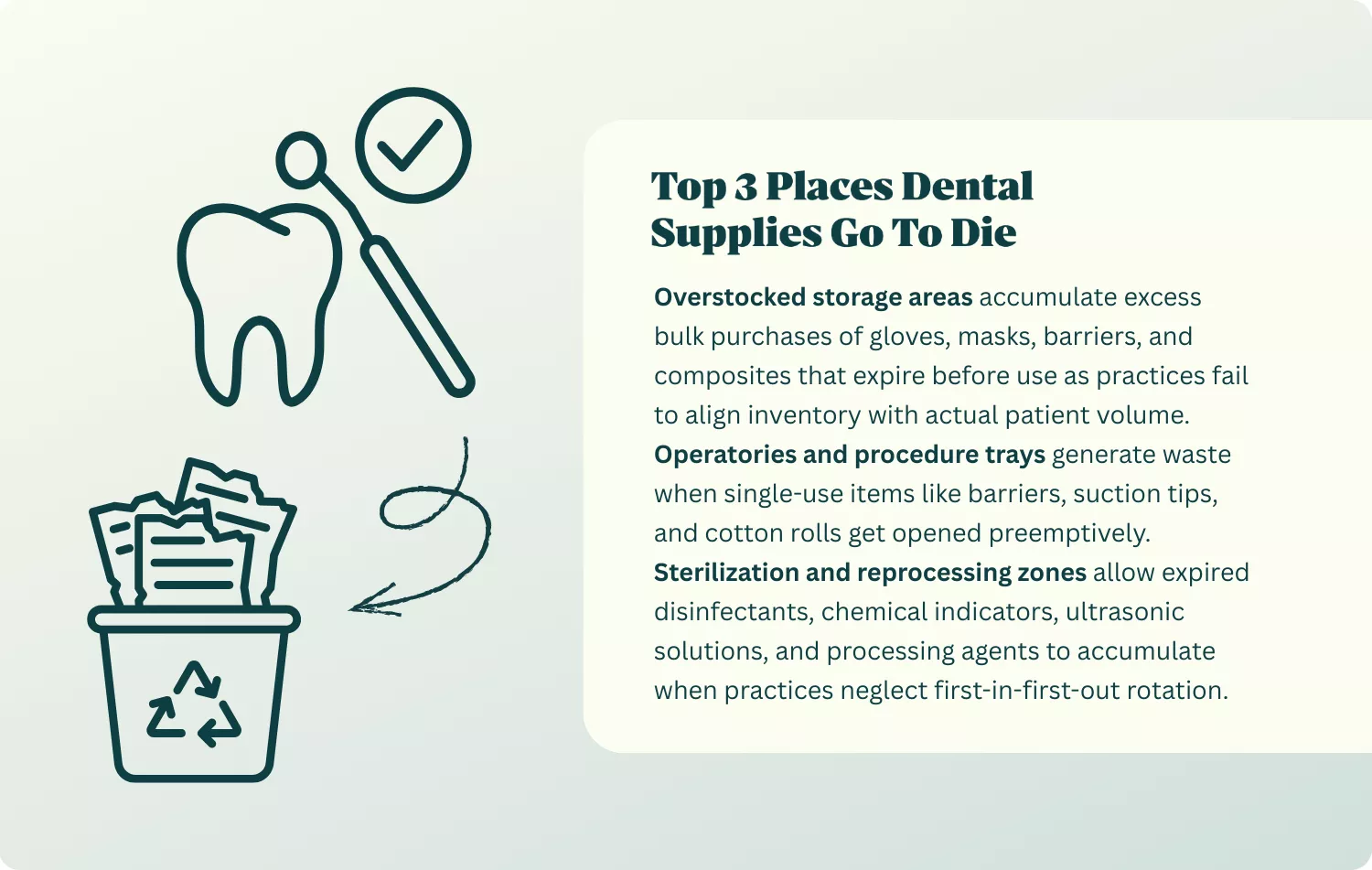
Understanding where supplies typically get wasted helps practices target inspection and prevention efforts for maximum impact:
Overstocked storage areas accumulate excess bulk purchases of gloves, masks, barriers, and composites that expire before use as practices fail to align inventory with actual patient volume. Materials pushed to back shelves or bottom drawers disappear from view until expiration dates pass.
Operatories and procedure trays generate waste when single-use items like barriers, suction tips, and cotton rolls get opened preemptively for routine procedures but discarded unused when cases resolve faster than anticipated. Materials fall behind cabinetry or get contaminated through improper handling.
Sterilization and reprocessing zones allow expired disinfectants, chemical indicators, ultrasonic solutions, and processing agents to accumulate when practices neglect first-in-first-out rotation. Damaged or leaking packaging discovered during setup forces immediate disposal of otherwise usable materials that improper storage compromised.
Conclusion
Dental supply waste cost silently drains practice profitability through expiration, redundancy, rush orders, and labor inefficiencies that compound into five-figure annual losses. The four-bucket framework reveals exactly where money disappears, while the simple worksheet formula quantifies total waste for the first time. Benchmarks showing supply spend significantly above the industry 5-8% target, inventory shrinkage exceeding 5%, and on-hand days over 60 signal out-of-control waste requiring immediate attention.
Cutting burn rate fast starts with tightening inventory controls, making expiration dates visible, and consolidating fragmented ordering workflows before negotiating vendor prices. ZenOne helps practices eliminate the chaos that creates waste by bringing all supply ordering into one platform with real-time price comparison, automated monitoring, and centralized visibility. Practices using ZenOne report cutting ordering time to 15-20 minutes while significantly reducing waste.
Ready to calculate your practice’s true dental supply waste cost and discover where thousands in preventable losses hide? Start a free trial to see how consolidating your supply workflow eliminates waste while maintaining the critical inventory your team needs every day.Start with one application, prove the value, and scale strategically.Ready to transform your supply ordering from chaos to control?Explore ZenOne’s intelligent ordering platform →
Join 1200+ dental professionals, shop from your favorite
suppliers, compare prices instantly, and save over $17,000/year
Try our platform free for 14 days.
Get the latest ZenOne updates and product launches in your inbox
Don't miss the latest news!
Receive exclusive offers and news straight to your inbox!
Continue reading
03/06/2026
~ 11 minutes to read
02/19/2026
~ 13 minutes to read
02/19/2026
~ 3 minutes to read
Let's discover how we can help you

Tiger Safarov
Hi, I'm Tiger, the CEO at ZenOne, and I'm happy to personally ensure your success with ZenOne. Send me your latest invoice or a statement for a Free Savings Analysis.
Ask me a question:

