


Miranda Moore
RDA Lead Assistant, Beacon Dentistry

07/03/2026
Dental Clinic Inventory Management Best Practices

~ 7 minutes to read
Dental inventory management works best when one person owns the process, reorder points come from actual usage, and the team follows a fixed counting schedule. Add FIFO rotation, ABC priority, and live tracking to reduce stockouts, overstock, and expired supplies.
A hygienist opens the last box of prophy paste on a Tuesday morning and nobody ordered more. An implant case stalls because one component sat on backorder for a week. A drawer of composite quietly expires behind a newer box that someone shelved in front of it. These small misses add up when the practice does not have a consistent inventory routine.
That number is larger than most owners expect. The American Dental Association recommends keeping supply costs near 5 to 6 percent of collections, yet many practices drift well past that on expired materials, emergency orders, and overstock nobody tracked. With equipment and supply prices up about 5 percent through the first three quarters of 2025, according to the ADA Health Policy Institute, the cost of a loose system climbs every year. The good news is that the fixes are well understood and entirely within your control: set reorder thresholds from real usage, rank items by value, rotate stock, count on a schedule, and let software hold the system together. At ZenOne, we build those disciplines into one platform so the work runs without constant oversight.
Summary
Good dental inventory management comes down to a handful of disciplines done consistently. Give the job one accountable owner. Set reorder thresholds from real usage and supplier lead time instead of guesswork. Use ABC analysis so high-value items get the most attention. Rotate with first-in, first-out to kill expiration waste. Run regular cycle counts to keep records honest. Practices that struggle are rarely understaffed; they are running inventory from memory instead of from a system. Layering automation on top, with reorder alerts and live counts, turns a reactive scramble into a workflow that protects both clinical readiness and the 5 to 7 percent of collections supply benchmark.
Run inventory from a system, not from memory
ZenOne tracks live counts, flags reorders automatically, and ties it all to spend. Start your free trial.
Start With Reorder Thresholds, Not Guesswork
Most stockouts and most overstock trace back to the same root cause: nobody set a clear point at which each item should be reordered. Fix that first, because it makes every other practice easier.
Use a Formula, Not a Feeling
A reliable reorder threshold is simple math: average daily usage multiplied by supplier lead time in days, plus a safety buffer. If you use two anesthetic cartridges a day, your supplier takes five days to deliver, and you want two days of cushion, the threshold writes itself. Pull the usage numbers from 12 months of order history rather than memory, because memory is exactly what fails on a busy Tuesday.
Set a Minimum and a Maximum for Every Item
A threshold tells you when to reorder; a maximum tells you when to stop. Setting both for each item keeps the practice from swinging between empty shelves and a back room full of product that will expire before it gets used. Recalculate every 90 days, because a summer student rush, an implant-heavy quarter, or a new associate all shift demand enough to make last quarter’s numbers wrong.
Rank Your Supplies With ABC Analysis
Not every item deserves equal attention, and treating them as if they do wastes the inventory owner’s time on cotton rolls while a $400 implant part slips out of stock. ABC analysis sorts your catalog by value and impact so effort lands where it matters.
A items are high value or clinically critical: implant components, specialty composites, anesthetics. They get tight control and frequent review. B items get a regular cadence of review but not daily attention. C items, the gloves and masks and bibs, run on simple low-touch rules because a small overage on a cheap item costs almost nothing. Reassess the categories once a year, because procedure mix changes and yesterday’s C item can become tomorrow’s A item.
Give every item the right level of attention
ZenOne’s tracking shows usage and value at a glance, so your A items never catch you short. Start your free trial.
Rotate Stock With FIFO to Stop Expiration Waste
First-in, first-out is the cheapest waste-killer in the building, and it fails for one boring reason: someone shelves new stock in front of old. Place new deliveries behind existing inventory, and date and label everything on receipt, so the oldest product is always the next one reached. The ADA’s inventory control guidance names FIFO and documented expiration dates as foundational practices for exactly this reason.
The savings are concrete. Audit expiration dates during your counts and flag anything 60 to 90 days out so it gets used rather than tossed. The single biggest driver of expiration waste is buying more than the practice can use before the date, which loops back to setting honest maximums in the first place. Get rotation and quantities right and a recurring write-off line simply disappears.
Count on a Schedule, Not in a Crisis
A once-a-year inventory count means eleven months of records you cannot trust. Monthly cycle counts, where you count a rotating subset of items, keep the numbers accurate all year and surface shrinkage or data-entry errors while they are still small and cheap to fix. Schedule a full count once or twice a year to validate the system as a whole.
The point of counting is not the count; it is what the count reveals. When a number does not reconcile, fix the discrepancy and then fix the root cause, because a recurring variance usually means a broken check-in or check-out step that will keep generating errors until you address it. And assign the count to a specific person, because an unowned count is a count that never happens.
Why Dental Inventory Counts Become Inaccurate
Inventory counts become inaccurate when check-in or check-out steps are missed. Correct the quantity, record the discrepancy, and fix the step that caused it before the same error repeats. For the full counting workflow, see our dental cycle counting guide.
Give the Job One Owner and a Routine
Shared responsibility for inventory creates gaps; one owner creates accountability. In most practices the natural fit is the Clinical Coordinator or lead assistant, working from a defined cadence with a budget cap and the authority to order up to a threshold without chasing sign-off for routine purchases. Dental Economics puts a healthy supply budget near 6 percent of collections, and one owner watching that number is what keeps the practice close to it.
Pair that owner with a shared formulary and approved vendor list. It prevents the ad hoc additions that inflate SKU counts and weaken volume buying power, and it makes onboarding painless, because a new owner can place a correct first order from the shared list without years of institutional knowledge. The ADA Health Policy Institute consistently identifies supply costs as one of the most controllable categories in private practice, and a single accountable owner is what turns that potential into actual control.
Make the inventory owner’s job easier
ZenOne gives one accountable person a single screen for counts, reorders, and spend. Start your free trial.
Where Automation Earns Its Keep
Every discipline above depends on a human remembering to do it, which is precisely where reactive practices break down. Automation removes the memory failure points. Reorder alerts fire when an item hits its threshold, before it becomes an emergency. Barcode or QR check-in and check-out give live counts instead of a manual tally that is wrong by the time it is finished. Spend analytics make creep visible in real time, so a March spike shows up in April rather than in a year-end surprise. Supplies typically account for 5 to 8 percent of a practice’s overhead, as NetSuite’s breakdown of dental overhead shows, which makes that visibility worth more than it first appears.
The biggest gain comes from connecting inventory to ordering. When the threshold that triggers a reorder also triggers a price-compared order to the best vendor, managing stock and managing cost become one workflow instead of two. That integration is the difference between software that tracks what you have and software that actually protects the supply budget, a distinction worth weighing as you compare dental inventory tools for 2026.
Track Dental Supply Usage and Trends
Track what leaves inventory, how often each item is reordered, and where monthly supply spend changes. Usage history helps you reset reorder points before old assumptions lead to stockouts or excess stock.
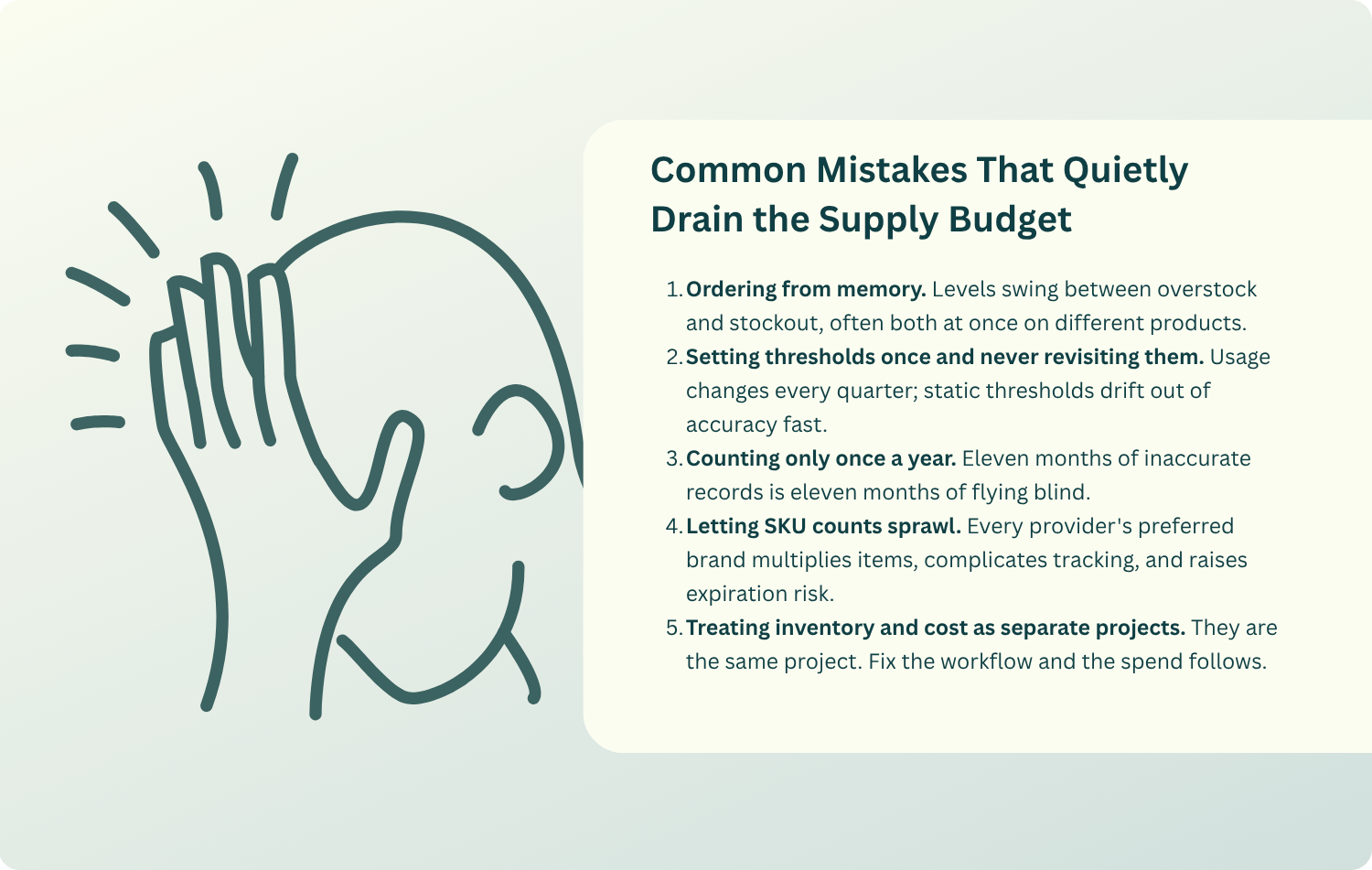
Common Mistakes That Quietly Drain the Supply Budget
Even practices with good intentions lose money to a short list of recurring habits. If you recognize your office in any of these, it is a sign the system needs tightening:
- Ordering from memory. Levels swing between overstock and stockout, often both at once on different products.
- Setting thresholds once and never revisiting them. Usage changes every quarter; static thresholds drift out of accuracy fast.
- Counting only once a year. Eleven months of inaccurate records is eleven months of flying blind.
- Letting SKU counts sprawl. Every provider’s preferred brand multiplies items, complicates tracking, and raises expiration risk.
- Treating inventory and cost as separate projects. They are the same project. Fix the workflow and the spend follows.
The thread connecting all five is the absence of a system. Each mistake is a place where a human is being asked to remember something a process should handle automatically.
How ZenOne Supports Inventory Management
ZenOne combines inventory tracking and price-compared ordering in one platform, so reorder thresholds, counts, and purchasing live together instead of in three disconnected tools. Barcode and QR scanning give live check-in and check-out, with automatic alerts the moment an item hits its reorder threshold.
The platform connects the vendors you already use, including Henry Schein, Patterson, Benco, and Darby, and shops every reorder against current pricing across more than 200,000 normalized SKUs. Spend analytics tie inventory discipline directly to the 5 to 7 percent of collections benchmark, so waste and overspend surface early. Practices that run inventory and ordering this way save over $17,000 a year on average, without cutting a single clinical item, a pattern detailed in ZenOne’s dental inventory management guide.
Put the Inventory Routine Into Practice
Dental clinic inventory management best practices are not complicated. They are just rarely done consistently. One accountable owner, usage-based reorder thresholds, ABC prioritization, FIFO rotation, scheduled counts, and automation to hold it together will turn a five-figure annual leak into a controlled, predictable line item that supports clinical care instead of undermining it.
ZenOne was built for the private practices that want that control without hiring a procurement team to get it. When counts, reorders, and pricing run from one system, the inventory owner stops firefighting and the supply budget stops surprising you.
Turn inventory from a chore into a system
Track stock, automate reorders, and compare vendor prices in one place built for private practices. Start your free trial with ZenOne.
Join 1400+ dental professionals, shop from your favorite
suppliers, compare prices instantly, and save over $17,000/year
Try our platform free for 14 days.
Get the latest ZenOne updates and product launches in your inbox
Don't miss the latest news!
Receive exclusive offers and news straight to your inbox!
Continue reading
10/02/2026
~ 7 minutes to read
09/23/2026
~ 7 minutes to read

09/11/2026
~ 7 minutes to read
Let's discover how we can help you

Tiger Safarov
Hi, I'm Tiger, the CEO at ZenOne, and I'm happy to personally ensure your success with ZenOne. Send me your latest invoice or a statement for a Free Savings Analysis.
Ask me a question:

