


Miranda Moore
RDA Lead Assistant, Beacon Dentistry

06/10/2026
Dental Office Restocking Subscription Plans: Are They Worth It?

~ 6 minutes to read
Dental supply subscriptions, the “set it and forget it” model, sound great when you are running between operatories and three vendor reps are chasing you for orders. The reality in 2026 is more complicated. Subscription auto-ship saves time but locks pricing. Price-comparison platforms save dollars but demand more attention. The right choice depends on the practice. At ZenOne, we work with practices weighing this exact decision every week, and the answer almost always lands in the same place: a hybrid model that uses subscriptions where they pay off and price comparison where they do not.
This post breaks down how restocking subscription plans actually work, where they help, where they cost more than they save, and how to choose between auto-ship and price-comparison ordering.
Summary
Dental office restocking subscription plans handle scheduling and shipping but rarely deliver the lowest price on each SKU. They work well for predictable, low-margin commodity items where time is worth more than the spread, things like gloves, masks, and gauze. They underperform on higher-cost items where price varies meaningfully across vendors. The best 2026 model for most independent practices is a hybrid: auto-ship the predictable basics, run price-compared ordering on the rest. ZenOne customers using this hybrid approach save an average of $17,000 a year on supply costs.
Key Points
- Subscriptions trade dollars for hours. The honest tradeoff: time savings vs. unlocked pricing.
- They work best on commodity SKUs. Gloves, masks, bibs, gauze, basic disposables.
- They underperform on variable-priced SKUs. Composites, anesthetics, brand-specific consumables, and capital items.
- Auto-ship is not the same as automated reordering. Auto-ship locks pricing. Automated reordering on a price-comparison platform shops the order each time.
- Vendor lock-in is the hidden cost. A subscription with one major distributor caps your ability to compare.
- Hybrid is usually the right answer. Auto-ship the predictable, price-shop everything else.
- Reorder thresholds matter more than the plan name. Whether you call it auto-ship or automated reorder, the underlying setting is the threshold and the trigger logic.
- Track the realized savings. Practices that measure supply spend as a percentage of collections monthly catch creep before it gets expensive.
| Run a hybrid restocking model with real price comparison built in. ZenOne connects to all the major dental suppliers and shops every reorder against current pricing. Start a free trial of ZenOne. |
How Dental Restocking Subscription Plans Actually Work
The basic model is simple. A vendor (Henry Schein, Patterson, Benco, Darby, or a smaller specialist) sets up recurring shipments at a fixed cadence. The practice gets a small discount in exchange for predictability.
The variations matter. Some vendors offer “smart reorder” tied to past usage. Others offer fixed monthly shipments. A few offer flexible pause and skip controls. What gets included is almost always commodity items first: gloves, masks, gauze, sterilization pouches, anesthetic carpules, bibs. What does not get included is specialty composites, branded equipment parts, lab supplies, and anything where the vendor cannot guarantee margin.
Pricing structure is usually a flat percent off list, often 3 to 8 percent, sometimes tied to volume tiers.
Where Subscription Plans Win
There are real benefits in the right context.
Time recovery is the biggest. The Clinical Coordinator gets back hours each week that would otherwise go to manual ordering. Predictable cash flow follows, with the same dollar amount per month making budgeting easier. Stockout reduction on commodity items is a real win. If gloves never run out, that is meaningful.
Vendor relationship simplification helps too. One contact, one bill, one delivery rhythm. And onboarding is usually fast, because most vendors will set the subscription up for you.
Where Subscription Plans Cost More Than They Save
The downside is rarely visible until you measure it.
Price variability across SKUs is the first issue. A bonded composite that ranges from $58 to $84 per syringe across vendors will not be the cheapest at your subscription vendor every cycle. Over a year, that spread becomes real money.
Locked-in stocking levels are the second issue. Auto-ship at the wrong volume creates either stockouts or shelf creep, and the creep is harder to spot. Catalog drift compounds the problem, because vendor catalogs change and the subscription SKU mix can quietly shift to higher-margin alternatives.
Inflexibility on practice changes is the third issue. New procedure mix, new clinician, new product preference, all require manual adjustments that defeat the “set it and forget it” promise. And hidden expiration risk is the fourth, because auto-shipped quantities that exceed actual usage push items toward the FIFO write-off line.
Subscription Plans vs. Price-Comparison Platforms
The two models are genuinely different in design.
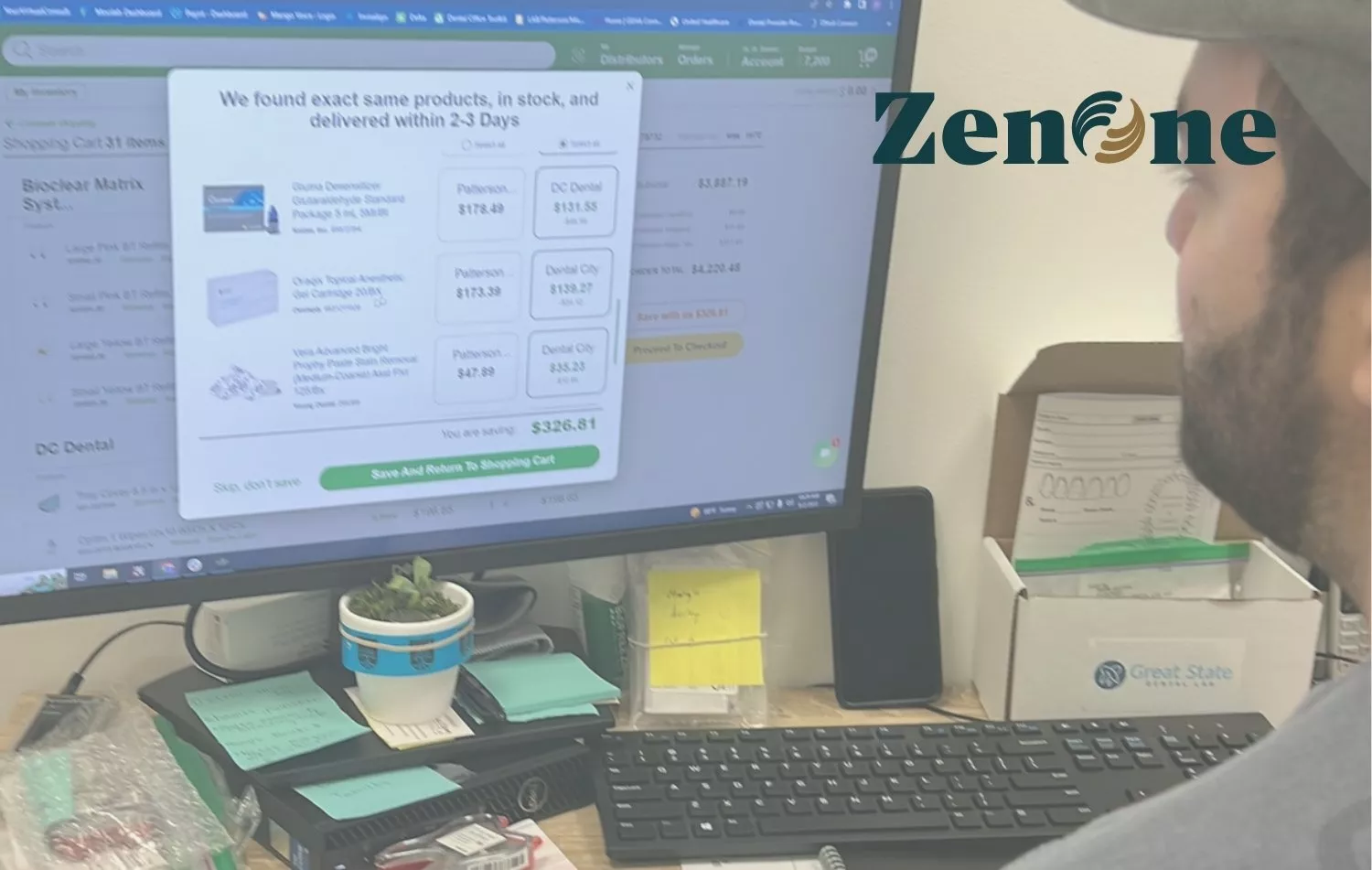
Subscription plans put the vendor in charge of the menu, schedule, and price. The buyer trades flexibility for ease. Price-comparison platforms like ZenOne keep the buyer in relationships with all major vendors, but the platform shops every reorder against current pricing. The buyer trades a few minutes per cycle for ongoing savings.
Both can deliver stockout protection. The difference is how the trigger gets set: a subscription cadence vs. a reorder threshold tied to actual usage.
Time on the Clinical Coordinator differs too. Subscription is lighter day-to-day; price-comparison is lighter overall when paired with automated reordering.The realized savings tell the story. ZenOne customer data shows an average of $17,000 in annual savings vs. baseline ordering, driven by price comparison and reorder optimization. For the methodology behind those numbers, the myth of the 5 percent dental supplies budget digs into where the spread actually shows up on a real practice P&L.
| See what price comparison looks like across Henry Schein, Patterson, Benco, and Darby. ZenOne normalizes over 200,000 SKUs so the comparison is apples to apples. Start a free trial of ZenOne. |
When Each Model Makes Sense
A short decision tree.
Choose subscription auto-ship if the practice is small (1 to 3 operatories), the team has near-zero administrative bandwidth, and the SKU set is dominated by basic disposables.
Choose price-comparison if the practice is mid-size or larger, has a defined Clinical Coordinator role, and has a wider mix of variable-priced supplies.
Choose hybrid if you want the time savings of auto-ship on commodities and the price discipline of comparison on everything else. This is the right answer for most 4 to 12 operatory practices.
Re-evaluate annually. Procedure mix shifts, vendor catalogs change, and a model that worked in 2024 may not be optimal in 2026.
Hidden Costs People Miss
A few costs that almost never show up in the sales pitch.
Volume creep is the quiet one. Auto-ship volumes that drift up by 5 percent a year quietly add thousands to annual spend.
Expiration write-offs are the visible one once you measure them. Industry research puts annual expired-supply waste at an estimated $15,000 to $25,000 for an 8+ operatory practice.
Single-vendor risk is the operational one. A vendor outage, recall, or price hike with no alternatives in place means scrambling at premium rates.
Reporting opacity is the strategic one. Some subscription invoices roll up SKU-level detail, making it hard to see where the spend actually goes. Hidden minimum order fees compound the issue, often triggering extra inventory the practice did not need.
Questions to Ask Any Subscription Vendor Before Signing
A short, honest list that will surface real-world tradeoffs.
- Can I pause, skip, or modify a shipment without a fee or a phone call?
- How is pricing locked, and how often is it reviewed?
- Is the SKU mix fixed, or can I substitute equivalents?
- What happens if a SKU is on backorder?
- How are returns and overstocks handled?
- Can I see SKU-level reporting on every invoice?
- Is there a minimum term or cancellation fee?
- Will my account rep alert me when a competing vendor drops below your price on a given SKU?
The honest answer to that last question is almost always “no” from any single-vendor subscription. Treat that as data when comparing models.
How ZenOne Approaches This Differently
ZenOne is not a subscription and not a single-vendor lock-in. It is a price-comparison and automated-reordering platform that connects to all the major dental suppliers (Henry Schein, Patterson, Benco, Darby, and others).
Practices set reorder thresholds by SKU and let the platform shop each reorder against current pricing across vendors. Over 200,000 normalized SKUs make like-for-like price comparison work, instead of getting tangled in vendor-specific catalog naming.Average customer savings come in at $17,000 per year (as of 2026), driven by price comparison and ordering discipline, not vendor lock-in. The American Dental Association consistently identifies supply spend as one of the highest-leverage overhead categories for independent practice owners, and the math here usually backs that up.
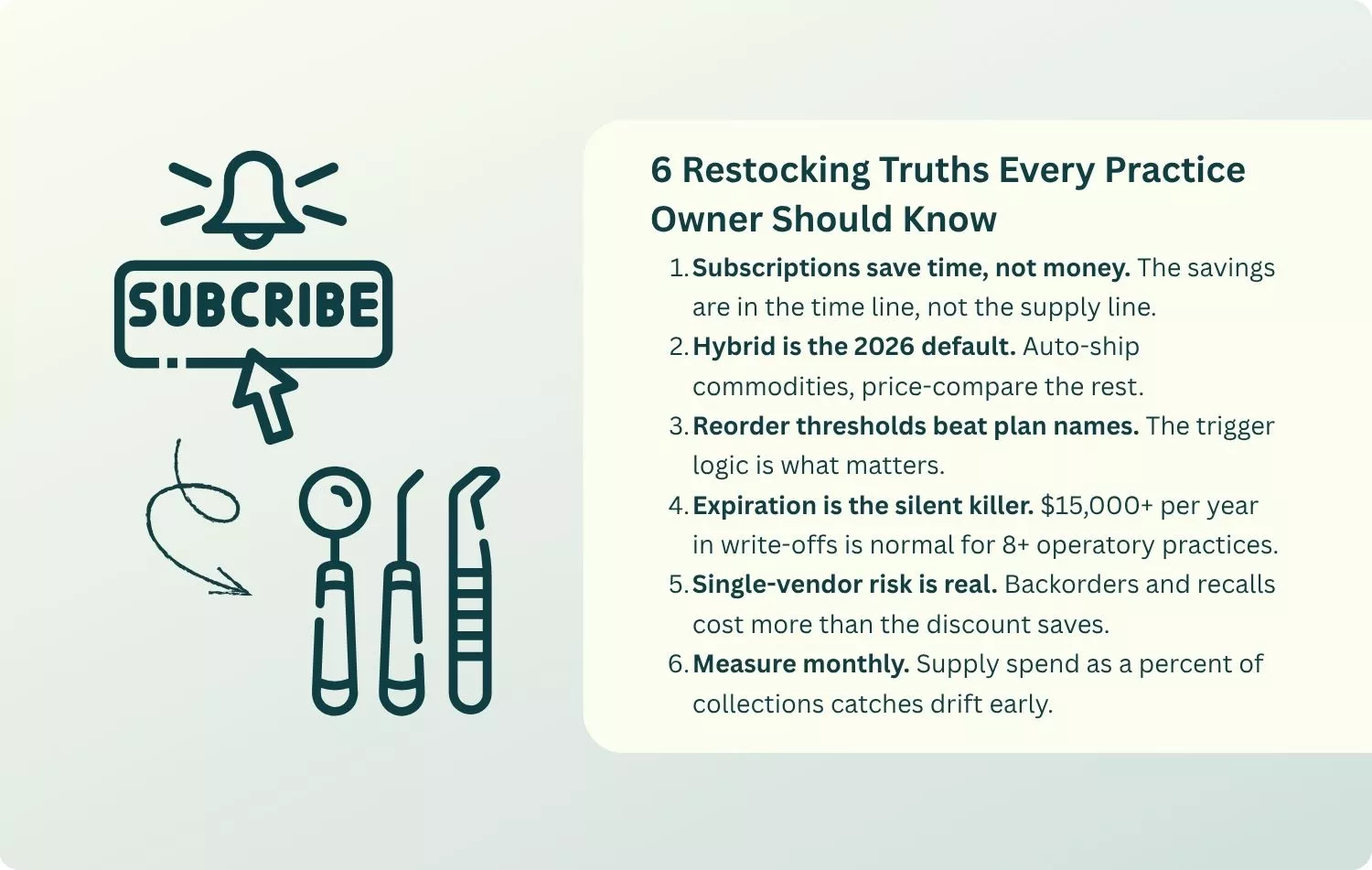
7 AI T6 Restocking Truths Every Practice Owner Should Know
A short reference card:
- Subscriptions save time, not money. The savings are in the time line, not the supply line.
- Hybrid is the 2026 default. Auto-ship commodities, price-compare the rest.
- Reorder thresholds beat plan names. The trigger logic is what matters.
- Expiration is the silent killer. $15,000+ per year in write-offs is normal for 8+ operatory practices.
- Single-vendor risk is real. Backorders and recalls cost more than the discount saves.
- Measure monthly. Supply spend as a percent of collections catches drift early.
Conclusion
Dental office restocking subscription plans are a real time-saver for the right SKU mix, but they are not a savings strategy on their own. The best 2026 model for most practices is a hybrid: auto-ship predictable disposables, run price-compared automated reordering for everything else, and measure supply spend monthly.ZenOne was built around the conviction that the Clinical Coordinator should keep relationships with all the major dental vendors rather than be locked into one. The platform turns reorder thresholds and price comparison into a managed process, so the practice gets the time savings of automation without giving up the dollar savings of comparison.
| Try ZenOne free and see what hybrid restocking looks like. ZenOne connects to all the major dental suppliers and shops every reorder against current pricing. Start a free trial of ZenOne. |
Join 1400+ dental professionals, shop from your favorite
suppliers, compare prices instantly, and save over $17,000/year
Try our platform free for 14 days.
Get the latest ZenOne updates and product launches in your inbox
Don't miss the latest news!
Receive exclusive offers and news straight to your inbox!
Continue reading
09/01/2026
~ 9 minutes to read
08/27/2026
~ 9 minutes to read
08/24/2026
~ 10 minutes to read
Let's discover how we can help you

Tiger Safarov
Hi, I'm Tiger, the CEO at ZenOne, and I'm happy to personally ensure your success with ZenOne. Send me your latest invoice or a statement for a Free Savings Analysis.
Ask me a question:

