


Miranda Moore
RDA Lead Assistant, Beacon Dentistry

01/22/2026
How to Save Money on Dental Supplies (Without Compromising Quality)

~ 8 minutes to read
Learning how to save money on dental supplies starts with understanding why your practice likely overspends in the first place. Most dental offices pay 15-25% more than necessary, simply because they stick with familiar suppliers without comparing prices. This “comfort tax” adds up quickly, turning what should be a manageable 5-7% of revenue into a budget drain that erodes profitability.
The good news? You don’t need to sacrifice quality to cut costs. Strategic supply management can streamline ordering, eliminate waste, and reclaim hours of administrative time each month. This article explores five proven strategies with real results from practicing dentists.
See how practices save $17K-$24K annually →
TL;DR: Save Money on Dental Supplies
Most dental practices overspend on supplies by 15-25% simply by sticking with familiar vendors without comparing prices, pushing costs well above the optimal 5-7% of revenue benchmark. Five proven strategies help you regain control: comparing prices across multiple suppliers, setting reorder points to avoid costly rush orders, cutting your SKU count by 30% to eliminate waste, tracking spending by category monthly to spot trends, and reclaiming valuable time through automation or streamlined processes. Real practices achieve dramatic results. Dr. Brandon Johnson saves $24,000 annually through price comparison, Dr. Nikki reclaimed 12 full days per year by delegating ordering, and Miranda Moore cut ordering time by 85%. Most practices see initial savings within 30 days, with full optimization taking 3-4 months, and the right approach depends on your practice size, volume, and complexity.
Key Points:
- Industry benchmark: Maintain supply costs at 5-7% of revenue for optimal profitability
- Avoid the comfort tax: Not comparing supplier prices costs practices 15-25% more annually
- Quick wins: A 30-minute SKU audit can reduce inventory by 30%, eliminating waste
- Rush orders drain money: Setting reorder points prevents costly expedited shipping
- Real results: Practices save $17,000-$24,000 annually through systematic supply management
Why Most Dental Practices Overspend on Supplies
The average overhead for dental office operations typically ranges from 60-70% of revenue, with supply and lab costs comprising 10-15% of that overhead. Top-performing practices maintain supply costs at the optimal 5-7% of revenue benchmark, but most practices exceed these targets without systematic tracking and price comparison.
Josh Reynolds, Operations Manager at Operation Dental, explains their approach: “Since 2022, we’ve reduced our annual item list from over 13,500 different SKUs to just over 1,500, a major improvement that led to significant pricing advantages.”
The “Comfort Tax” Costs You 15-25%
The biggest hidden expense in dental supply management isn’t waste or theft. It’s loyalty. Practices stick with the same suppliers year after year, paying premium prices for the comfort of familiarity. This “comfort tax” costs the average practice 15-25% more than necessary on their annual supply budget.
Why? Traditional ordering makes price comparison prohibitively time-consuming. For a five-chair practice spending $60,000 annually on supplies, a 20% comfort tax equals $12,000 in unnecessary expenses.
Supply Cost Benchmark: 5-7% of Revenue
Top-performing practices maintain supply expenses at 5-6% of revenue, with lab fees adding another 6-8%. A practice generating $1 million annually should spend roughly $50,000-60,000 on supplies. If you’re spending $80,000-90,000, you’re leaving $20,000-30,000 on the table each year.
These benchmarks matter even more in 2025, as tariffs are projected to cause 9-14% price increases for dental supplies. Method USA’s budget control analysis emphasizes: “Regularly reviewing the performance and cost of products is vital. With uncertainty of supply costs in today’s world of tariffs and trade wars, it’s good to be on top of ever-changing costs.”
Strategy #1 – Compare Prices Across Multiple Suppliers
Price comparison represents your single most powerful lever for reducing supply costs immediately. The same box of gloves costs $8.50 from one supplier and $6.75 from another. Those composite tips you ordered for $42 are available for $34 elsewhere. Multiply these differences across dozens of monthly orders, and the savings become substantial.
Tooth & Coin’s dental supply budgeting guide recommends: “Focus on the high-frequency or high-cost items: Track and periodically review the pricing of your top five to ten purchases.”
According to industry data on tariff-driven price increases, practices face rising costs on imports, with tariffs ranging from 10% to over 50% on certain supplies. This volatility creates wider price variations between suppliers.
Manual vs. Automated Comparison
Manual price comparison means calling three suppliers for every order. Spending 15-20 minutes on hold, writing down prices, comparing manually. This proves impractical for routine supply orders.
Modern platforms display real-time pricing from 50+ suppliers side-by-side, letting you spot the best deal in seconds. When you search for a product, you immediately see pricing from every supplier who stocks it, with the lowest price highlighted.
Real example:Dr. Brandon Johnson (Brushy Creek Dentistry) was “spending so many hours on eBay, Net32 and Amazon just trying to find the best price.” After implementing systematic price comparison through ZenOne, he now saves $2,000/month ($24,000/year) on his $10,000 monthly supply spend.
Alternatively, dental supply chains’ preferred partner programs from major distributors like Henry Schein or Patterson offer preferred pricing and streamlined ordering without full inventory software.
Start comparing prices across 50+ suppliers →
Strategy #2 – Eliminate Rush Orders With Reorder Points
Nothing drains your supply budget faster than rush orders. Overnight shipping can triple your costs. Expedited shipping fees add $25-75 per order, but the financial impact extends further because you’re forced to use whatever supplier has inventory available, losing all negotiating power.
The typical practice spends 10-15% of their supply budget on rush shipping and premium pricing for urgent orders. For a practice spending $60,000 annually, that’s $6,000-9,000 wasted on preventable expedited delivery.
Set Reorder Points Based on Usage Patterns
Review your usage patterns for your 20 most frequently ordered items. If you use three boxes of gloves weekly and standard delivery takes five days, set your reorder point at four boxes. When inventory hits that level, order more.
Modern inventory systems automate this process through barcode scanning, usage pattern monitoring, and low-stock alerts. The system suggests optimal reorder quantities based on historical usage.
For practices preferring manual methods, Operation Dental’s inventory approach shows an alternative: each office conducts monthly inventory checks and places one consolidated order to prevent overstocking, reduce shipping costs, and support budgeting.
Strategy #3 – Cut Your SKU Count by 30%
Most dental practices stock three times more products than necessary. This overstocking ties up capital, creates waste from expired products, and complicates inventory management. Reducing your SKU count by 30% streamlines operations while cutting costs without impacting patient care quality.
Walk through your storage area and you’ll likely find multiple brands of the same product type, items ordered once and never reordered, and supplies that duplicate functionality.
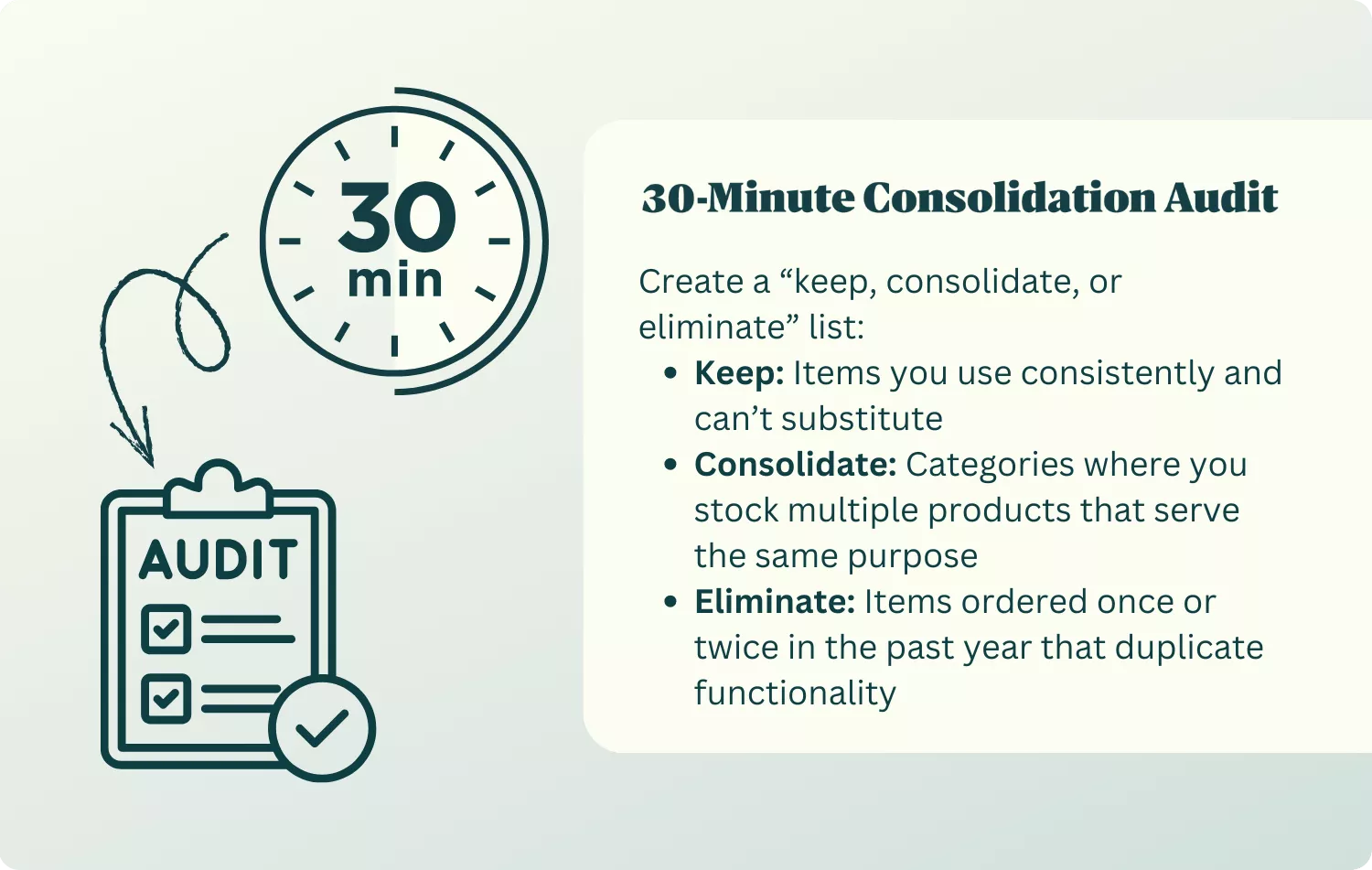
30-Minute Consolidation Audit
Pull your past six months of supply orders and identify your 50 most frequently purchased items. These represent roughly 80% of your spending. Look for duplication and rarely ordered items within each category.
Create a “keep, consolidate, or eliminate” list:
- Keep: Items you use consistently and can’t substitute
- Consolidate: Categories where you stock multiple products that serve the same purpose
- Eliminate: Items ordered once or twice in the past year that duplicate functionality
Document your decisions in a preferred products list. This becomes your ordering template, preventing SKU creep from recurring.
Strategy #4 – Track Spending by Category Monthly
What gets measured gets managed. Yet most practices don’t track supply spending beyond total monthly invoices. Without category-level visibility, you can’t identify which areas drive overspending.
Top-performing practices achieve 39% margins before debt service and capital expenditures by maintaining precise cost visibility and control.
Set Up Category Tracking
Categorize supplies into major groups: infection control, restorative materials, preventive supplies, anesthetics, office supplies, and lab fees. Review past invoices and assign each purchase to the appropriate category.
Calculate what percentage of total supply spending each category represents. These percentages become your benchmarks. Track them monthly to spot anomalies.
Modern platforms provide automatic category tracking, displaying spending by category in real-time and highlighting variances. You can set budget caps for specific categories and receive alerts when spending approaches limits.
For practices using manual methods, simple spreadsheet templates combined with monthly reviews achieve similar visibility.
Strategy #5 – Reclaim Your Time
Supply management shouldn’t consume hours of your team’s time weekly. Traditional approaches require constant attention: searching for products, comparing prices manually, tracking orders, managing invoices, and monitoring inventory levels.
The typical practice invests 8-12 hours weekly on these tasks. At $25-35/hour for administrative staff, that’s $10,400-21,840 annually in labor costs just for supply ordering.
Automation Delivers Time Savings
Real example:Miranda Moore (Lead Assistant, Beacon Dentistry) was ordering from 18 different vendors. “Each order took 2-3 hours.” After centralizing with ZenOne: “With Zen I have all my products in one place. Ordering takes 15-20 minutes (85% time reduction).”
Real example:Dr. Nikki (multi-practice owner) spent “a full day every month ordering supplies for 10+ years. Now my back office managers place one monthly order without me. I basically got a free day back every month (12 days/year).”
Modern inventory platforms automate time-consuming elements through barcode scanning, automated reorder alerts, one-click ordering across multiple suppliers, and budget controls without micromanagement.
When These Strategies Work Best (And When They Don’t)
Ideal Candidates for Inventory Software
Multi-chair practices (4+ operatories) with high supply volume see the fastest ROI from inventory platforms. If you’re spending $50,000+ annually on supplies, automated systems typically save enough money and time to justify investment within 2-3 months.
When Simpler Approaches Suffice
For 1-2 chair practices spending under $30,000 annually, manual price comparison via supplier websites combined with group purchasing organizations (GPOs) like Dental Gator might suffice. GPOs aggregate purchasing power across multiple practices to negotiate bulk discounts.
Small practices with low supply variety can implement basic organization through manual methods: creating physical shopping lists, setting supply budgets (aiming for 5-6% of collections), organizing with bin systems, and reducing redundancy.
Common Implementation Challenges
Research on dental practice inventory management identifies several common challenges:
Staff burden and time constraints create immediate friction. The transition demands training and discipline to consolidate orders, initially increasing administrative time before efficiency gains materialize.
Supply chain vulnerabilities present ongoing concerns. Multi-supplier adoption requires established alternatives and buffer stocks, risking interruptions without proper planning.
Balancing stock levels proves challenging. Changing systems involves predicting demand accurately amid unpredictable patient volumes.
Realistic Implementation Timeline
Most practices see initial savings within 30 days as they begin comparing prices and eliminating rush orders. However, full optimization takes 3-4 months as you refine reorder points and adjust to new workflows.
Real Results: Implementation Stories
Dr. Brandon Johnson: $24,000/Year Saved
Dr. Brandon Johnson operates a busy five-chair practice that was spending roughly $84,000 annually on supplies (about 7.8% of revenue, slightly above the optimal benchmark).
Challenges overcome: The practice ran parallel systems for the first month, continuing regular orders while using ZenOne to track what they could have saved. Seeing $2,000 in potential monthly savings motivated the team to commit fully. Staff training took about 10 days.
Results: Within 45 days, the practice was consistently ordering from the lowest-price supplier for each item. The first year delivered $24,000 in savings, a 28% reduction bringing supply costs down to approximately 5.5% of revenue.
Dr. Nikki: 12 Days/Year Reclaimed
Dr. Nikki’s team spent approximately 10 hours weekly on supply-related tasks, 520 hours annually, equivalent to 65 full workdays.
Results: By week six, the practice reduced supply management time to roughly 2 hours weekly, an 80% reduction freeing up 416 hours annually (12 full days). The team reinvested this in patient communication, insurance follow-up, and treatment plan presentation.
Miranda Moore: 85% Time Reduction
Miranda Moore, managing supplies for multiple locations, experienced the most dramatic transformation. Each location ordered independently, often duplicating effort and missing volume discount opportunities.
Results: Miranda reduced inventory management time by 85% within three months, freeing her attention for strategic practice management. This efficiency improvement allowed the practice to expand to an additional location without proportionally increasing administrative overhead.
Conclusion
The five strategies outlined here: price comparison, reorder points, SKU reduction, category tracking, and time reclamation, deliver substantial savings through smarter purchasing decisions and systematic cost control.
Real practices achieve measurable results:
- Dr. Brandon Johnson: $24,000 annually saved
- Dr. Nikki: 12 days reclaimed per year
- Miranda Moore: 85% reduction in administrative burden
For practices spending $50,000+ annually on supplies with 4+ operatories, ZenOne makes implementing these strategies straightforward through automation, real-time price comparison across 50+ suppliers, and intelligent inventory tracking. Most practices see initial savings within 30 days, with full optimization taking 3-4 months.
For smaller practices or those with simpler needs, alternative approaches like GPOs, preferred partner programs, or disciplined manual systems can deliver meaningful savings without software investment. Ready to transform your supply spending? Start your free 14-day trial with ZenOneto scan inventory, compare prices, and experience streamlined ordering without commitment.
Join 1200+ dental professionals, shop from your favorite
suppliers, compare prices instantly, and save over $17,000/year
Try our platform free for 14 days.
Get the latest ZenOne updates and product launches in your inbox
Don't miss the latest news!
Receive exclusive offers and news straight to your inbox!
Continue reading
03/06/2026
~ 11 minutes to read
02/19/2026
~ 13 minutes to read

02/19/2026
~ 3 minutes to read
Let's discover how we can help you

Tiger Safarov
Hi, I'm Tiger, the CEO at ZenOne, and I'm happy to personally ensure your success with ZenOne. Send me your latest invoice or a statement for a Free Savings Analysis.
Ask me a question:

