


Miranda Moore
RDA Lead Assistant, Beacon Dentistry
03/26/2026
Dental Staff Retention Strategies: Automate Inventory

~ 11 minutes to read
Inventory automation staff retention might sound like an odd pairing, but dental practices bleeding talent are discovering what manufacturers learned decades ago: chaotic supply chains burn out people faster than any difficult patient ever could. While you’re hosting pizza parties and rewriting your mission statement, your best assistant is rage-ordering emergency supply packages at 4 p.m. because someone forgot to restock composite resin. Again.
The math is brutal. 62% of dentists identified staffing shortages as their top challenge this year, yet most retention strategies ignore the operational chaos silently grinding down team morale. ZenOne works with over 1,000 dental professionals who’ve learned that automating inventory management saves the people you can’t afford to lose. This isn’t about buying loyalty with better software. It’s about stopping the daily operational violence that makes good employees quit good jobs.
Summary: Inventory Automation & Staff Retention
Dental practices face a retention crisis that workplace culture alone can’t fix. Hidden beneath the surface is inventory chaos: stockouts create panic work, multi-vendor ordering punishes administrative staff, and reactive firefighting replaces predictable workflows. Inventory automation addresses these retention killers by creating predictability, reallocating time to higher-value work, and establishing clear ownership without blame. Real practices using systems like ZenOne have reduced ordering time to 15-20 minutes, eliminated stockout crises, and freed staff to focus on patient care rather than supply emergencies. Implementation succeeds when practices assign one empowered inventory owner, standardize stock definitions, and consolidate purchasing with layered controls, all without disrupting team dynamics.
Key Points
- Staff turnover stems from operational chaos and administrative burden, not just culture problems or compensation issues
- Inventory stockouts force employees into high-stress “panic work” that accelerates burnout and disengagement
- Multi-vendor ordering creates punitive administrative tasks that waste time and drain morale across dental teams
- Automation creates workflow predictability, replacing reactive firefighting with proactive inventory management
- Time savings from automation can be reallocated to professional development and higher-value patient care activities
- Clear inventory ownership with proper tools reduces blame culture and increases accountability without toxicity
- Real practices have cut ordering time by up to 80% while eliminating stockouts and reducing owner oversight to near zero
Why Dental Staffing Is Still a Crisis (and Why “Culture” Is Not Enough)
The dental staffing shortage isn’t cooling off. 90% of dentists still report recruiting hygienists as very or extremely challenging, with 70% saying the same for dental assistants. Turnover climbed from 16.5% in 2022 to 19% in 2023, and 3 in 5 dentists worry about recruiting and retaining staff.
Here’s what most practice owners miss: their solutions focus almost exclusively on culture initiatives. Team building events, better break rooms, motivational posters. These matter, but they’re band-aids on structural wounds. Your hygienist doesn’t leave because you didn’t celebrate her birthday loudly enough. She leaves because she’s drowning in operational demands that shouldn’t exist in 2025.
Dental practice management consultants confirm this. According to MGE Management Experts, poor leadership and communication is the primary operational cause of turnover, manifesting as inconsistent expectations and unclear vision. But equally critical are factors like unmanageable workloads and inadequate training or support. As one consultant notes, “Team members feel set up to fail when they aren’t given the tools or education to succeed.”
The data supports this operational focus. High workload and burnout from operational demands drive turnover across dental roles. Only 33% of dental assistants report job satisfaction, with excessive administrative burden consistently ranking among top exit factors. Insurance complexities get blamed often, but inventory chaos flies under the radar, even though it creates the same daily friction that makes people start browsing Indeed.
Culture doesn’t fail because you hired poorly. It fails when operational systems force your team into reactive mode every single day, turning patient care into an obstacle course of missing supplies and emergency vendor calls.
The Hidden Retention Killer: Inventory Chaos
At 1:45 p.m., your hygienist prepares for a routine cleaning. She reaches for size medium gloves, the practice’s most-used item, and finds an empty box. She checks the backup supply. Also empty. Now the cascade begins.
The hygienist walks to the front desk, interrupting the receptionist mid-phone call with an insurance company. The receptionist texts the office manager, who’s currently with a vendor rep. Three minutes pass. The patient sits in the chair, waiting. The hygienist makes small talk, checking her watch. The office manager finally responds: no gloves were ordered this week because someone assumed there was backup stock.
The office manager abandons her vendor meeting, logs into the Patterson website, discovers the gloves are backordered, then tries Henry Schein. Same problem. She calls Benco’s customer service line, enduring a seven-minute hold. Meanwhile, the hygienist has borrowed gloves from another operatory, shorting that station. When this happens three times per week, and it does, that’s six hours of productive time lost monthly. The hygienist isn’t leaving because of the glove shortage. She’s leaving because this preventable chaos has become her normal.
Stockouts create “panic work”
The moment someone discovers you’re out of a critical supply mid-appointment, every person involved enters crisis mode. The assistant scrambles to find alternatives, the hygienist stalls the patient, the front desk fields the stress, and the doctor mentally calculates whether to cancel or improvise.
This reactive “panic work” creates a psychological tax that accumulates across the day, week, and month. Research shows that workflow interruptions and insufficient time or clear information, hallmarks of stockout firefighting, significantly drive burnout in healthcare workers, predicting 44.2% of exhaustion variance. Your team isn’t choosing chaos. They’re adapting to an inventory system that guarantees it.
Multi-vendor ordering is admin punishment
37.5% of practices actively recruited dental assistants in Q3 2025, with 69.2% finding it very or extremely challenging. Meanwhile, those same practices ask existing assistants to juggle supply ordering across 10-15 different vendors while also prepping treatment rooms, taking radiographs, and sterilizing instruments.
Each vendor maintains its own website, pricing structure, account credentials, ordering interface, shipping timeline, and invoice format. Your staff becomes a human router, manually translating needs across incompatible systems. The administrative burden doesn’t just add work. It sends a message that the practice doesn’t value their time. Practices lose over $100K per year due to staff turnover, yet continue imposing multi-vendor torture on the employees they can’t afford to lose.
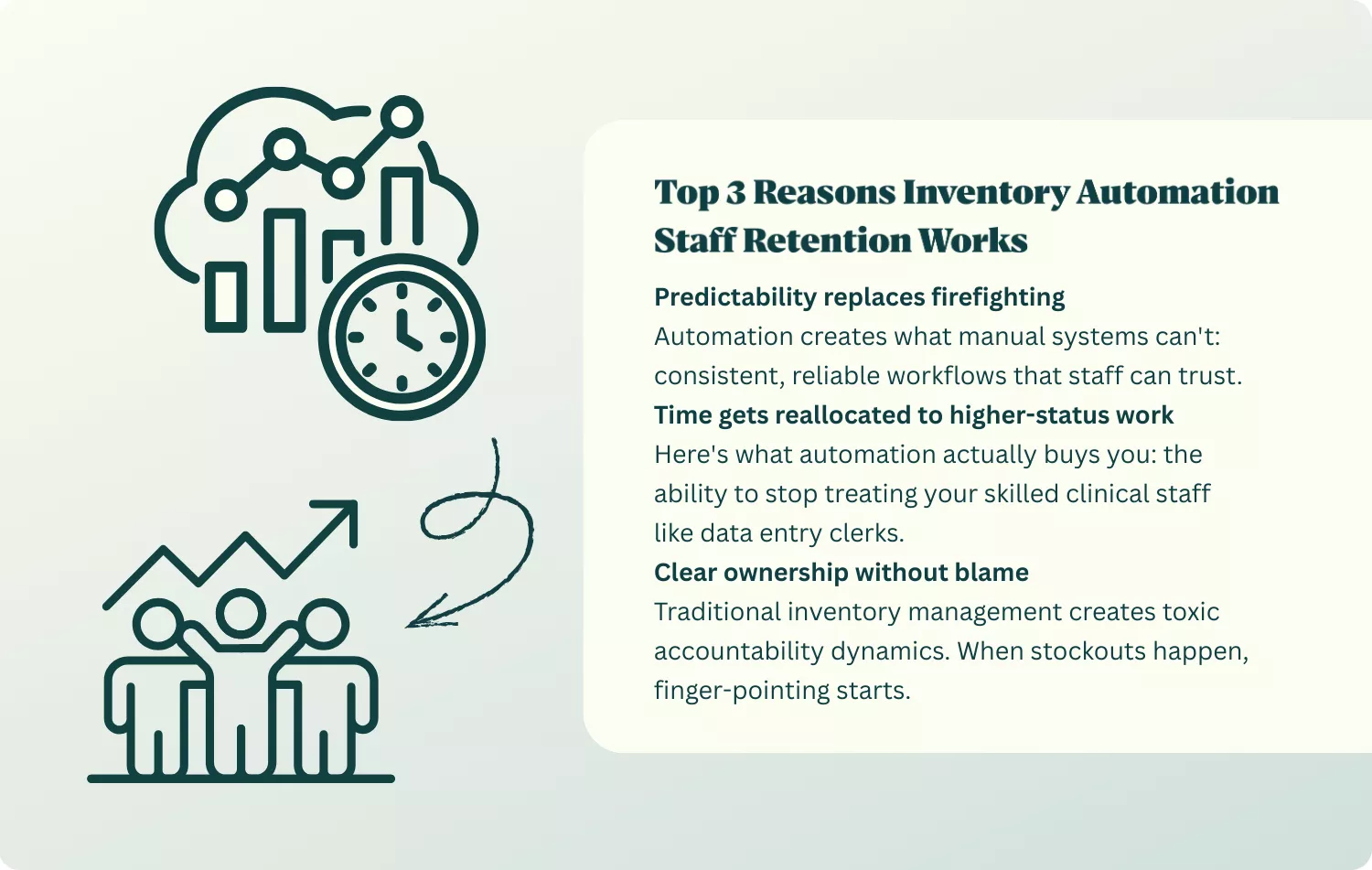
Top 3 Reasons Inventory Automation Staff Retention Works
The connection between inventory automation and staff retention is mechanical. When you remove operational friction, people stay. Here’s exactly how automation translates into better retention outcomes.
1) Predictability replaces firefighting
Automation creates what manual systems can’t: consistent, reliable workflows that staff can trust. Instead of reacting to each stockout crisis, automated systems monitor stock levels, identify low stock proactively, and generate reorder requests before emergencies occur. ZenOne’s platform tracks what practices order and use, then uses that data to prevent the panic work entirely.
This shift from reactive to proactive management fundamentally changes the employee experience. Staff know supplies will be available. They trust the system to catch problems before patients arrive. The psychological relief is real. When automation removes workflow interruptions, it doesn’t just save time. It restores the mental space required for actual job satisfaction.
One ZenOne customer at Beacon Dentistry condensed inventory from 10-15 vendors into one platform, reducing ordering time to 15-20 minutes per session. That’s not just efficiency. That’s the difference between chaos and calm.
2) Time gets reallocated to higher-status work
Here’s what automation actually buys you: the ability to stop treating your skilled clinical staff like data entry clerks. When ordering takes 15 minutes instead of two hours, those 105 minutes don’t vanish. They get reallocated to work that actually requires professional training.
Dental assistants didn’t go to school to comparison shop for gloves across vendor websites. When automation handles the administrative grunt work, your team can focus on patient education, treatment planning support, clinical skill development, and the relationship-building work that drew them to healthcare in the first place.
This reallocation matters because it directly addresses professional fulfillment. As dental consultants note, “Employees who feel stagnant or unchallenged are more likely to leave”. Staff stay when they feel their skills are valued and utilized. They leave when they’re stuck doing work a spreadsheet should handle.
Dr. Jack Fan from The Dental Centre watched his assistants fully manage ordering across multiple distributors without his involvement, eliminating stockout issues and reducing oversight to one less major task on his plate. His team wasn’t just freed from administrative punishment. They were empowered to own a professional responsibility with proper tools.
3) Clear ownership without blame
Traditional inventory management creates toxic accountability dynamics. When stockouts happen, finger-pointing starts. Without clear systems and data, every crisis becomes a potential HR incident.
Automation solves this by establishing transparent ownership with built-in visibility. One person owns inventory, but they’re supported by software that tracks every order, flags low stock, and maintains complete order history. When something goes wrong, the data shows what happened without requiring blame or defense.
ZenOne’s platform enables this through user permissions, role-based access, and centralized tracking with budgets and order history. The inventory owner sees exactly what’s needed, when to order, and how much to spend. The practice owner sees full visibility without micromanaging. When the system is clear, ownership feels like authority rather than liability.
What Inventory Automation Looks Like in a Real Practice
Theory is cheap. Let’s look at what actually happens when practices automate inventory properly, focusing on Miranda Moore’s experience at Beacon Dentistry in Weatherford, TX.
Before automation: Miranda’s Tuesday mornings started at 7:30 a.m., logging into Patterson’s website first. She’d manually check stock levels against a printed list, then switch to Henry Schein’s portal, re-entering her search terms. After that came Benco, then her specialty vendor for orthodontic supplies. Each site required different login credentials, different interfaces, different shopping carts. By 9:15 a.m., she’d placed four partial orders across three vendors, but she still needed to cross-reference prices manually because no system showed her comparison data. The entire process consumed 90-120 minutes, twice weekly.
She’d then spend Wednesday tracking shipments across multiple carrier sites, reconciling invoices that arrived at different times, and fielding questions from Dr. Tom Novak about why certain items cost more this month. When a hygienist reported being low on prophy paste Thursday afternoon, Miranda had to remember which vendor carried their preferred brand, log in again, and expedite an order. The stockout still happened Friday morning.
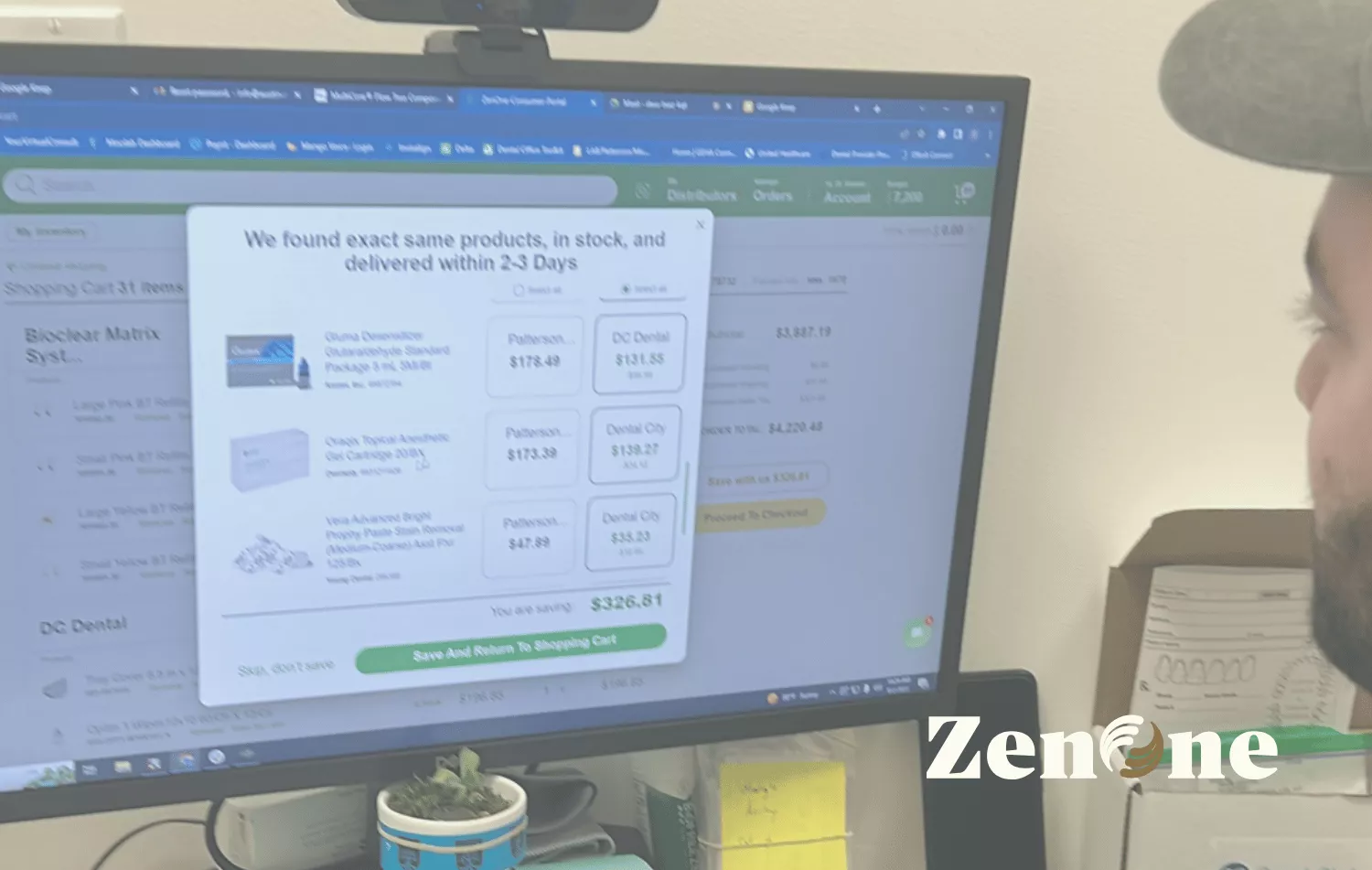
After ZenOne: Miranda now spends Monday mornings scanning barcodes as she restocks treatment rooms. She reviews the consolidated list on her phone, compares prices across all vendors in real-time, and places one order covering everything needed. Total time: 15-20 minutes. No separate logins. No manual price checking. No forgotten items.
When asked how the change affected her job satisfaction, Miranda said the difference wasn’t just about time. It was about control. She went from reactive firefighting to proactive management, from feeling blamed for stockouts to owning a system that actually worked. Their practice consolidated 10-15 vendors through the platform, and Miranda reclaimed nearly eight hours monthly that now go toward patient care coordination and clinical development.
River Run Dental Spa in Richmond scaled from one location to multiple by relying on centralized inventory control that removed growth bottlenecks. At Acre Wood Dental, Dr. Benjamin Johnson achieved near-zero owner input on supply management. His team handles consistent budgeting and on-demand supplies without pulling him into vendor decisions or stockout crises.
The retention benefit isn’t theoretical. When assistants can independently handle inventory in minutes instead of hours, they’re not just more productive, they’re more satisfied. When doctors trust their team with full supplier access because the system provides built-in budget controls, staff feel respected rather than micromanaged. When stockouts disappear, panic work disappears.
Implementation: How to Automate Inventory Without Annoying Your Team
Technology solves nothing if your team resents it. Most automation failures happen during implementation, not because the software was wrong but because the rollout ignored basic change management. Here’s how to automate inventory in a way your team will actually appreciate.
Assign one inventory owner, give them leverage
Don’t ask three people to share inventory management. Designate one owner, usually a senior assistant or office manager, and give them real authority. This person needs access to the full system, budget visibility, and decision-making power over vendors and purchasing.
The right person wants ownership but currently lacks tools. They’re already mentally tracking stock, noticing patterns, and worrying about shortages. Automation doesn’t add to their workload; it amplifies their effectiveness. Research confirms that recognition and involvement boost engagement more than workload demands, with involvement fostering psychological empowerment. Your inventory owner should feel this is a professional elevation, not additional burden.
Standardize what “in stock” means
Automation fails when teams can’t agree on basic definitions. What does “low stock” mean? What’s the difference between main stock and daily stock?
Define par levels for every critical item. Use ZenOne’s restock tool to calculate differences between target stock levels and actual inventory via checklists or barcode scans. Establish clear thresholds that trigger reorders automatically, removing subjective judgment calls.
This standardization isn’t bureaucracy. It’s clarity. When everyone understands the system, new team members onboard faster, coverage during vacations works smoother, and blame disappears because the rules are explicit.
Consolidate purchasing, then layer controls
Don’t try to implement automation across 15 vendors simultaneously. Start with your top three suppliers by spend. They probably represent 70% of your ordering volume. Get those running smoothly in the automated system, then migrate the rest.
Consolidation isn’t about limiting vendor choice. It’s about creating operational sanity. ZenOne allows unlimited suppliers on their Growth plan and higher, but smart practices consolidate where possible to reduce cognitive load. When you can’t consolidate, use the platform’s multi-vendor management to at least centralize the interface.
After consolidation, layer in controls gradually. Start with basic budget tracking so your inventory owner understands spend patterns. Add approval workflows if needed once the system is stable. This phased approach prevents overwhelming your team while building confidence in the system.
Common implementation challenges
Even well-planned automation hits predictable obstacles. The most common: staff resistance from those comfortable with current systems, even when those systems create chaos. The key is assigning a dedicated point person responsible for inventory rather than the “whoever’s free” approach that causes failures.
Expect a 2-4 week adjustment period before time savings materialize. During this window, some staff will be tempted to revert to old workflows or maintain parallel manual systems “just in case.” This is where clear leadership matters. One practice initially tried maintaining old vendor relationships while using ZenOne, creating confusion with parallel systems. After three weeks of frustration, the owner committed fully to the platform and saw immediate results.
Poor foundational data can also derail automation. If your reorder points are wrong or your par levels don’t match actual usage, automation will replicate those errors faster. Before automating, establish accurate par levels using the formula: Average Daily Usage × Lead Time + Safety Stock. The system can then optimize these levels based on actual patterns.
Throughout implementation, emphasize how the system benefits staff directly. They’re not learning new software because you want better reporting. They’re getting tools that eliminate the worst parts of their job.
Is Automation Right for Your Practice?
Inventory automation delivers maximum value for practices with specific characteristics, and honest assessment prevents mismatched expectations.
Where automation thrives: Practices ordering from multiple vendors (5+), managing inventory across multiple locations or operatories, experiencing frequent stockouts or emergency orders, or spending more than 2 hours weekly on supply ordering see immediate returns. Automation also benefits practices planning to scale, where growth multiplies inventory complexity.
Where automation may be premature: Solo practitioners with extremely simple supply needs, practices ordering from only 1-2 vendors with excellent relationships, or extremely small offices (1-2 operatories) with very predictable supply usage might find basic spreadsheet systems sufficient.
The implementation investment: Automation requires upfront time for setup (typically 1-2 weeks to input initial inventory and par levels), staff training (2-4 hours initial training, 2-4 weeks for habit formation), and change management (overcoming resistance to new workflows). Some practices also need to standardize inventory processes before automating. If your current workflows are completely undefined, you’ll need to create structure before systemizing it.
One limitation to consider: Automation works best when you have established workflows to systematize. If your purchasing decisions are highly idiosyncratic or you frequently switch vendors based on relationships rather than data, automation may feel constraining initially. The platform optimizes predictable patterns, not chaos.
Inventory automation approaches range from basic spreadsheet systems to enterprise platforms. The key is choosing a solution that matches your practice size and technical comfort, whether that’s ZenOne or another system built for dental-specific needs.
Conclusion
The dental staffing crisis won’t be solved by better pizza parties. 24% of practices lack sufficient administrative staff while 32% report clinical shortages, and those gaps exist because operational chaos makes good jobs unbearable. Inventory automation staff retention isn’t correlation, it’s causation. When you automate the administrative chaos that burns out your team, people stay.
ZenOne’s platform gives private practices the same inventory sophistication that enterprise operations have used for decades, without requiring enterprise budgets or complexity. Over 1,000 dental professionals are already saving an average of $17,000 annually while reclaiming hours every week for work that actually matters. The ROI isn’t just financial; it’s the assistant who stops browsing job postings because her workday no longer includes panic ordering. It’s the hygienist who stays because she finally has time for patient education. It’s the practice owner who can scale confidently because systems work without constant intervention.
Implementation takes weeks, but the retention benefits compound for years. Assign one inventory owner, give them proper tools through automation platforms, and watch operational predictability replace firefighting chaos. Your team didn’t sign up to fight vendor websites and stockout emergencies. They signed up to help patients.Ready to see how inventory automation changes retention in your practice? Start a free trial with ZenOne to see real-time price comparison, consolidated ordering, and the automated reordering that gives your team their time back. Your retention problem might be simpler than you think. It just requires better systems, not better speeches.
Join 1200+ dental professionals, shop from your favorite
suppliers, compare prices instantly, and save over $17,000/year
Try our platform free for 14 days.
Get the latest ZenOne updates and product launches in your inbox
Don't miss the latest news!
Receive exclusive offers and news straight to your inbox!
Continue reading

03/12/2026
~ 9 minutes to read

03/06/2026
~ 11 minutes to read

02/19/2026
~ 13 minutes to read
Let's discover how we can help you

Tiger Safarov
Hi, I'm Tiger, the CEO at ZenOne, and I'm happy to personally ensure your success with ZenOne. Send me your latest invoice or a statement for a Free Savings Analysis.
Ask me a question:

