


Miranda Moore
RDA Lead Assistant, Beacon Dentistry

Most dental AI conversations in 2026 still center on diagnostics. Caries detection, periapical reads, periodontal charting. Useful, but a small slice of where AI is actually changing the practice. The bigger story is operational. AI is now embedded in scheduling, inventory, claims, communications, and back-office workflow, and those tools are reaching mature pricing and reliability for the average independent practice. At ZenOne, we work with practices that are sorting through which AI tools deserve a seat at the operations table, and the seven uses below are the ones consistently producing measurable returns.
This post covers seven AI uses outside the operatory that move the needle on time, cost, and patient experience right now, plus what to watch for when evaluating tools.
Summary
Diagnostic AI gets the press; operational AI captures the savings. In 2026, the highest-leverage uses of AI in dentistry are AI receptionists and call handling, intelligent scheduling, automated insurance verification, claims and billing review, supply and inventory management, patient communications, and AI agents that orchestrate multistep back-office workflows. Practices adopting two or three of these tools regularly recover an estimated $50,000 to $200,000 in annual revenue and free up 30 to 50 percent of front-desk time. The catch is integration with the practice management system and the team’s willingness to redesign workflows around the tools rather than bolt them on.
Key Points
- Diagnostic AI is mature; operational AI is where the next gains live. Caries detection works. The bigger win is everything that happens around the chair.
- AI receptionists are reliable in 2026. They handle inquiries, schedule appointments, and update charts, with measured reductions in missed calls.
- Smart scheduling reduces no-shows. Practices report no-show reductions of about 41 percent and patient volume increases of about 20 percent with AI scheduling tools.
- AI claims review cuts denials. RCM tools using AI review reduce denial rates by 25 to 30 percent in practices that previously billed manually.
- AI inventory management is here. Reorder thresholds, price comparison, and expiration tracking now run on AI-powered platforms with measurable savings.
- Patient communication is automatable. Recall, recare, post-op, treatment plan follow-up: all running on AI sequencing today.
- AI agents are emerging. Multistep autonomous workflows that span phone, calendar, chart, and claims are real in 2026, not theoretical.
- Integration is the deciding factor. A great AI tool that does not talk to your PMS will fail. Buyers should evaluate integrations as carefully as features.
| See what AI-powered inventory looks like inside a real practice. ZenOne handles reorder thresholds, multi-vendor price comparison, and expiration tracking in one platform. Start a free trial of ZenOne. |
Use 1: AI Receptionists and Call Handling
AI receptionists in 2026 are not the awkward phone trees of five years ago. They handle initial inquiries, route by reason, schedule appointments, and update patient charts automatically. The biggest win is recapturing missed calls outside hours and during peak load, where industry research cites an estimated $50,000 to $200,000 in annual revenue recovered for typical practices that adopt the technology.
The front-desk team is freed for in-office patient experience instead of phone triage. The receptionist who would otherwise be juggling three calls at once becomes the person greeting the patient walking through the door.
Watch for voice quality, language coverage, integration with the existing PMS, and clear escalation rules to a human team member when a caller asks for something outside the AI’s scope.
Use 2: Intelligent Scheduling and No-Show Reduction
AI scheduling tools predict peak times and chair utilization, then suggest schedule reshuffles that maximize productive hours. They also manage rescheduling and cancellation flow dynamically, reducing gaps in the schedule before they create a billable hour gap.
Practices using AI scheduling report no-show reductions of about 41 percent and patient volume increases of about 20 percent (as of early 2026). That is a meaningful swing for a tool that runs in the background.
The honest watchouts are rules around emergency slots, multi-provider scheduling, and how the scheduling layer integrates with patient communications. A scheduler that books the appointment but does not trigger the confirmation sequence is half a tool.
Use 3: AI Insurance Verification and Eligibility
AI insurance verification runs real-time eligibility checks at booking and at check-in, surfacing coverage gaps before the patient sits down. The benefit is straightforward: fewer surprise out-of-pocket conversations, fewer post-visit collections issues, and a smoother experience for patients who would otherwise find out about a denied claim two weeks later.
Major PMS systems are increasingly compatible, but it is worth confirming directly with the vendor before purchase. The American Dental Association has documented eligibility verification as one of the most common sources of revenue leakage in independent practices.
Use 4: Claims and Billing Review
AI claims review catches coding errors, missing information, and documentation gaps before claims hit the payer. Revenue cycle management tools using AI review reduce denial rates by 25 to 30 percent in practices that were previously billing manually. The downstream effect is that billing staff get to spend time on appeals and AR work that actually requires judgment, rather than on the data-entry layer.
The best fit is practices with high claims volume or a recurring denial category that has been hard to crack. A practice that loses 8 percent of claims to a single PPO’s coding rules is exactly the kind of practice that benefits most.
Use 5: Inventory and Supply Chain
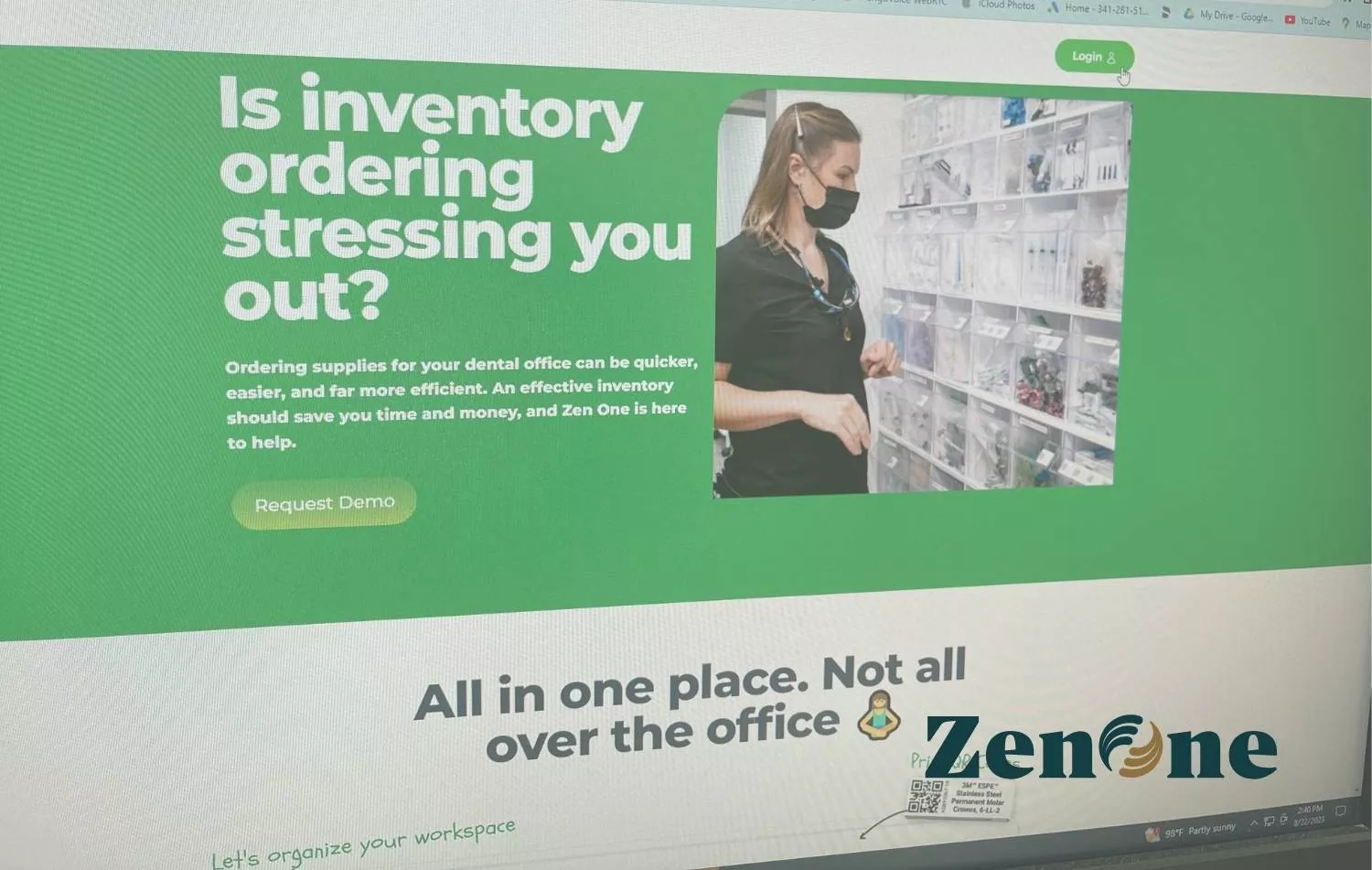
Automated reorder thresholds across hundreds of SKUs, with multi-vendor price comparison built in, are now standard in modern dental inventory software. Expiration tracking and FIFO logic prevent the slow drip of waste that costs practices an estimated $15,000 to $25,000 annually (industry research consistently lands in this range for 8+ operatory practices).
The seat this pairs with is the Clinical Coordinator. Software handles the math, the seat handles the decisions. The two work together rather than substituting for each other.
ZenOne is built specifically for this use case across Henry Schein, Patterson, Benco, Darby, and other dental supply vendors. For a deeper breakdown of how this works in practice, the ZenOne guide on how to manage dental inventory walks through the full playbook.
Use 6: Patient Communications and Recall
Recall, recare, post-op, and treatment plan follow-up are all handled by AI sequencing across SMS, email, and voice in modern practices. Personalized timing, with messages tuned to procedure type and patient history, reactivates dormant patients without manual outreach.
The watchouts here are opt-out compliance, brand voice quality (an AI that sounds nothing like your office tone undermines trust), and integration with the chart so the AI knows which patients to reach and what to say.
| See where AI-powered inventory fits in your AI stack. ZenOne adds the inventory layer of the operational AI stack with no vendor lock-in. Start a free trial of ZenOne. |
Use 7: AI Agents Running Multistep Workflows
The 2026 frontier is AI agents that combine model reasoning with action, running multistep workflows across systems autonomously. The clearest example is an agent that takes a patient request, checks the schedule, verifies insurance, books the appointment, sends the confirmation, and updates the chart, all without a human touching each step.
Adoption is early but accelerating. Major industry analysts treat agentic AI as the most consequential operational shift of the next 18 months in dentistry. The honest read is that this is still a frontier capability for most practices, and the foundational tools (scheduling, communications, inventory) should be in place before stacking agents on top.
Watch for governance, audit trails, and exception handling. An agent that can act on its own needs to leave a trail of what it did and why.
How to Evaluate Dental AI Tools in 2026
A short evaluation framework will save more money than chasing the latest demo.
Integration first. A tool that does not talk to your PMS will create a parallel data trail and fail. Confirm the integration before you confirm the contract.
Measurable outcomes. The vendor should be able to show no-show reduction, denial reduction, supply savings, or hours recovered, with real customer data.
Support and training. A great tool with no implementation support stalls. Ask what the first 90 days look like.
Compliance. HIPAA, state-specific dental rules, audit trails, and data residency are all non-negotiable.
Total cost. Subscription, integration cost, internal time. Compare to the line items the tool replaces, not to nothing.
Stack fit. A practice running 6 disconnected AI tools is not better off than a practice running 2 well-integrated ones. Phase the rollout, and let each tool prove itself before adding the next.
Where AI Falls Short Today
There are real limits worth naming.
Empathy and judgment in patient conversations still belong to humans. AI can route, summarize, and schedule, but it should not replace the human read on a worried patient.
Edge cases in clinical decision-making sit with the clinician. Diagnostic AI is a co-pilot, not a clinician, and the American Dental Association guidance treats it that way.
Multi-system orchestration without integration is fragile. AI agents only work when the systems underneath them speak to each other.
Adoption fatigue is real. Stacking 6 vendors at once burns out the team. Phase the rollout.
How ZenOne Fits Into the AI Stack
ZenOne owns the inventory and procurement layer of the back office. Automated reordering, multi-vendor price comparison, budget control, expiration tracking, and reporting all live in one platform. It is designed to integrate with the rest of the practice operating system rather than to be a one-off side tool, and over 200,000 normalized SKUs make like-for-like price comparison work across the major dental suppliers.Practically, ZenOne helps a Clinical Coordinator turn supply spend from chaos into a managed line item, freeing the rest of the team to focus on patient care. The connection to overhead targets is direct, which is why supply spend benchmarks keep showing up as a leading indicator of practice health.
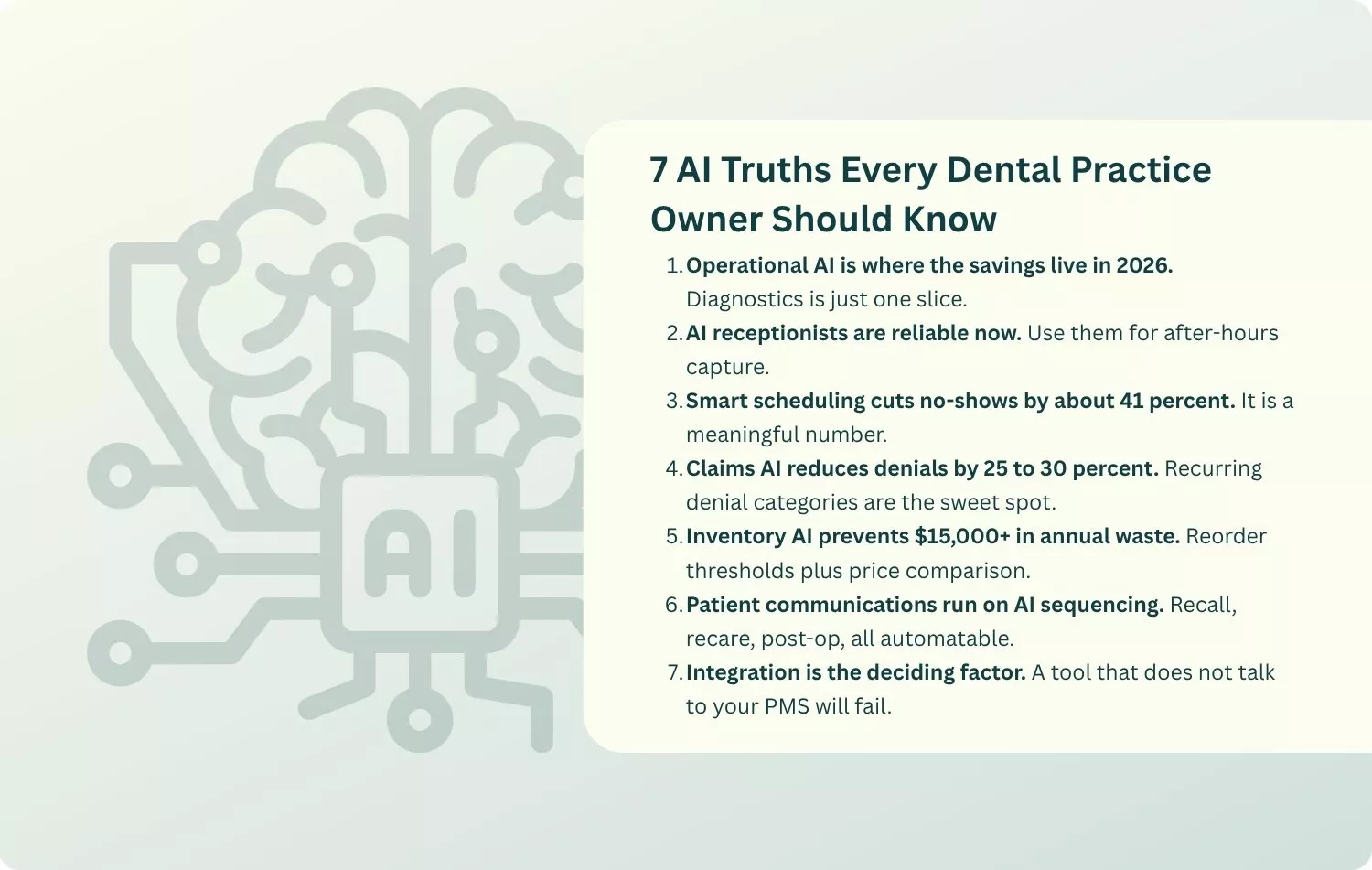
7 AI Truths Every Dental Practice Owner Should Know
A quick reference for the next vendor meeting:
- Operational AI is where the savings live in 2026. Diagnostics is just one slice.
- AI receptionists are reliable now. Use them for after-hours capture.
- Smart scheduling cuts no-shows by about 41 percent. It is a meaningful number.
- Claims AI reduces denials by 25 to 30 percent. Recurring denial categories are the sweet spot.
- Inventory AI prevents $15,000+ in annual waste. Reorder thresholds plus price comparison.
- Patient communications run on AI sequencing. Recall, recare, post-op, all automatable.
- Integration is the deciding factor. A tool that does not talk to your PMS will fail.
Conclusion
AI in dentistry is no longer just a diagnostic conversation. The biggest 2026 wins live in scheduling, communications, billing, and supply, and the practices that pick two or three high-leverage tools and integrate them well are pulling ahead on cost and patient experience.ZenOne was built to be the inventory layer of that stack. The platform connects to all the major dental suppliers, runs reorder thresholds and multi-vendor price comparison automatically, and gives the Clinical Coordinator a real system to run. The goal is to make supply spend a managed line item rather than a chronic source of waste, and to do it without locking the practice into a single vendor.
| Add the inventory layer to your AI stack. ZenOne handles automated reordering, multi-vendor price comparison, and expiration tracking, with no vendor lock-in. Start a free trial of ZenOne. |
Join 1400+ dental professionals, shop from your favorite
suppliers, compare prices instantly, and save over $17,000/year
Try our platform free for 14 days.
Get the latest ZenOne updates and product launches in your inbox
Don't miss the latest news!
Receive exclusive offers and news straight to your inbox!
Continue reading

09/01/2026
~ 9 minutes to read
08/27/2026
~ 9 minutes to read
08/24/2026
~ 10 minutes to read
Let's discover how we can help you

Tiger Safarov
Hi, I'm Tiger, the CEO at ZenOne, and I'm happy to personally ensure your success with ZenOne. Send me your latest invoice or a statement for a Free Savings Analysis.
Ask me a question:

