


Miranda Moore
RDA Lead Assistant, Beacon Dentistry
05/18/2026
Manual Logs vs. Digital Procurement: The True Cost of Spreadsheets

~ 7 minutes to read
The question of digital vs manual inventory looks simple on the surface. Spreadsheets feel free. Software has a line item in the budget. Most dental practices default to manual tracking for that reason, and many have run inventory that way for years. The real cost comparison is not the subscription cost. It is the compounding expense of staff time, ordering errors, expired waste, and missed supplier savings that a manual system carries quietly in the background.
Dental practices spend roughly 5 to 7 percent of total revenue on supplies, according to the Academy of Dental CPAs and ADA benchmarks. When that spending is tracked in a shared spreadsheet, the leaks are invisible until year-end. At ZenOne, we help over 1,000 dental professionals replace manual inventory tracking with automated procurement, and the savings consistently exceed the software cost within the first two months.
| Still running inventory on a spreadsheet? See how dental teams replace manual tracking with ZenOne. One ordering platform, automated reordering, real-time spend visibility. |
Summary: Digital vs Manual Inventory in Dental Practices
Manual inventory management costs dental practices 5 to 10 hours of staff time per week, generates duplicate orders through scattered spreadsheets, hides thousands of dollars in expired waste each year, and misses GPO pricing that digital platforms apply automatically. Spreadsheets can work in a single-operator practice with under 50 SKUs, but for any growing dental office, the hidden costs of manual tracking quickly exceed the price of a procurement platform. Digital procurement replaces manual effort with threshold-based reorder automation, centralized ordering, and spend analytics.
Key Points
- Supplies are a top three overhead category. Typically 5 to 7 percent of revenue, and easy to lose control of when tracking is manual.
- Spreadsheets are not free. Staff time, errors, and waste make them expensive in practice.
- Manual data entry carries a 1 to 4 percent error rate. In a dental supply context, that means duplicate orders and wrong quantities on a regular basis.
- Expired inventory runs $15,000 to $25,000 per single-location practice annually. When tracking is reactive.
- Automated systems have saved practices $8,000 to $10,000 per month in supply spend. Primarily by cutting duplicates and standardizing orders.
- GPO pricing requires system integration. Contract discounts only help if they are applied at checkout, which manual workflows rarely achieve.
- Digital procurement takes one to two weeks to implement. Less time than most practices think.

How Manual Inventory Tracking Actually Works in Most Dental Practices
The typical manual setup is familiar: a Google Sheet or Excel file maintained by one or two staff members, supplemented by paper logs in the supply closet and tribal knowledge about what the office usually orders. Counts happen weekly or whenever someone notices a shortage. Reorders get placed by calling vendors or logging into three to five different supplier portals, each with its own login, cart, and invoice format.
The California Dental Association recommends distributing inventory responsibility across multiple team members to reduce expired waste and duplicate ordering. That advice works only when there is a shared system backing it. Without one, distributed ownership becomes scattered ownership, and the practice ends up with the same problems amplified.
What Manual Tracking Looks Like in Practice
- Shared spreadsheet or paper log maintained by one or two staff members.
- Supplies counted by hand, weekly or when a shortage surfaces.
- Reorders placed across three to five supplier portals with separate logins.
- No automated alerts, so shortages are discovered after they happen.
- Order history scattered across email confirmations, invoices, and personal memory.
- Price comparison requires manually checking multiple catalogs per order.
The Hidden Costs of Manual Supply Tracking
The real cost of a manual system is not one large line item. It is four or five smaller ones that compound every month. Practices rarely see the full picture until they consolidate onto a single platform and pull the first analytics report.
Staff Time
A mid-size dental practice spends five to ten hours per week on inventory tasks when tracking is manual. That includes counts, data entry, cross-referencing orders across suppliers, and reconciling invoices. At market dental assistant wages, that is real labor cost, and the time comes out of patient-facing work. Over a year, five hours per week is 260 hours, equivalent to six and a half working weeks of a full-time assistant.
Ordering Errors
Research from Invensis puts the error rate for manual data entry at 1 to 4 percent of keystrokes. In a dental supply context, that translates into duplicate orders when two staff members reorder the same item, wrong quantities from outdated spreadsheet data, and missed items that drop off the list because no one updated the sheet. Each of those errors costs money, some in overnight shipping, some in returns, some in sitting stock that was never needed.
Expired Inventory and Waste
Manual tracking does not flag expiration dates proactively. Analysis from Method Procurement estimates conservative all-in waste at $15,000 to $25,000 per single-location dental practice per year when inventory is not actively rotated. Overstocked composite and bonding agent sitting past use-by creates both direct waste and a compliance risk around expired product disposal under state dental board requirements.
Missed Supplier Savings
Without aggregated spend data, there is no leverage in supplier negotiations. GPO contract pricing goes unused when the practice has no system connecting negotiated rates to the order line. Bulk discount thresholds are missed when ordering is fragmented across suppliers and time periods. Dental industry analysis in Dental Economics shows that GPO pricing typically saves practices 15 to 35 percent on clinical supplies when applied consistently, and that consistency is what manual workflows fail to deliver.
| Curious how much your practice is losing? See how ZenOne helps dental teams identify and eliminate expired material waste before it reaches the year-end cleanup pile. |
What Digital Procurement Changes
A digital procurement platform replaces the four cost centers above with automation. The underlying dental supply workflow does not disappear, it becomes structured and trackable. Practices that make the switch typically report the first meaningful savings within 30 to 60 days, and Dental Economics reports that automated inventory and procurement systems have reduced monthly supply spending by $8,000 to $10,000 in the first four months of use.
Automated Reorder Triggers
Reorder thresholds are set once per item and enforced automatically. When stock drops below threshold, the system alerts the ordering team or places the reorder directly. Reactive, shortage-driven buying disappears, and with it the overnight shipping charges and procedure delays that come with it.
Centralized Ordering
One platform replaces three to five supplier portals. Every order, from every vendor, lands in one searchable history with date, quantity, price, and approver logged automatically. Billing reconciliation at month-end goes from hours to minutes because the data is already consolidated.
Spend Visibility
A dashboard replaces the “open every invoice folder” approach to understanding spend. Practices can see total spend by category, by supplier, and by time period in one view. Waste becomes visible, because the platform can compare what was ordered to what was actually used.
Price Optimization
GPO contract pricing gets applied automatically at checkout. Side-by-side price comparison across suppliers happens in the same interface, so the decision is informed rather than habitual. Aggregated spend data strengthens the practice’s position in the next supplier renewal.
Side-by-Side: Manual vs Digital Procurement
The clearest way to see the cost difference is dimension by dimension. Here is how manual and digital systems compare across the categories that actually matter in a dental practice.
| Dimension | Manual | Digital |
| Reorder process | Reactive, shortage-driven | Proactive, threshold-triggered |
| Staff time per week | 5 to 10 hours | Under 2 hours |
| Order accuracy | Error-prone, duplicate risk | System-validated, single source |
| Expiration tracking | Periodic hand checks | Automated alerts before expiry |
| Spend visibility | Requires pulling invoices | Real-time dashboard |
| Supplier pricing | Catalog-by-catalog comparison | GPO and contract pricing auto-applied |
| Audit readiness | Reconstruct from emails and paper | Exportable order history |
When Spreadsheets Still Work for Dental Supply Management
Manual tracking is not always the wrong answer. There are a few situations where a spreadsheet is reasonable, and a procurement platform would be overkill. Honesty about those cases matters more than selling software for its own sake.
- Solo practitioner with a single operatory and fewer than 50 active SKUs.
- Practice with an experienced office manager who has memorized supply patterns over years and runs a tight reorder cadence.
- Startup practice in its first few months with very low order volume and minimal supplier relationships.
- Specialty practice with a narrow, predictable supply list and a single preferred vendor.
- The qualifier in each case is that the cost of errors is low, not that the manual system is good. Once the practice grows past that threshold, the economics reverse quickly.
| Benchmark your supply spend. Compare your practice to industry averages in the ZenOne overhead benchmarks guide. Ten minutes to see if your spend is in a healthy range. |
How ZenOne Replaces the Spreadsheet
The ZenOne platform is built specifically for dental practices that want to stop managing supply chains in spreadsheets and email threads. Setup takes one to two weeks, not months, and the platform covers the complete inventory workflow in one interface.
- Single ordering platform for every supplier, with GPO-contracted pricing applied automatically.
- Low-stock alerts and usage-based reorder suggestions built into the daily workflow.
- Order history and spend analytics across all suppliers in one dashboard.
- Dental-specific product catalogs, so no searching through general medical or industrial supply listings.
- Order approval workflows for multi-staff practices that prevent duplicates and unauthorized purchases.
- Simple onboarding: import your current supplier list and start ordering in days.
For practices that want a deeper view of the full workflow, our complete dental inventory management guide walks through every step from audit to ongoing review. The guide is the same playbook our team uses when onboarding new practices.
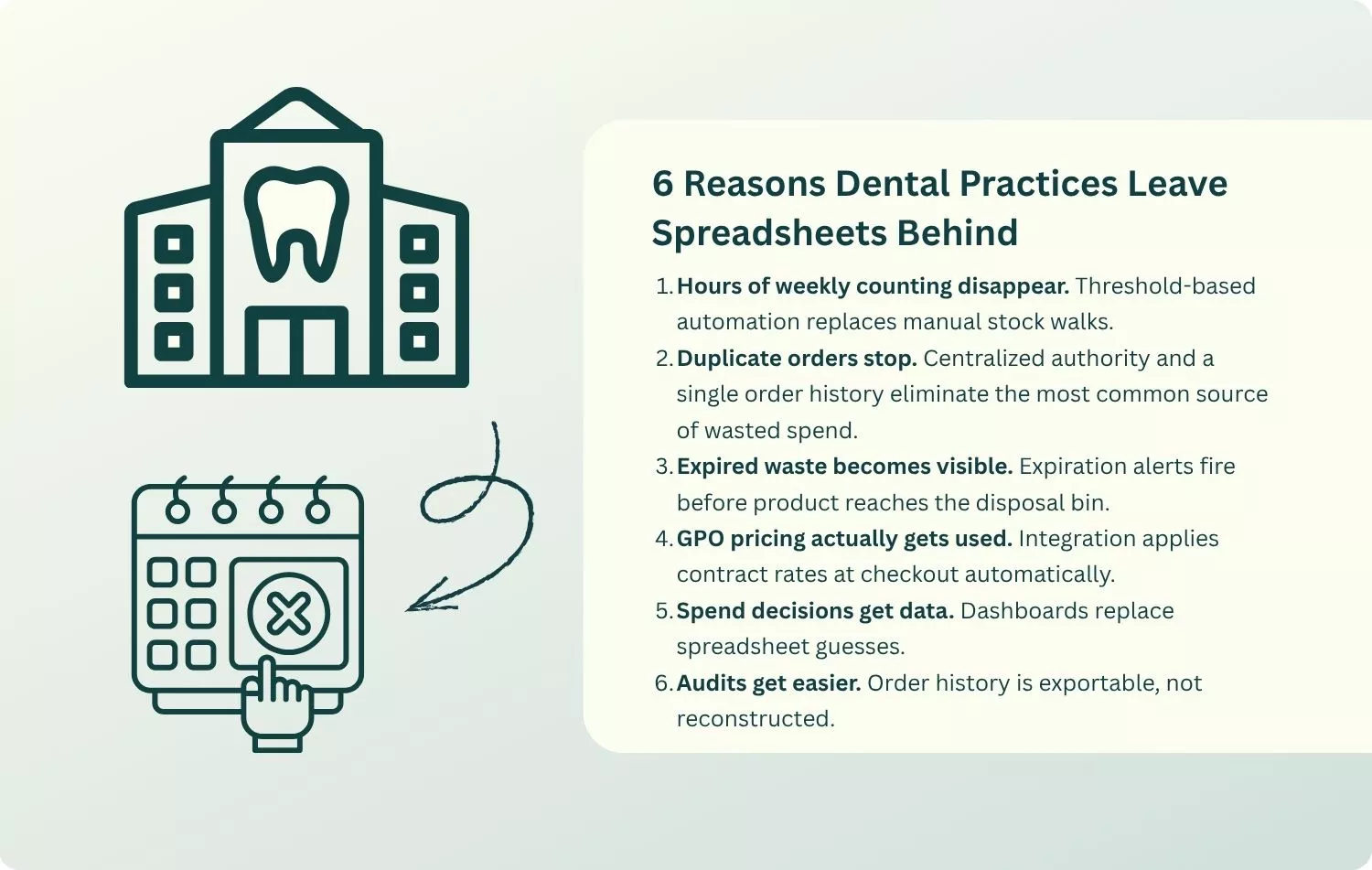
6 Reasons Dental Practices Leave Spreadsheets Behind
Short list for the next practice meeting. Each of these is a specific pain point that digital procurement resolves on day one.
- Hours of weekly counting disappear. Threshold-based automation replaces manual stock walks.
- Duplicate orders stop. Centralized authority and a single order history eliminate the most common source of wasted spend.
- Expired waste becomes visible. Expiration alerts fire before product reaches the disposal bin.
- GPO pricing actually gets used. Integration applies contract rates at checkout automatically.
- Spend decisions get data. Dashboards replace spreadsheet guesses.
- Audits get easier. Order history is exportable, not reconstructed.
Conclusion: Spreadsheets Are a Starting Point, Not a Strategy
The comparison between digital vs manual inventory comes down to where the real costs live. Manual tracking carries costs that are distributed across the team, the storage closet, and the supplier invoices, and those costs compound every order cycle. Digital procurement replaces that sprawl with a single workflow: automated reorder thresholds, one ordering interface, real-time spend visibility, and GPO pricing applied at checkout.
ZenOne is built for dental practices specifically. Our platform combines dental-specific catalogs, GPO integration, low-stock alerts, and spend analytics, and it supports over 1,000 dental professionals who have moved off spreadsheets. The savings consistently exceed the platform cost, and the hours saved get reinvested in patient care where they belong.
| Ready to retire the spreadsheet? Replace manual supply tracking with automated procurement. Book a Demo of ZenOne today. Fourteen days, no contract, full access to the platform. |
FAQ
How much does a dental procurement platform cost compared to spreadsheets?
How much does a dental procurement platform cost compared to spreadsheets?
Spreadsheets are free to buy but expensive to run. When staff time, ordering errors, expired waste, and missed GPO pricing are included, most practices spend far more on manual inventory processes than a platform subscription costs. The cost comparison only looks close when the hidden costs of manual tracking are ignored.
Can I keep using my current suppliers if I switch to a digital platform?
Can I keep using my current suppliers if I switch to a digital platform?
Yes. Platforms like ZenOne integrate with the major dental suppliers most practices already use. Existing vendor relationships continue, but the ordering, invoicing, and tracking happen in one interface rather than scattered across each vendor portal.
How long does the transition from spreadsheets to a digital system take?
How long does the transition from spreadsheets to a digital system take?
Most practices are fully operational on ZenOne within one to two weeks. That includes importing the current supplier list, setting reorder thresholds for core SKUs, and training the team on the new ordering workflow. Practices do not need to freeze operations during the transition.
What if my staff is not comfortable with technology?
What if my staff is not comfortable with technology?
If the team can use an online shopping cart, they can use a dental procurement platform. Most purpose-built inventory systems have simpler interfaces than the multi-tab spreadsheets they replace. Onboarding is typically a few short training sessions, not a major change management project.
Join 1400+ dental professionals, shop from your favorite
suppliers, compare prices instantly, and save over $17,000/year
Try our platform free for 14 days.
Get the latest ZenOne updates and product launches in your inbox
Don't miss the latest news!
Receive exclusive offers and news straight to your inbox!
Continue reading
10/02/2026
~ 7 minutes to read
09/23/2026
~ 7 minutes to read
09/11/2026
~ 7 minutes to read
Let's discover how we can help you

Tiger Safarov
Hi, I'm Tiger, the CEO at ZenOne, and I'm happy to personally ensure your success with ZenOne. Send me your latest invoice or a statement for a Free Savings Analysis.
Ask me a question:

