


Miranda Moore
RDA Lead Assistant, Beacon Dentistry

04/06/2026
Dental Supply Ordering: How Private Practices Simplify the Process and Save Money

~ 9 minutes to read
Dental supply ordering is one of the most time-consuming workflows in a private practice, and most of that time is avoidable. The average practice orders from five or more vendors, each with separate logins, catalogs, and invoices. Without a consistent process, ordering becomes reactive: staff reorder from memory, skip price comparisons, and scramble when something runs out at the wrong moment.
Practices that treat supply ordering as a system rather than a routine task cut admin hours, reduce stockouts, and stay inside the 5 to 7 percent of collections benchmark that top practices maintain. ZenOne helps private practices build that system, centralizing vendor ordering, automating price comparison, and giving teams the visibility they need to make every order count. Start your free trial with ZenOne and see how much your practice can recover.
| Spending too many hours on supply ordering? ZenOne centralizes all your vendors into one platform so your team can place accurate orders in minutes, not hours. Start your free trial |
Summary: Dental Supply Ordering
A clean dental supply ordering process comes down to four things: one accountable team member, consolidated vendors, monthly spend tracking against a 5 to 7 percent of collections target, and price comparison on every order. Most practices that fix their ordering process cut admin time by 70 to 85 percent and reduce supply costs by 15 to 20 percent within the first 90 days. The practices that struggle are not spending more because they need to. They are spending more because their process has not caught up with the complexity of managing multiple vendors without a central system.
Key Points
- Multi-vendor fragmentation is the root cause: ordering from five or more vendors through separate portals adds up to hours of avoidable administrative work every month.
- Distributor markup ranges from 5 to 40 percent: price comparison is not optional for cost control; it is the difference between a 5 percent and a 9 percent supply spend.
- Practices above 7 percent almost always have a process problem: not a pricing problem. Fix the workflow before negotiating with vendors.
- Miranda Moore cut ordering time by 85 percent: she went from 2 to 3 hours per order cycle down to 15 to 20 minutes after centralizing in ZenOne.
- Dr. Brandon Johnson reduced supply spend by 20 percent: that equals $2,000 per month on a $10,000 monthly budget, or $24,000 per year straight to the bottom line.
- One accountable owner changes everything: a defined ordering role with approved vendors, budget caps, and reorder points eliminates the guesswork that drives overages and stockouts.
- Technology should do the comparison work: platforms that show prices across all your vendors in one screen make price comparison the default, not an extra step.
Why Dental Supply Ordering Is Harder Than It Should Be
How Multi-Vendor Fragmentation Adds Up
Every vendor your practice works with adds a layer of operational overhead. Separate logins, separate catalogs, separate pricing structures, separate invoices, and separate shipping timelines all require management. When an order spans five vendors, your team is essentially running five separate ordering processes every time.
Manual price comparison across those portals is too slow to do consistently, so most practices skip it. According to ADA Health Policy Institute research, supply costs are among the most variable and controllable overhead categories in private practice. The practices that control them well are the ones that compare prices systematically, not occasionally.
The Hidden Costs of a Reactive Ordering Process
A reactive ordering process creates costs that go beyond what appears on any invoice. Missed items lead to duplicate orders when someone reorders without checking what was already placed. Rush shipping fees accumulate when stockouts force emergency orders. Invoice reconciliation across multiple vendors takes time that could go toward patient care.
There is also the opportunity cost. Every hour your office manager or lead assistant spends on supply management is an hour not spent on scheduling, patient follow-up, or revenue cycle tasks. The operational load is real, and it compounds over time without a system to contain it.
The American Dental Association has identified supply cost control as one of the highest-impact areas for practice profitability. The ADA’s dental supply inventory control guidelines recommend standardized ordering processes and consistent spend benchmarking as the foundation of a well-managed supply budget.
The Most Common Dental Supply Ordering Mistakes
Ordering from Memory
Ordering from memory means your supply levels depend on whoever is placing the order that week and what they happen to remember. It oscillates between overstock and stockout, often both happening at the same time with different products. You end up with three boxes of gloves and no composite because no one tracked usage between orders.
Staying Loyal to One Vendor Without Comparing Prices
Single-vendor loyalty is one of the most common and costly habits in dental supply management. Distributors know when they have your business without competition, and prices reflect that. Markup varies from 5 to 40 percent by product. Over 12 months, the loyalty tax on a $10,000 monthly supply budget can run into thousands of dollars.
Dr. Jack Fan experienced this directly. Vendor reps promised competitive pricing, but “some items were cheaper while they got it back through other things. It ended up sometimes even more expensive than ordering myself.” Systematic price comparison across vendors is the fix, not loyalty to one distributor.
Letting Rush Orders Become Routine
When rush orders happen once, it is a mistake. When they happen monthly, it is a system problem. Regular emergency orders mean your practice has no reliable way to track what is running low before it runs out. The cost is not just expedited shipping. It is the staff time, the premium pricing under urgency, and the signal it sends to your vendor about your negotiating position.
Carrying Too Many SKUs
When providers choose their own preferred brands across categories, SKU counts multiply. More SKUs mean lower volume per product, which reduces pricing leverage, complicates inventory tracking, and increases the chance of expired stock. It also makes onboarding new team members harder, since there is no shared standard they can follow.
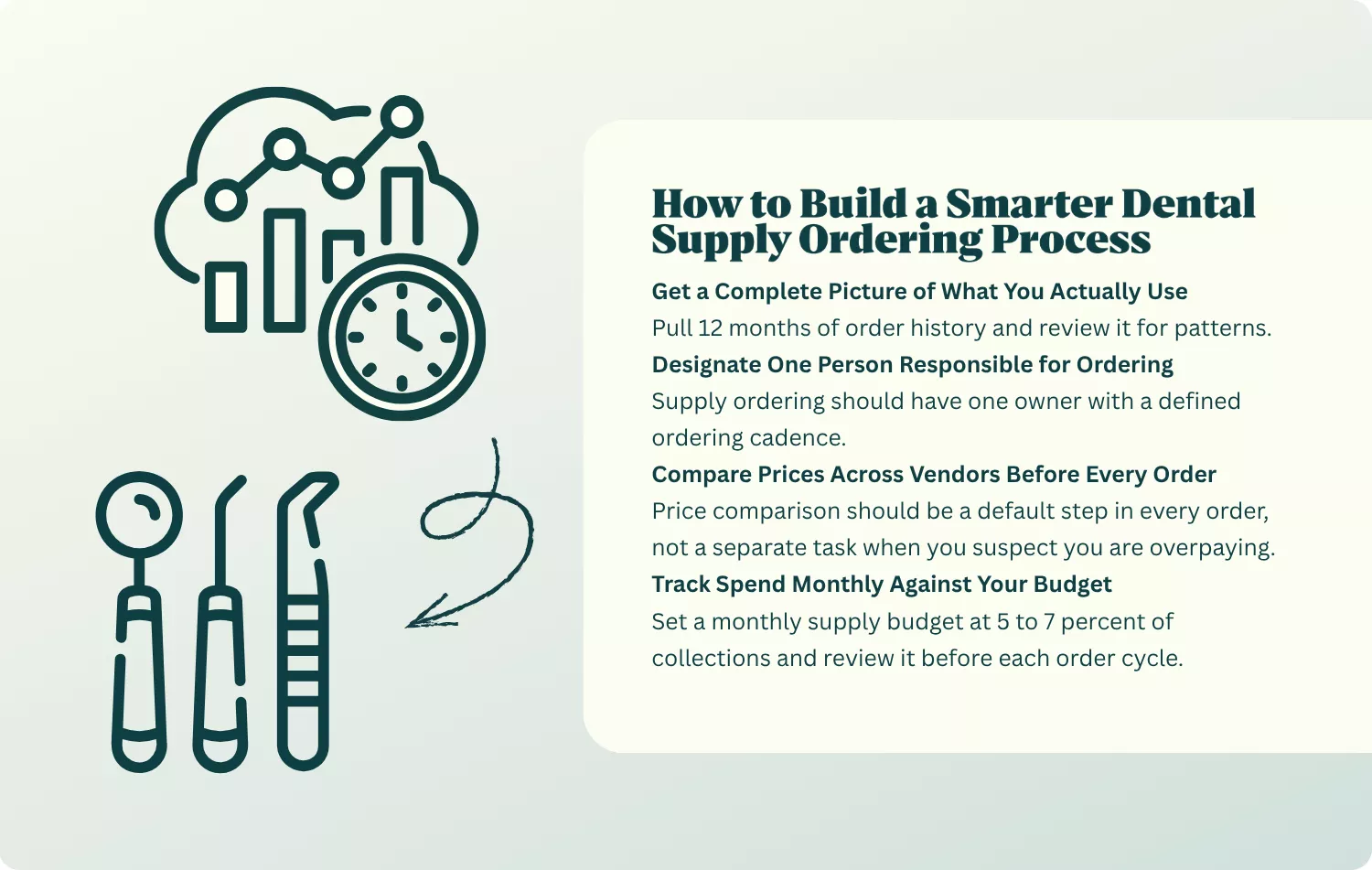
How to Build a Smarter Dental Supply Ordering Process
Step 1: Get a Complete Picture of What You Actually Use
Pull 12 months of order history and review it for patterns. Look for products you order frequently at low quantities, duplicate SKUs across similar products, items that expire regularly, and categories where you have no vendor comparison data. This audit takes time once and saves time every month after.
Step 2: Designate One Person Responsible for Ordering
Supply ordering should have one owner with a defined ordering cadence. That person makes day-to-day decisions, escalates only when purchases exceed a budget threshold, and is accountable for the monthly spend number. Shared responsibility creates gaps. One owner creates accountability.
Step 3: Compare Prices Across Vendors Before Every Order
Price comparison should be a default step in every order, not a separate task you run when you suspect you are overpaying. The comparison does not have to be manual. Platforms that pull pricing from all your vendors into a single view make comparison automatic and fast.
Step 4: Track Spend Monthly Against Your Budget
Set a monthly supply budget at 5 to 7 percent of collections and review it before each order cycle. Category-level tracking catches overages before they compound across the quarter. If consumables spike in March, you can address it in April instead of discovering it in June when the year-over-year comparison shows a $15,000 gap.
Inventory management is consistently highlighted as a top cost-saving opportunity for dental practices. The Canadian Dental Association notes that strategic inventory control is one of the most accessible ways for dental practices to reduce overhead without compromising clinical quality or patient care.
| See how ZenOne supports each of these steps. From automated reorder points to real-time price comparison, ZenOne gives your team everything they need to order smarter every cycle. Start your free trial |
How to Choose the Right Vendors for Your Practice
What to Look for Beyond Unit Price
Unit price is one variable in vendor evaluation. Shipping cost and timeline, product availability, backorder frequency, and service reliability all factor into whether a vendor is truly delivering value. A distributor with a slightly lower unit price but frequent backorders may cost more in staff time and rush shipping than one with a modestly higher price and reliable fulfillment.
How to Evaluate Shipping Costs as Part of the Real Price
Track shipping as a separate line item in your supply budget. Compare the landed cost, which is the unit price plus shipping allocated per item, not just the catalog price. A product that looks 10 percent cheaper at one vendor may cost the same or more once shipping is included, especially for smaller orders that do not meet free shipping thresholds.
When to Add or Drop a Vendor from Your Rotation
Add a vendor when they offer meaningfully lower prices on enough of your core products to justify the ordering overhead. Drop a vendor when their backorder rate, shipping reliability, or pricing no longer delivers enough value to warrant a separate portal and invoice. Most practices find a rotation of three to four vendors covers nearly everything at competitive prices.
How to Manage Dental Supply Ordering Across Multiple Team Members
Setting Approval Workflows That Prevent Overspending
Your ordering owner should have full autonomy up to a defined spending threshold, with purchases above that threshold automatically flagged for doctor review. This structure gives your team enough authority to keep ordering moving without creating the risk of unchecked spending on non-formulary items or vendor changes made without visibility.
Keeping Everyone Ordering from the Same Approved List
A shared formulary and approved vendor list prevents ad hoc additions that inflate SKU count and complicate tracking. It also speeds up onboarding. When a new team member takes over supply duties, a shared approved list with defined reorder points means they can place their first order correctly without institutional knowledge they have not had time to accumulate.
Dr. Brandon Johnson saw the results of this approach directly. After putting a consistent ordering process in place with ZenOne, his lead assistant manages all supply ordering with a 20 percent reduction in monthly spend. That is $2,000 per month on a $10,000 budget, or $24,000 per year. “We spend about $10,000 a month on supplies. Saving around 20% with ZenOne is $2,000 straight to the bottom line.” See more on how practices save money on dental supplies.
The Role of Technology in Modern Dental Supply Ordering
What a Centralized Ordering Platform Actually Does
A centralized ordering platform connects all your vendor accounts into a single interface. Orders are still routed to your existing distributors and reps. The difference is that your team works from one screen instead of five, and every order is logged automatically rather than tracked manually across separate systems.
This changes the economics of ordering. Tasks that previously required logging in and out of multiple portals, cross-referencing a handwritten list, and reconciling separate invoices now happen in one place. The time savings are immediate and consistent.
How Real-Time Price Comparison Works in Practice
Search a product by name or scan a barcode. The platform returns current pricing from every connected vendor alongside shipping costs and availability. Your team adds to the order from the best option, and the system routes it to the correct distributor automatically. No separate tabs, no manual notes, no guessing who had the better price last month.
Inventory Tracking That Prevents Stockouts
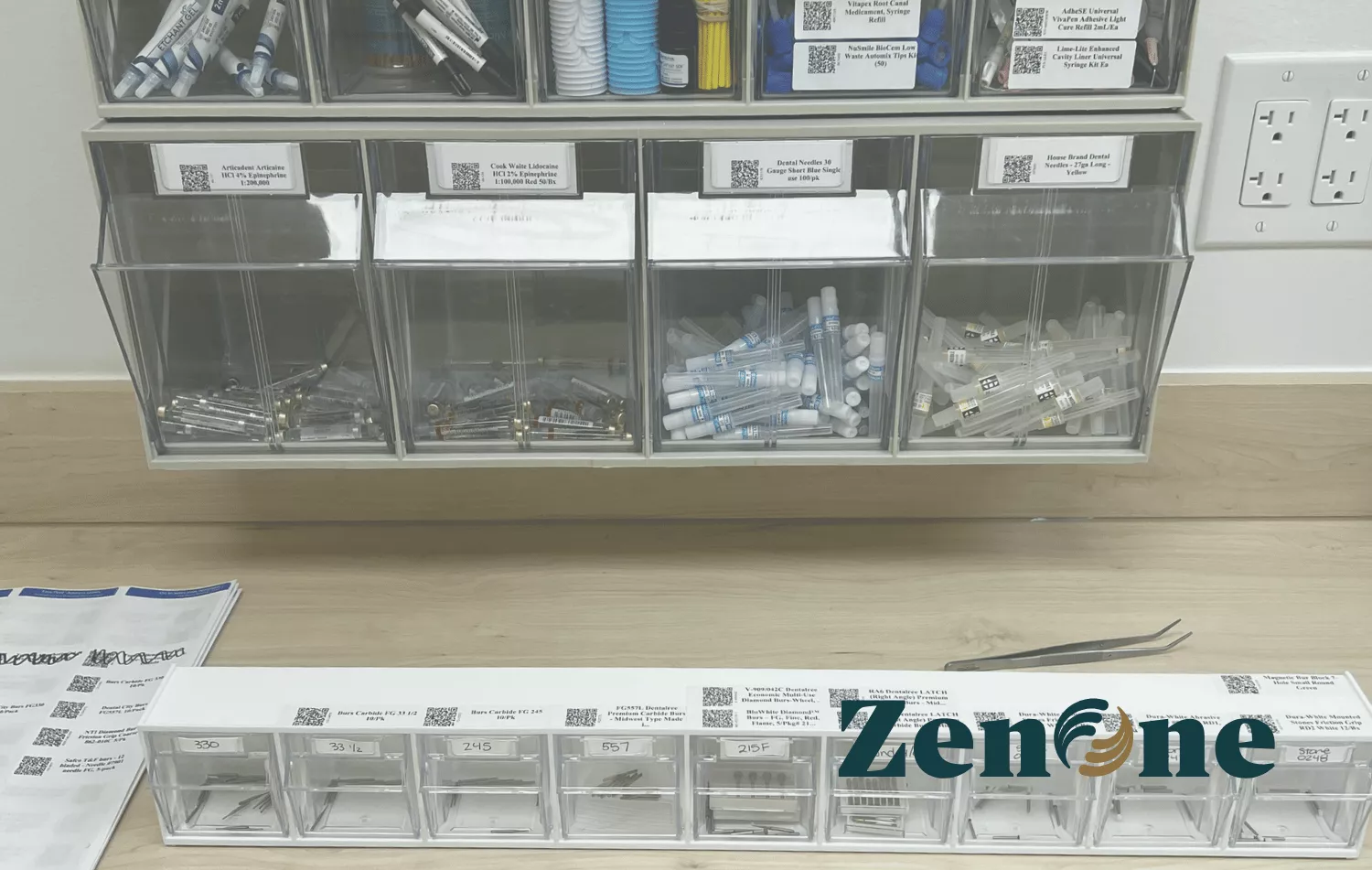
Barcode and QR scanning lets your team check items in and out against live inventory levels. When a product hits its reorder point, the system flags it for the next order cycle before it becomes an urgent shortage. Combined with spend analytics, this gives you a complete picture of what you have, what you need, and what it should cost. See how ZenOne’s ordering and inventory platform works.
| Ready to see your entire supply process in one place? ZenOne connects your vendors, tracks your inventory, and compares prices automatically so your team can focus on patient care. Explore ZenOne’s platform |
What Practices Save When They Fix Their Ordering Process
Time Savings: From Hours to Minutes Per Order Cycle
Miranda Moore managed ordering across 18 vendors before centralizing in ZenOne. Her order cycles went from 2 to 3 hours down to 15 to 20 minutes, an 85 percent reduction. She did not reduce the number of vendors she worked with. She stopped managing each one separately.
Practices that consolidate onto a centralized platform consistently report the same pattern. The ordering task does not disappear, but it stops being a significant time commitment. Discover how dental inventory management supports this kind of efficiency.
Cost Savings: Real Numbers from Private Practices
Dr. Brandon Johnson reduced his monthly supply spend by 20 percent on a $10,000 monthly budget. That is $2,000 per month and $24,000 per year, without switching to lower-quality products or cutting clinical items. The savings came from price comparison and process consistency, not compromise.
According to benchmark data from dental practice management consultants, practices that achieve supply costs of 5 to 7 percent of collections consistently outperform peers on overall profitability. The gap between average and optimized supply management at a $1 million practice is $20,000 to $40,000 annually.
Conclusion
A clean dental supply ordering process is built on four elements: one accountable owner, consolidated vendors in a single platform, price comparison on every order, and monthly spend tracking against a 5 to 7 percent of collections target. Practices that put these in place stop overspending not because they find cheaper products, but because they stop paying for process inefficiency.
Miranda Moore reclaimed two to three hours every order cycle. Dr. Brandon Johnson saved $24,000 in a year. Dr. Jack Fan moved supply management entirely off his plate. None of these results required switching vendors or compromising on clinical quality. They required fixing the process.
ZenOne gives private practice teams the tools to run that process without friction: centralized vendor ordering, automated price comparison, inventory tracking with reorder alerts, and spend analytics that make every dollar visible.
| Ready to see how much time and money your practice can recover? ZenOne helps private practices simplify supply ordering, reduce costs, and build systems that run without constant oversight. Start your free trial |
FAQ
How often should a dental practice place supply orders?
How often should a dental practice place supply orders?
Monthly or bi-weekly ordering works for most private practices, depending on storage capacity and product volume. More frequent small orders reduce storage demands but increase shipping costs. Less frequent large orders improve shipping efficiency but require accurate reorder points to avoid stockouts between cycles.
How do you control dental supply costs effectively?
How do you control dental supply costs effectively?
Set a monthly budget target at 5 to 7 percent of collections, compare prices across vendors before every order, standardize your product formulary to reduce SKU count, and review category-level spend at the start of each month. These four practices, done consistently, bring most practices from above-benchmark to within it within 90 days.
What is the best way to track dental inventory?
What is the best way to track dental inventory?
Barcode or QR scanning tied to a centralized platform gives you the most accurate real-time picture. Products are checked in when received and checked out as they are used, with the system automatically flagging items that have hit their reorder point. This eliminates manual counts and the guesswork that comes with them.
Do I need to switch distributors to save money on dental supplies?
Do I need to switch distributors to save money on dental supplies?
Usually not. Most practices have existing vendor relationships with competitive distributors. The savings come from comparing prices across those existing vendors on every order, rather than ordering from habit. Platforms like ZenOne do that comparison automatically, so you stay with vendors you already trust while capturing the savings that come from real competition.
Join 1200+ dental professionals, shop from your favorite
suppliers, compare prices instantly, and save over $17,000/year
Try our platform free for 14 days.
Get the latest ZenOne updates and product launches in your inbox
Don't miss the latest news!
Receive exclusive offers and news straight to your inbox!
Continue reading
03/26/2026
~ 11 minutes to read

03/12/2026
~ 9 minutes to read
03/06/2026
~ 11 minutes to read
Let's discover how we can help you

Tiger Safarov
Hi, I'm Tiger, the CEO at ZenOne, and I'm happy to personally ensure your success with ZenOne. Send me your latest invoice or a statement for a Free Savings Analysis.
Ask me a question:

