


Miranda Moore
RDA Lead Assistant, Beacon Dentistry
05/11/2026
What Private Dental Practices Can Learn from DSO Procurement Strategies

~ 6 minutes to read
DSO procurement strategies are one of the quiet reasons dental service organizations have grown so quickly. While the industry talks about clinical standardization and HR scale, the supply chain story is just as consequential. American Dental Association Health Policy Institute data shows DSO affiliation has reached roughly 16 percent of dentists nationally, more than double the share a decade ago, and over 25 percent of dentists within their first ten years of graduation now practice inside a DSO. That growth is not accidental.
Part of the reason is procurement. DSOs treat supply buying as a strategic function, not an administrative one, and the result shows up in both unit cost and waste. The encouraging news for independent practice owners is that the core strategies do not require 200 locations to work. At ZenOne, we help independent practices apply the same procurement principles DSOs rely on, using tools and tactics that fit a single office.
| Want DSO-level pricing without joining a DSO? See how independent practices use ZenOne to consolidate suppliers, apply GPO pricing, and centralize purchasing authority in one platform. |
Summary: DSO Procurement Strategies for Independent Practices
DSOs typically pay 15 to 30 percent less for dental supplies than independent practices by centralizing procurement, standardizing product lists, using usage data to negotiate, and concentrating ordering authority. None of these practices require DSO scale. An independent practice can close most of the gap by joining a dental GPO, consolidating suppliers onto one platform, and using real spend data in supplier conversations.
Key Points
- DSOs now affiliate with roughly 16 percent of U.S. dentists. And over 25 percent of dentists in the first decade of practice, per ADA Health Policy Institute data.
- Procurement is part of the DSO playbook. DSOs pay 15 to 30 percent less for supplies than the typical independent practice.
- GPO membership is the single largest lever for independents. Contracted pricing typically reduces clinical supply costs by 15 to 35 percent.
- Supply spend benchmarks are well documented. The ADA and dental CPAs recommend supplies stay near 5 to 6 percent of collections.
- Standardization reduces SKU sprawl. Fewer products across providers means deeper volume per item and cleaner ordering data.
- Centralized authority prevents duplicates. One approver for all supply orders is the easiest structural change a practice can make.
- Data is the negotiation currency. Twelve months of organized spend data unlocks vendor pricing that gut-feel negotiations never reach.
How DSO Procurement Actually Works
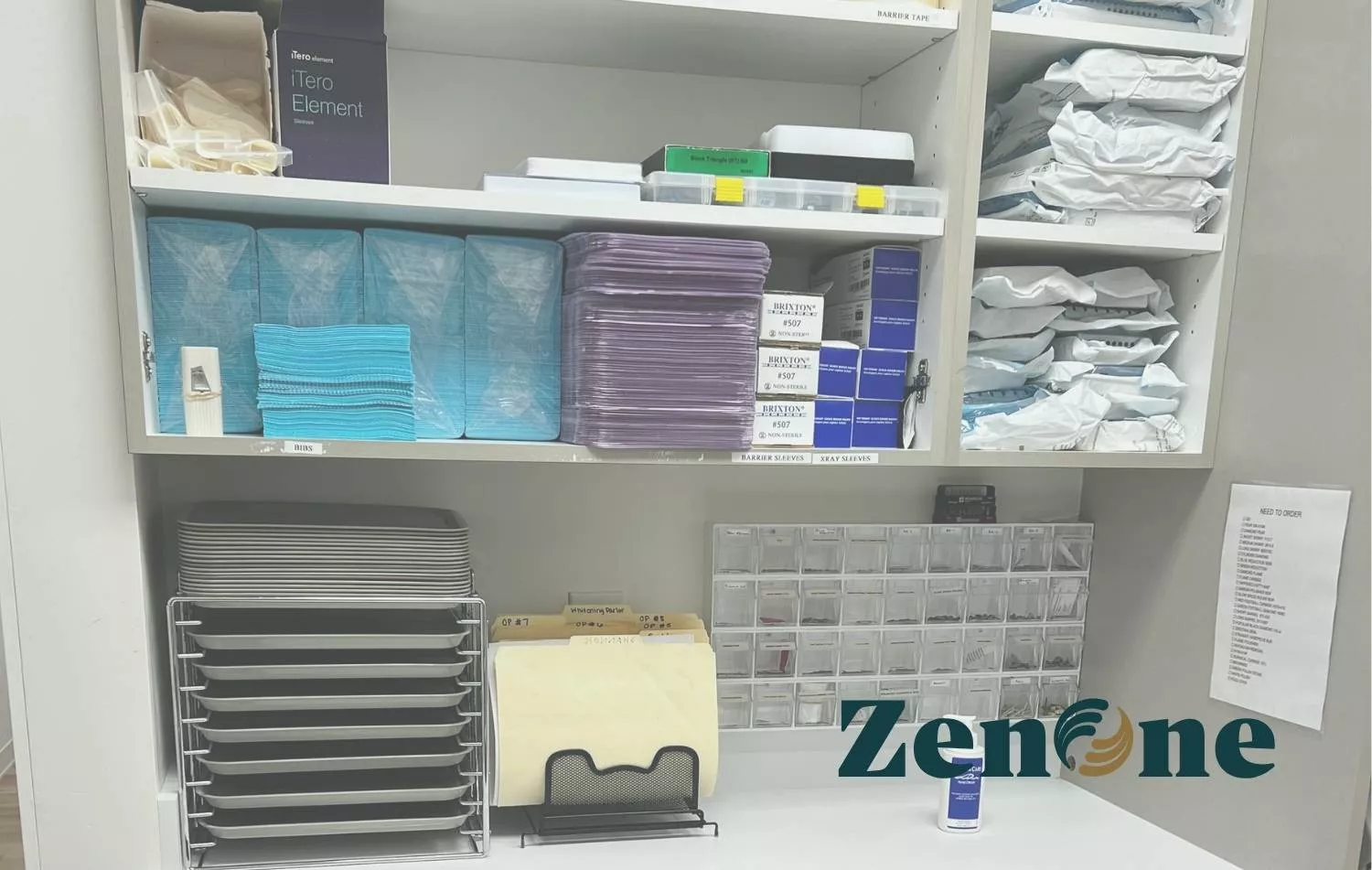
DSO procurement operates more like a mid-market healthcare system than a group of dental offices. According to the Association of Dental Support Organizations, ADSO-member organizations now represent 80 or more DSOs and more than 15,000 affiliated dentists across 44 states. At that scale, a dedicated procurement team becomes economical, and every decision in that function is data-backed.
The Operating Model
- Group pricing contracts negotiated once and applied across every affiliated location.
- A standardized approved product list for each clinical category, enforced through the ordering system.
- Centralized vendor management handled by a procurement team, not individual offices.
- Usage data from every location feeds forecasting, volume commitments, and renegotiations.
- Procurement performance is tracked with metrics, the same way clinical productivity is tracked.
The result, per industry analysis in Dental Economics, is that DSO and GPO-member practices consistently save 15 to 35 percent on clinical supplies and 10 to 25 percent on technology purchases compared with practices buying individually.
What Independent Practices Leave on the Table
Most independent practices are not losing money because they lack negotiation skill. They are losing money because they have no consolidated view of their own spend. When dental CPAs benchmark practice financials, supplies should sit around 5 to 6 percent of collections, as summarized by Porter Kinney. Practices that lack procurement structure routinely spend well above that range without knowing why.
Dental-specific procurement analysis from Method Procurement puts average supply spend at $65,000 to $120,000 per practice per year, and estimates that GPO participation can save $10,000 to $40,000 annually per office. The structural problems creating that gap look the same across most independent practices.
The Common Gaps
- Fragmented ordering across four or five suppliers with no visibility into total spend.
- Provider-level preferences that multiply SKUs and dilute volume per product.
- No usage data to support volume commitments or challenge vendor pricing.
- Reactive reordering driven by shortages, not planned purchasing cycles.
- Approval authority distributed across three or four staff members, creating duplicates.
| Curious where your supply spend actually goes? Benchmark against peer practices in the ZenOne overhead guide and see the categories where most independent offices overspend. |
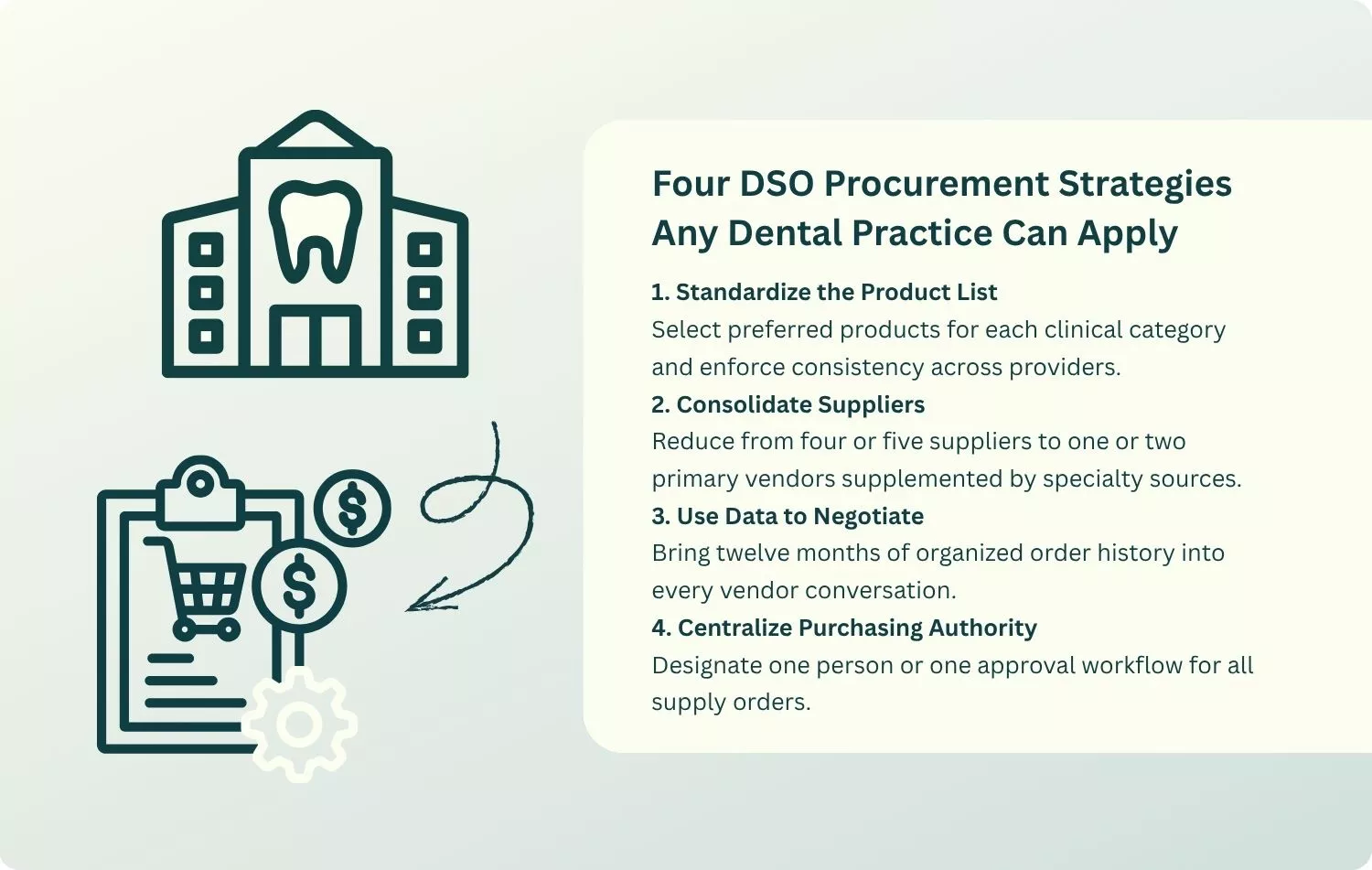
Four DSO Procurement Strategies Any Dental Practice Can Apply
These are the strategies DSOs use, translated for a single-location or small group setting. None of them require scale. All of them compound.
1. Standardize the Product List
Select preferred products for each clinical category and enforce consistency across providers. The goal is not to take away clinical judgment, it is to eliminate redundant SKUs where the clinical difference is minimal. Most practices that run standardization exercises find that 80 percent of product preferences are already shared across providers, and the remaining 20 percent can be addressed with a small list of documented exceptions.
2. Consolidate Suppliers
Reduce from four or five suppliers to one or two primary vendors supplemented by specialty sources. Consolidation does two things: it builds per-vendor volume that becomes negotiation leverage, and it simplifies billing, receiving, and return processes. Using a dental-specific platform like ZenOne, a practice can still order across multiple suppliers behind the scenes while managing them from one ordering interface.
3. Use Data to Negotiate
Bring twelve months of organized order history into every vendor conversation. When a vendor sees concrete volume commitments backed by real purchase data, pricing moves. When a practice asks for a discount without data, the conversation stalls. Practices that start tracking spend in a single system almost always find opportunities in the first ninety days, and those opportunities become leverage for the next renewal.
4. Centralize Purchasing Authority
Designate one person or one approval workflow for all supply orders. Other team members can flag needs or request items, but the ordering itself runs through a single authority. This one change eliminates most duplicate purchases and keeps the practice inside its monthly supply budget without extra oversight.
Group Purchasing Organizations: The Independent Practice Shortcut
GPOs are the closest analog to DSO procurement for an independent practice. A dental GPO aggregates purchasing power across thousands of independent offices, negotiates group contracts with suppliers, and makes those prices available to every member without a volume commitment from the practice itself.
Per Method Procurement’s analysis, a typical dental practice spending $65,000 to $120,000 per year on supplies can expect $10,000 to $40,000 in annual savings from GPO membership, depending on current spend mix and supplier diversity. On top of that, a platform like ZenOne can integrate directly with major dental GPOs to apply contracted pricing automatically at checkout, so the savings show up without the team memorizing contract codes.
What to Look For in a Dental GPO
- Contracted pricing with the suppliers the practice already uses, not just niche vendors.
- No required volume commitment or long-term contract.
- Clear documentation of which products are covered and at what discount levels.
- Integration with a procurement platform that applies pricing automatically.
- Member support for onboarding and ongoing contract questions.
| Ready to centralize ordering? Walk through ZenOne’s complete dental inventory guide for a practical setup path that consolidates suppliers and applies GPO pricing in the same workflow. |
How ZenOne Brings DSO-Level Procurement to Private Practices
Our platform is built around the same procurement principles DSOs use, packaged for practices that do not have a corporate procurement team. The design goal is simple: give independent practices the structure that makes DSO-level pricing and waste control possible without hiring new roles.
- Single ordering platform replacing three to five separate supplier portals.
- Spend analytics that show total supply cost by category, supplier, and time period.
- GPO integration for automatic contract pricing at checkout.
- Low-stock alerts and usage-based reorder suggestions that replace reactive ordering.
- Order approval workflows that centralize purchasing authority without slowing the team down.
Over 1,000 dental professionals use ZenOne today to consolidate procurement and reduce supply costs. The common pattern across those practices is that the structural changes do most of the work. The platform simply makes those changes easy to implement and durable over time.
5 DSO Procurement Tactics Every Independent Dentist Should Know
Short list for the next team huddle. Any one of these moves money immediately.
- Audit supplier count. List every vendor used in the last twelve months. Consolidate anything under 5 percent of spend.
- Pick a preferred composite, bonding agent, and matrix system. Three SKUs become one across every provider, overnight.
- Join a dental GPO. The single highest-leverage move for an independent practice.
- Pull twelve months of invoices before the next renewal. Data turns a negotiation into a contract review.
- Set one approver for all orders. Duplicate purchases stop the same day.
These tactics borrow the mechanics of DSO procurement without borrowing the complexity. Each one can be implemented in a week.
Conclusion: Independent Practices Have the Same Tools, Just Smaller
DSOs win on procurement because they treat purchasing as a strategic function. The tactics they rely on, standardized product lists, supplier consolidation, data-driven negotiation, and centralized authority, are not scale-dependent. A three-operatory practice can implement all four of them in a month and start capturing the same cost and waste advantages DSOs report at the enterprise level.
That is the problem ZenOne solves. We consolidate ordering, apply GPO pricing automatically, and give dental practice owners the spend visibility that makes procurement decisions easier. Over 1,000 dental professionals already use the platform to run procurement with the rigor of a DSO and the simplicity of a single office. The American Dental Association benchmark of 5 to 6 percent of collections for supplies is within reach for practices that put the right structure in place.
| See DSO procurement strategies in action. Consolidate suppliers, apply GPO pricing, and benchmark supply spend with ZenOne. Book a Demo today. Fourteen days, no contract, full access to the platform. |
FAQ
Can a single-location practice realistically achieve DSO-level pricing?
Can a single-location practice realistically achieve DSO-level pricing?
Not fully, but the gap is smaller than most owners assume. GPO membership plus consolidated ordering typically captures the majority of DSO pricing advantages. The remaining gap is volume-based and shows up on a few high-volume categories, not across the whole catalog.
What is the first step toward better procurement for an independent practice?
What is the first step toward better procurement for an independent practice?
A supply spend audit. Pull the last twelve months of invoices, categorize spend by supplier and product type, and identify the top 20 SKUs by dollar volume. Those 20 items usually represent more than half of total supply spend, and they are where the next contract conversations should focus.
Does standardizing products mean dentists lose their preferred brands?
Does standardizing products mean dentists lose their preferred brands?
It means fewer exceptions, not none. Most standardization efforts find that 80 percent of provider preferences already overlap. The remaining 20 percent can be documented and maintained as exceptions. The benefit to the practice comes from reducing SKU sprawl on everyday consumables, not from taking away clinically meaningful choices.
How large is the DSO shift in dentistry right now?
How large is the DSO shift in dentistry right now?
Substantial and accelerating. Per Becker’s Dental, DSO-affiliated buyers accounted for a majority share of dental practice acquisitions in 2024, with consolidation pace continuing to climb. ADA Health Policy Institute data puts current DSO affiliation near 16 percent of U.S. dentists overall, with much higher rates among early-career clinicians.
Join 1400+ dental professionals, shop from your favorite
suppliers, compare prices instantly, and save over $17,000/year
Try our platform free for 14 days.
Get the latest ZenOne updates and product launches in your inbox
Don't miss the latest news!
Receive exclusive offers and news straight to your inbox!
Continue reading
10/02/2026
~ 7 minutes to read
09/23/2026
~ 7 minutes to read
09/11/2026
~ 7 minutes to read
Let's discover how we can help you

Tiger Safarov
Hi, I'm Tiger, the CEO at ZenOne, and I'm happy to personally ensure your success with ZenOne. Send me your latest invoice or a statement for a Free Savings Analysis.
Ask me a question:

