


Miranda Moore
RDA Lead Assistant, Beacon Dentistry
05/04/2026
Inventory Management for Dental Assistants: A Practical Guide

~ 7 minutes to read
Effective inventory management for dental assistants is one of the quietest drivers of a profitable dental practice. When supplies are in the right place at the right time, procedures run on schedule, the dentist stays focused on chair time, and the front office is not chasing backorders. When inventory slips, the cost shows up in rescheduled patients, expired composite, and duplicate orders that nobody catches until the invoice arrives.
According to the U.S. Bureau of Labor Statistics, dental assistants handle recordkeeping, equipment preparation, sterilization, and scheduling on top of chairside support. Supply management sits in the middle of all of that, and it rarely gets a formal system. At ZenOne, we work with dental assistants and office managers every day to replace reactive ordering with a clear, low-effort process that fits the way a practice actually runs.
| Tired of reactive ordering? See how dental teams consolidate every supplier into one workflow with ZenOne. Setup takes days, not months. |
Summary: Inventory Management for Dental Assistants
Most dental practices lose money on supplies because there is no formal system. Dental assistants are best positioned to own inventory, but they need structure: a centralized list of every SKU, reorder thresholds tied to real usage, expiration tracking, and a single ordering platform that replaces three or four supplier portals. Done right, this protects procedure flow, keeps supply spend in the 5 to 6 percent of collections range recommended by the American Dental Association, and gives the assistant back hours each week for patient care.
Key Points
- Supplies should stay in a predictable range. The ADA recommends dental supplies stay within roughly 5 to 6 percent of collections, with office supplies around 2 percent.
- Dental assistants are the natural owners of inventory. They are closest to the operatory, the consumables, and the daily usage data.
- Centralization beats individual knowledge. One source of truth, visible to every team member, eliminates the duplicate orders that come from siloed tracking.
- Reorder thresholds are the core mechanic. Every SKU should have a minimum trigger tied to actual usage, not a guess.
- Expired materials are a quiet profit killer. Waste on a single-location practice can run $15,000 to $25,000 per year when inventory is not rotated.
- Manual data entry is error-prone. Hand-keyed counts and reorders carry a 1 to 4 percent error rate, and in dental supply that translates into real dollars.
- Suppliers should shrink, not grow. Practices running four or five vendor portals benefit from consolidation into one ordering interface.
- Software should match the practice workflow. A good platform integrates reorder thresholds, approvals, and usage data without adding a new layer of work.
Why Dental Inventory Management Is Harder Than It Looks
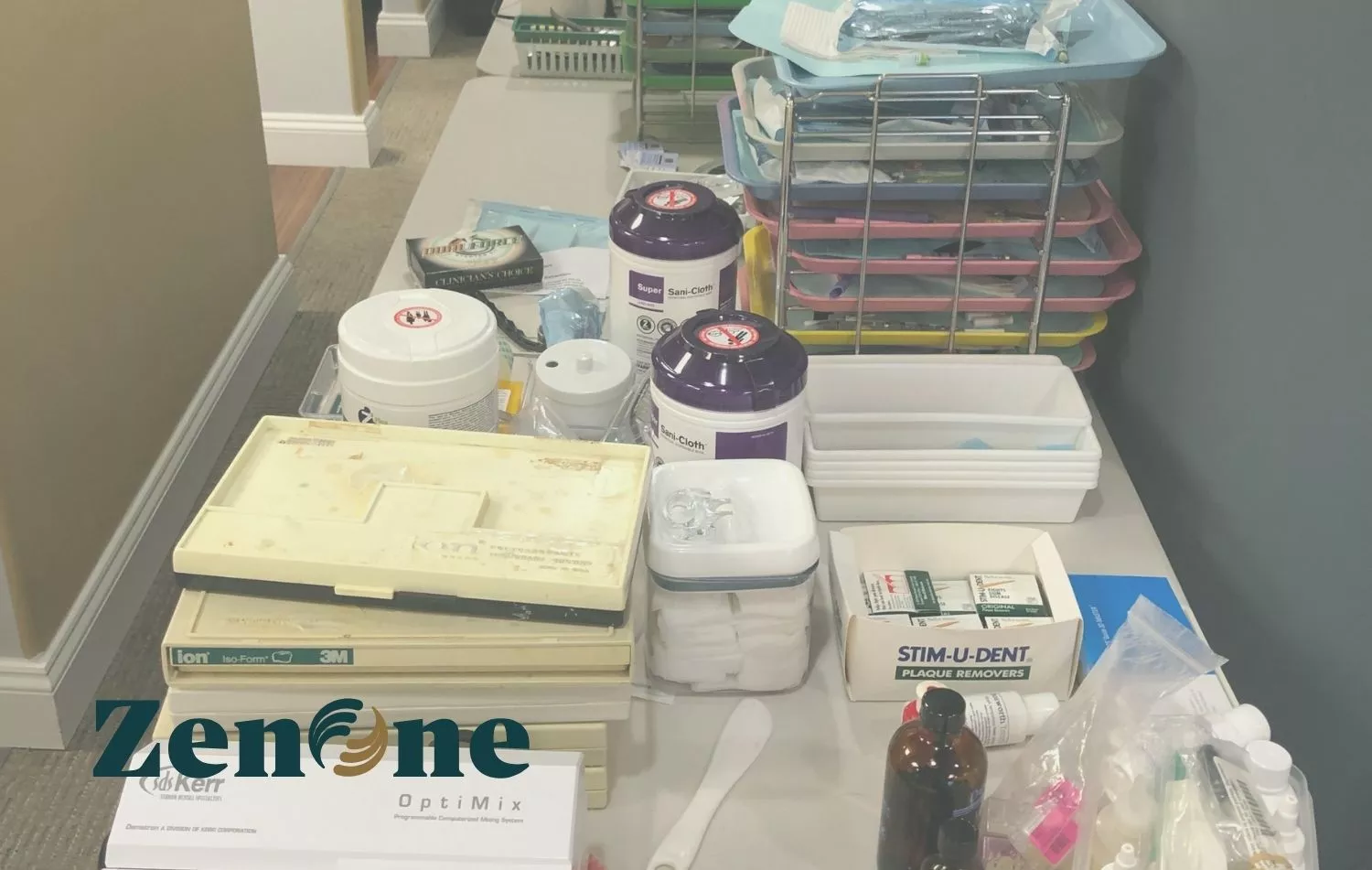
Dental supply is not a small list. A typical general practice manages hundreds of SKUs across composites, bonding agents, impression materials, anesthetics, burs, endodontic files, gloves, masks, sterilization pouches, and consumables that most patients never see. Each category has its own storage location, its own expiration timeline, and its own reorder cadence.
The California Dental Association recommends splitting inventory responsibility across at least three team members, with one owning clinical supplies, one owning equipment, and one owning office supplies. That structure only works if there is a shared system underneath it. Without one, the three leads order against their own notes, and the practice ends up with duplicate composite on one shelf and no anesthetic in the drawer.
The Structural Problems
- Most practices track supplies mentally or on a single shared spreadsheet that only one person maintains.
- Product proliferation across composites, burs, anesthetics, and disposables makes memory-based tracking unreliable.
- Vendor fragmentation, with three to five suppliers billing through different portals, hides total spend.
- Expiration dates are rarely flagged proactively, so waste is only noticed at year-end cleanup.
- Reorder processes are triggered by shortages rather than preset thresholds, which means a delay is already in motion by the time someone places the order.
The Real Cost of Poor Dental Inventory Management
Supply problems do not stay in the supply closet. They spread into the schedule and the P&L. Dental Economics reports that practices switching to automated inventory and procurement systems have reduced monthly supply spending by $8,000 to $10,000 in the first four months, largely by cutting duplicates and enforcing standardized ordering.
Waste is the other half of the picture. Analysis from Method Procurement puts conservative all-in waste for a single-location dental practice at $15,000 to $25,000 per year, and notes that eliminating even $10,000 of that waste is the production equivalent of generating an additional $30,000 in revenue. That math is why inventory management belongs on the leadership agenda, not just in the back office.
How the Costs Compound
- Supply shortages cause procedure delays and same-day rescheduling, which hits chair-time revenue.
- Overstock ties up cash in materials that expire before a case finds them.
- Duplicate orders from multiple team members quietly inflate monthly invoices.
- Hours spent counting and reconciling pull clinical staff away from patient care.
- Last-minute overnight shipping charges cost far more than the discount that was missed.
See where your practice is losing money
Benchmark your supply spend against peers in the ZenOne overhead guide. Built for dental teams who want a clear view of where dollars are going.
Core Principles of a Working Dental Inventory System
A working system does not need to be complicated. It needs three things: a single source of truth, reorder thresholds that reflect real usage, and a closed loop between ordering and consumption. Every practice that controls its inventory runs on some version of this.
Centralized Tracking
One list, visible to every team member who touches supplies, tied to one ordering platform. That is the entire principle. When three people order from three spreadsheets, duplicates are inevitable. When everyone is looking at the same stock picture, the duplicates disappear.
Reorder Thresholds and Triggers
For every SKU, set a minimum quantity that triggers a reorder. The threshold should cover lead time and weekly usage with a small buffer. For a practice ordering weekly, a two to four week buffer is typical. The mistake most practices make is setting reorder thresholds once and never revisiting them. Usage changes when providers change, when patient volume changes, and when procedure mix changes. Thresholds should get reviewed every quarter.
Usage-Based Ordering
Order based on what the practice actually uses, not what it remembers ordering. The best way to see usage is to track consumption by procedure type. A practice that does twelve composites on an average day burns through a predictable amount of bonding agent and matrix bands. When the data is in one place, forecasting is straightforward. When it is not, the practice is guessing.
Step-by-Step: Setting Up Inventory Management for Dental Assistants
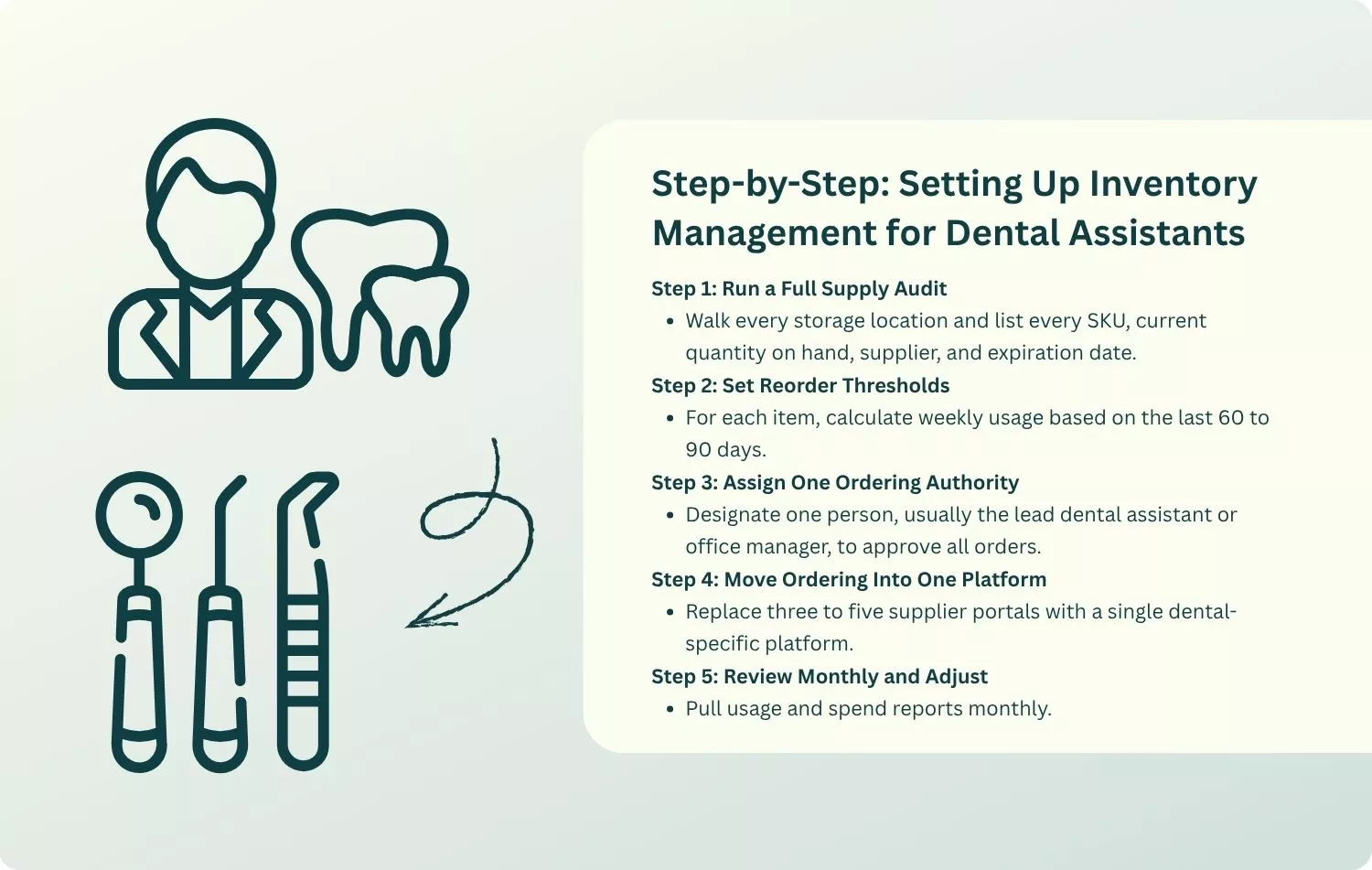
A full setup does not take weeks. It takes a weekend of focused work followed by a few disciplined weeks of running the new process. This is the sequence ZenOne recommends to practices starting from scratch.
Step 1: Run a Full Supply Audit
- Walk every storage location and list every SKU, current quantity on hand, supplier, and expiration date.
- Flag any items with expiration dates in the next 90 days so they can be used first.
- Consolidate the list into one file or one platform before going further.
Step 2: Set Reorder Thresholds
- For each item, calculate weekly usage based on the last 60 to 90 days.
- Set the reorder trigger at two to four weeks of usage depending on supplier lead time.
- Flag items with inconsistent usage for manual review each week.
Step 3: Assign One Ordering Authority
- Designate one person, usually the lead dental assistant or office manager, to approve all orders.
- Others can flag needed items, but only one person places the order.
- This single change eliminates most duplicate purchasing.
Step 4: Move Ordering Into One Platform
- Replace three to five supplier portals with a single dental-specific platform.
- Every order, from every supplier, should land in one searchable history.
- This is the point where supplier price comparisons become easy instead of impossible.
Step 5: Review Monthly and Adjust
- Pull usage and spend reports monthly.
- Adjust reorder thresholds for any SKU whose consumption pattern has shifted.
- Identify the top five items driving waste and act on them.
| Want the full inventory playbook? Read ZenOne’s complete guide to dental inventory management for step-by-step workflows, reorder templates, and supplier consolidation tactics. |
Common Inventory Mistakes Dental Assistants Can Avoid
Even experienced dental assistants fall into patterns that cost their practice money. These are the ones that show up most often in ZenOne onboarding conversations.
- Panic-ordering at the last minute. When a critical item is already out, decisions are driven by availability, not price. Overnight shipping and emergency orders add up fast.
- Bulk buying without expiration tracking. Quarterly bulk orders save money only when the practice can realistically consume the stock. Otherwise, the savings evaporate in the disposal bin.
- Splitting orders across suppliers without comparison. Buying gloves from one vendor and composite from another makes sense only if the prices are compared. Without a platform, they rarely are.
- Excluding the dentist and office manager from budget visibility. Ordering without shared visibility creates friction when invoices arrive. Transparent approvals prevent that.
- Treating expired materials as routine waste. As ZenOne has written about extensively, expired dental materials are a fixable problem, not a fact of practice life.
6 Inventory Habits Every Dental Assistant Should Build
The practices that stay ahead of supply problems share a short list of habits. None of them are complicated. All of them compound.
- Do a weekly ten-minute walk-through. Not a full count, just a visual check against reorder thresholds.
- Log usage daily, not weekly. Small consistent entries beat a weekly catch-up every time.
- Group orders by supplier. Hitting volume thresholds matters more than saving a day on delivery.
- Rotate stock as it arrives. First in, first out, always. It takes 30 seconds and saves real money.
- Keep expiration dates visible. Label boxes on the shelf with the earliest expiring date inside.
- Review reorder thresholds quarterly. Usage shifts. Thresholds should shift with it.
Share this list in a team huddle. The habits are simple, but the cumulative effect on spend and workflow is significant.
Conclusion: Inventory Management Is a Skill, Not an Afterthought
Dental assistants are positioned to own supply management more effectively than any other role in the practice. They are closest to the chair, they know what gets used, and they feel the consequences of shortages first. What they need is structure: a centralized list, reorder thresholds grounded in real usage, a single ordering platform, and visibility the dentist and office manager share.
That is what ZenOne is built for. Our platform gives dental teams one ordering interface across every supplier, automated low-stock alerts, usage-based reorder suggestions, expiration tracking, and spend analytics in one dashboard. We support over 1,000 dental professionals who have replaced manual tracking with an automated process, and the common thread is simple: the dental assistant goes from reactive supply manager to strategic owner of the function. The American Dental Assistants Association has long framed inventory as part of the dental assistant’s business-operations scope. A working system is what makes that ownership real.
| Ready to take control of dental supply management? Consolidate your suppliers, automate reordering, and eliminate expired waste. Book a Demo of ZenOne today. Fourteen days, no contract, full access to the platform. |
FAQ
How long does it take to set up a proper inventory system?
How long does it take to set up a proper inventory system?
An initial supply audit takes one to two days. Full setup on a platform like ZenOne typically runs about a week, including importing your current supplier list, setting reorder thresholds, and training the team on approvals.
Which supplies need the tightest controls?
Which supplies need the tightest controls?
Anesthetics, composites, bonding agents, and gloves. These are high-use, have short expiration windows, or carry compliance risk if they run out. Reorder thresholds on these items should be reviewed monthly rather than quarterly.
Can one dental assistant manage inventory for a multi-operatory practice?
Can one dental assistant manage inventory for a multi-operatory practice?
Yes, with the right system. A centralized platform with automated alerts and usage reporting scales comfortably across four to six operatories. The assistant stops doing manual counts and starts reviewing exceptions.
What is a reasonable supply spend for a dental practice?
What is a reasonable supply spend for a dental practice?
The American Dental Association recommends dental supplies stay within 5 to 6 percent of collections. Practices spending significantly above that range usually have one of three problems: no reorder thresholds, too many suppliers, or expired waste going uncounted.
Join 1400+ dental professionals, shop from your favorite
suppliers, compare prices instantly, and save over $17,000/year
Try our platform free for 14 days.
Get the latest ZenOne updates and product launches in your inbox
Don't miss the latest news!
Receive exclusive offers and news straight to your inbox!
Continue reading
10/02/2026
~ 7 minutes to read
09/23/2026
~ 7 minutes to read

09/11/2026
~ 7 minutes to read
Let's discover how we can help you

Tiger Safarov
Hi, I'm Tiger, the CEO at ZenOne, and I'm happy to personally ensure your success with ZenOne. Send me your latest invoice or a statement for a Free Savings Analysis.
Ask me a question:

