


Miranda Moore
RDA Lead Assistant, Beacon Dentistry
01/16/2024
9 Dental Organization Ideas for a More Efficient Office

~ 5 minutes to read
Is Dental Office Organization a Rule or a Myth?
Dental office organization should be treated as a shared system, not a personality trait. Some people are naturally more organized than others, but every dental team can create routines that make appointments, instruments, supplies, and administrative work easier to manage.
Organization doesn’t happen by accident. It requires clear responsibilities, standard storage locations, written processes, and time set aside for preparation. When those systems are missing, even a highly organized dental assistant may struggle to keep the office running smoothly.
The goal isn’t to make every employee organize work in exactly the same personal way. The goal is to create a system everyone can understand and follow.
Why Organization Matters in a Dental Office
A dental practice has many moving parts. The front office manages scheduling and patient communication while the clinical team prepares treatment rooms, sterilizes instruments, monitors supplies, and supports patient care.
A reliable dental office organization system can help the team:
- Prepare treatment rooms before patients arrive.
- Find instruments and supplies without unnecessary searching.
- Reduce appointment delays caused by missing materials.
- Identify products that need to be reordered.
- Prevent duplicate purchases and excess inventory.
- Use products before they expire.
- Hand tasks from one employee to another more consistently.
- Reduce stress during schedule changes and busy days.
Organization won’t prevent every problem. Patients cancel, emergency appointments get added, employees call out, and treatment plans change. A good system helps the team adjust without losing track of important tasks.
What Experienced Dental Assistants Say
We asked dental assistants whether being organized is a rule, a skill, or simply a personal preference. Their responses show why dental office organization needs both individual responsibility and shared processes.
The following responses have been lightly edited for grammar and readability without changing their meaning.
Organization Helps Prevent a Domino Effect
“Being organized is, without a doubt, the rule. Being a dental assistant for six years means you see a lot of what does and doesn’t work in an office. Organization is key. If you aren’t organized, everything else can start to fall apart and create a domino effect.
Preparation for the next day should be completed ahead of time. That can make the morning easier instead of forcing the team to run around before the day begins.”
This response highlights an important point: preparation should happen before the team is under pressure. Waiting until the first patient arrives leaves little time to solve missing-supply or room-setup problems.
Shared Organization Supports Productivity
“Being organized should be a general requirement for dental assistants. Without organization, the office can become chaotic and productivity can fall.
If a dental assistant is running around trying to find misplaced supplies, procedures may fall behind. Misplaced products can also contribute to overspending when the practice orders supplies it already has.”
— Samantha, dental assistant with seven years of experience
Supplies shouldn’t depend on one employee remembering where everything is stored. Each product should have an assigned location that other team members can find without asking for help.
The System Must Work for More Than One Person
“I think organization can depend on the individual and how that person functions. For me, being organized was a rule because it caused less stress and anxiety during my day.
I also wanted another person to be able to find items if they had to step in for me. However, someone might still ask where something was because the way I organized it didn’t always make sense to another person.
Pre-setting trays and organizing inventory can also be affected by schedule changes. A patient may cancel or be added to the schedule. The dental assistant still needs to be flexible when the plan changes.”
— Jillian, dental professional
Jillian’s experience shows the difference between personal organization and office-wide organization. A system isn’t truly reliable if only one person understands it.
How to Build a Dental Office Organization System
Start by documenting the tasks that must happen every day, every week, and every month. Then assign responsibility and decide how the team will confirm that each task is complete.
1. Give Every Item an Assigned Location
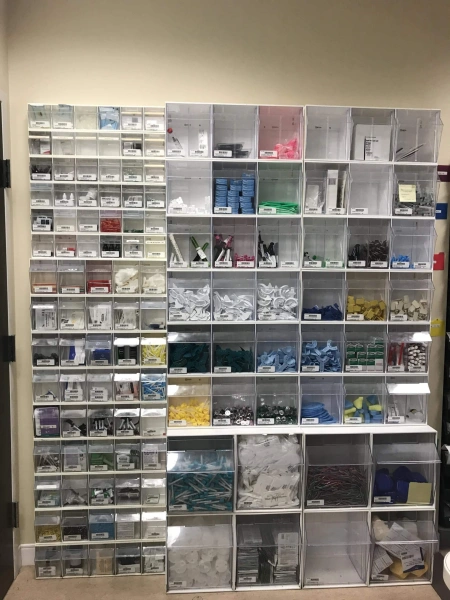
Instruments, supplies, forms, equipment, and cleaning products should have clearly labeled locations. Avoid storing the same item in several unmarked places unless each location is part of a documented stocking plan.
Use labels that identify the product, size, storage location, and minimum quantity when appropriate. Employees should be able to return an item without depending on memory.
2. Standardize Treatment-Room Setup
Create a basic room-opening checklist for each type of treatment area. The checklist may include disinfecting surfaces, checking equipment, preparing commonly used materials, and confirming that required instruments are available.
For procedures that require specific supplies, use standard tray or setup lists. Keep the lists where assistants can review them while preparing the room.
3. Prepare for the Next Day
Review the following day’s schedule before the current workday ends. Identify procedures that need special instruments, materials, lab cases, consent forms, or additional preparation.
Preparation should include a backup plan. A pre-set tray may need to change if a patient cancels or an emergency visit is added.
4. Use Opening and Closing Checklists
An opening checklist helps the team prepare before the first patient arrives. A closing checklist helps employees reset treatment rooms, finish sterilization tasks, secure records, identify low supplies, and prepare for the next day.
Keep each checklist short enough to use consistently. A checklist that’s too long or vague may be ignored.
5. Create a Supply-Reordering Process
Assign a minimum quantity or reorder point to frequently used products. Decide who reviews inventory, who approves purchases, and when orders should be placed.
Don’t rely only on employees noticing an empty box. Record products when they reach their reorder points so the purchasing process can begin before the practice runs out.
6. Standardize Digital and Paper Files
Use consistent names and locations for forms, office documents, schedules, and other administrative files. Employees should know which version is current and where completed work belongs.
Limit duplicate files and outdated forms. Follow the practice’s privacy, record-retention, and access-control requirements when managing patient or employee information.
7. Assign Ownership Without Creating Dependency
Each recurring task should have an owner, but another trained employee should be able to complete it when needed. Document the process so it doesn’t disappear when someone is absent or leaves the practice.
Daily, Weekly, and Monthly Organization Checklist
| Frequency | Tasks to Review | Main Goal |
|---|---|---|
| Daily | Review the schedule, prepare rooms, confirm special materials, return supplies, and note low-stock products. | Keep patient care moving without avoidable delays. |
| Weekly | Review inventory, check expiration dates, place approved orders, correct misplaced items, and update incomplete tasks. | Prevent stockouts, waste, and repeated problems. |
| Monthly | Review spending, emergency orders, expired products, storage problems, and employee feedback. | Improve the system based on actual results. |
Connect Office Organization With Inventory Control
Physical storage and inventory records need to match. If a product appears in the inventory system, employees should be able to find it in its assigned treatment-room or reserve location.
Use these basic controls:
- Choose one primary location for each product.
- Set minimum and maximum quantities.
- Store reserve inventory in a central location.
- Rotate products so items with earlier expiration dates are used first.
- Record products when they’re received, moved, or used.
- Review differences between recorded and physical quantities.
For a complete process, follow this guide to managing dental inventory. You can also review practical ways to prevent expired dental materials.
How to Know Whether the System Is Working
Organization should produce measurable improvements. Track a few simple problems before and after introducing a new system:
- How often procedures are delayed by missing supplies.
- How much time employees spend searching for products.
- How many emergency supply orders are placed.
- How much expired or unused inventory is discarded.
- How often products are ordered when they’re already in stock.
- How often tasks are missed during employee handoffs.
Review the results after 30 days. Keep the parts that work, simplify the steps employees aren’t following, and clarify any task that doesn’t have an owner.
Turn Organization Into a Repeatable Office System
Dental office organization isn’t a myth, and it doesn’t have to depend on one naturally organized employee. It’s a skill supported by shared routines, clear storage locations, written responsibilities, and regular review.
Start with one area that creates frequent delays or frustration. Document the current process, assign responsibility, and test a clearer system for 30 days. Once the team can follow it consistently, apply the same approach to another part of the practice.
If inventory and supply ordering are creating the biggest problems, see how ZenOne works. The platform helps dental practices connect inventory records, product organization, supplier comparison, and ordering through one system.
Join 1400+ dental professionals, shop from your favorite
suppliers, compare prices instantly, and save over $17,000/year
Try our platform free for 14 days.
Get the latest ZenOne updates and product launches in your inbox
Don't miss the latest news!
Receive exclusive offers and news straight to your inbox!
Continue reading
10/02/2026
~ 7 minutes to read
09/23/2026
~ 7 minutes to read

09/11/2026
~ 7 minutes to read
Let's discover how we can help you

Tiger Safarov
Hi, I'm Tiger, the CEO at ZenOne, and I'm happy to personally ensure your success with ZenOne. Send me your latest invoice or a statement for a Free Savings Analysis.
Ask me a question:

