


Miranda Moore
RDA Lead Assistant, Beacon Dentistry
09/23/2026
How to Order Dental Supplies for Dental Offices: A Complete Guide

~ 7 minutes to read
Most dental offices know exactly how to place an order. What they’re missing is a system that decides when to place it and how much to buy. That gap is why a practice runs out of bonding agent mid-procedure, then pays a premium to fix a problem it could’ve prevented.
That premium is measurable. Expedited freight typically runs two to three times the cost of standard shipping, according to Legacy Supply Chain, and a small emergency order also misses the free-shipping minimum. Hence, the penalty stacks exactly when you can least afford it. Rush ordering isn’t a discipline failure. It’s the symptom of a missing threshold.
The wider squeeze makes the waste harder to absorb. Since January 2021, prices for dental equipment and supplies have risen 23 percent while reimbursement averaged across all payer types has risen 19 percent, according to the ADA Health Policy Institute. When costs outrun pay for five years running, the margin for sloppy ordering disappears.
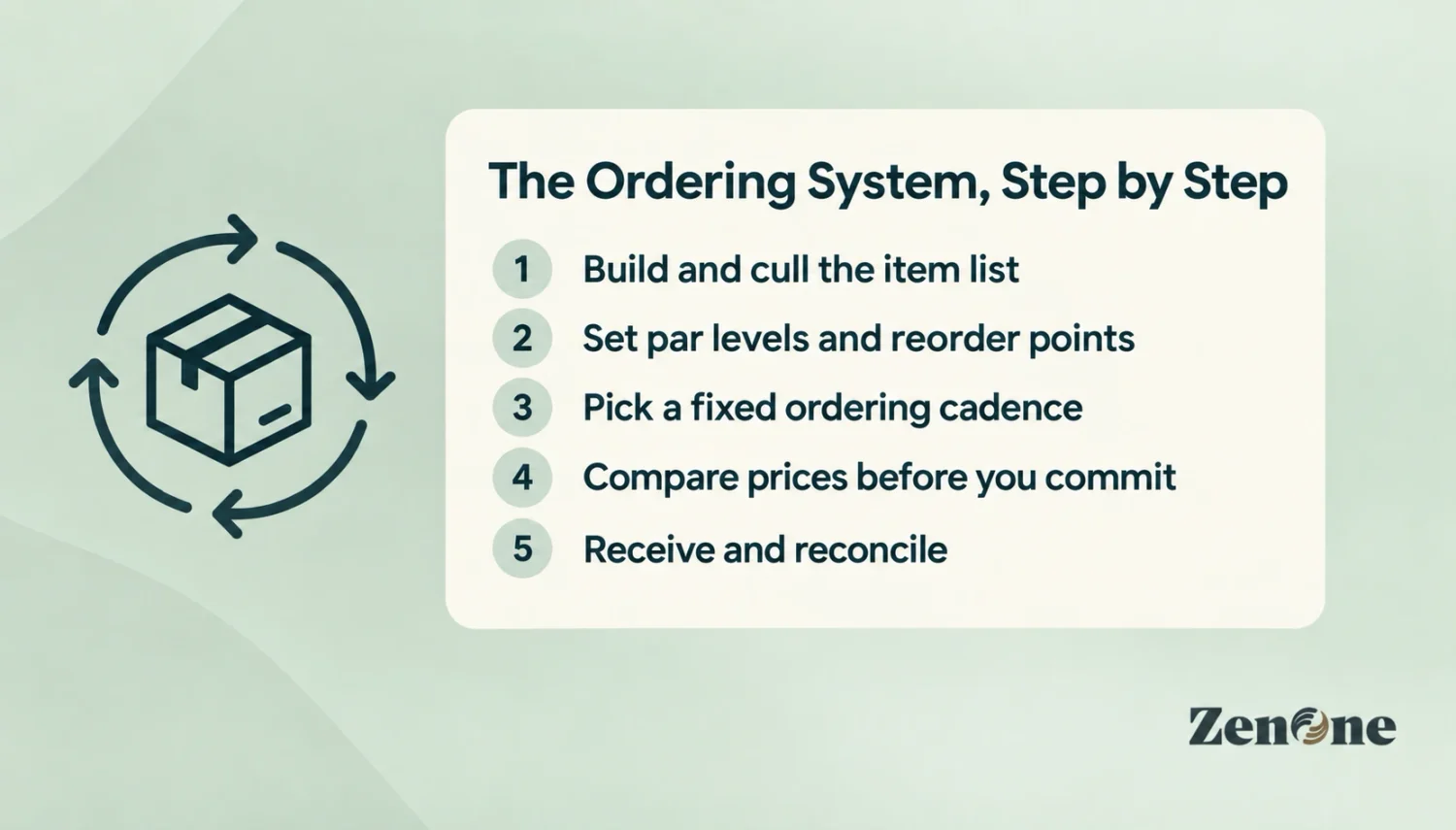
So treat ordering as a system, not a task you do well or badly on a given day. This guide builds that system end to end: the item list, par levels and reorder points, a fixed cadence, one comparison step before you buy, and a receiving check that keeps the whole thing honest. ZenOne automates the parts of it a two-person team shouldn’t have to hold in their heads.
Also Read
- How to Compare Prices on Dental Supplies (Without Spending Hours Doing It)
- Dental Clinic Inventory Management Best Practices
- Switching From Dental Spreadsheets to Software: A Practical Guide for Private Practices
Summary
A reliable ordering system runs on five layers. You build an item list and cut it down to what you actually use. You set par levels and calculate reorder points from real usage. You pick a fixed ordering cadence. You compare prices before you commit the order. Then you receive and reconcile what arrives, so the counts stay true. Skip any layer, and you get one of two failure modes: stockouts and rush orders on one side, overstock and expiration waste on the other. Both trace back to the same root: not knowing what you have and what you use. Fix that, and ordering stops being a scramble.
Key Points
- “How to order” is the wrong question. When and how much prevent stockouts.
- Rush orders aren’t a discipline problem. They’re the absence of a calculated reorder threshold.
- Par levels and reorder points come from math. Average daily use times lead time, plus a buffer.
- A fixed cadence beats ordering by memory. One owner, one calendar slot, every time.
- Compare before you commit. The same item’s price moves by vendor and by week.
- Receiving is the step everyone skips. Skip it and your counts, and every threshold built on them, drift.
Stop ordering from memory. ZenOne fires reorder alerts on set thresholds and prices each order across the distributors you already use. Start your free trial with ZenOne.
Why “How to Order” Is the Wrong Question
You searched for how to order, but the mechanics of placing an order aren’t what’s hurting you. The damage lives in the timing and the quantity.
Order too late and you run out, then pay two to three times the freight to rush a replacement that also blows past the free-shipping minimum. Order too much and you tie up cash on the shelf and risk writing off product before you use it. Holding inventory isn’t free: carrying costs run 20 to 30 percent of inventory value per year, according to NetSuite, so $40,000 sitting in the supply closet costs you $8,000 to $12,000 a year in cash you can’t deploy.
A system solves both at once, because both come from the same missing information. The rest of this guide builds that system one layer at a time.
Step 1: Build the Item List
Start by writing down what you actually order, then cut the duplicates. One prophy paste, not five. One glove brand per size, not three because two assistants each had a preference. Post the list, and require a quick approval step before anyone adds to it.
Consolidation belongs on commodity items, disposables, and non-clinical stock where a substitute changes nothing clinically. It does not belong on bonding agents, composites, or anything a doctor has a clinical reason to prefer. Force standardization there and you’ll start a quiet compliance war, complete with a private stash in operatory two. Everything downstream depends on this list, so it’s worth getting clean before you build on it.
Step 2: Set Par Levels and Reorder Points
A par level is the quantity you want on hand. A reorder point is the count that triggers a new order. The reorder point is where practices either build a system or keep guessing.
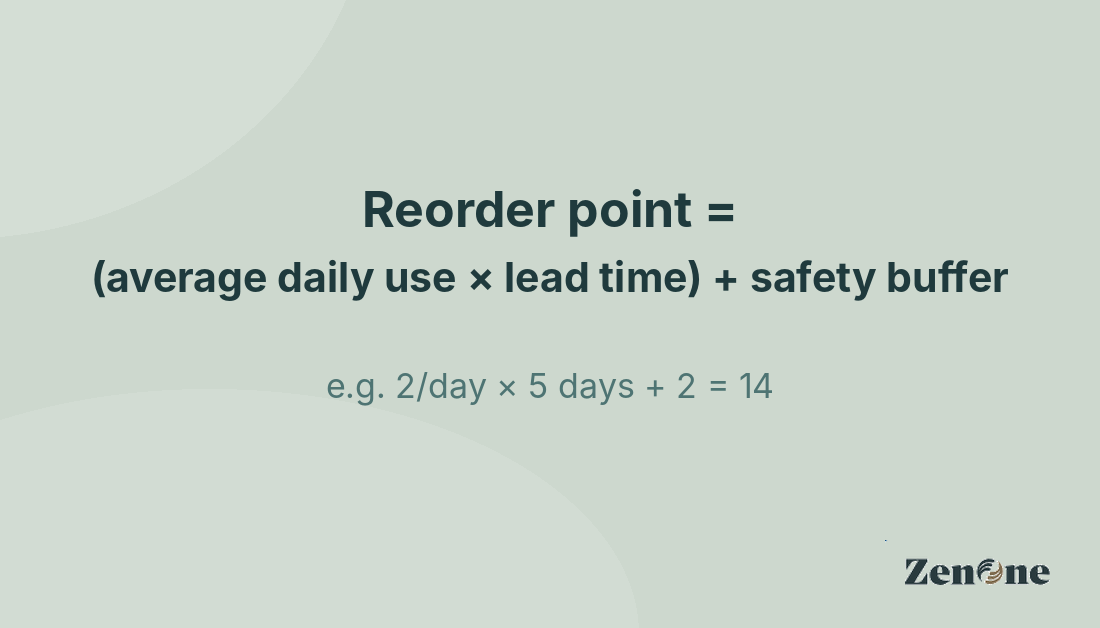
Calculate it instead of remembering it. Reorder point equals average daily use times supplier lead time in days, plus a safety buffer. Two anesthetic cartridges a day, a five-day lead time, and a two-day buffer put your reorder point at 14. When the count hits 14, you order back up to par. The calculation removes the judgment call that fails on a busy Monday, which is why it works.
Step 3: Pick an Ordering Cadence
Ordering by memory means ordering when someone notices, which is always too early or too late. Replace it with a schedule tied to how fast your stock turns.
Aim for four to six inventory turns a year, which works out to roughly 60 to 90 days on hand, according to Pearl. A practice that orders monthly sits at the tighter end of that range, with threshold-triggered top-ups between scheduled orders for anything that moves faster than expected. Give the standing order one named owner and one recurring calendar slot, so it survives that person taking a week off.
Step 4: Compare Prices Before You Commit
This is the step most ordering routines skip, and it’s the one that attacks cost directly. The same item’s price moves by vendor and by week, so pricing the order before you place it is where the savings actually live.
Compare total cost, not unit price. Daniel Gordon, writing in Dental Economics, points out that the real cost of a purchase includes shipping, the staff hours spent shopping and tracking it, and the risk of a poor-quality substitute for that great price. Keep the comparison to your highest-spend items so it stays a few minutes, not an afternoon.
Step 5: Receive and Reconcile
The order isn’t done when the boxes arrive. Check the packing slip and invoice against the quote, because contracted prices drift and nobody notices an unsolicited increase. Date and label everything on receipt, and shelve new stock behind old so FIFO rotation actually happens instead of just getting talked about.
Then update your counts. Every threshold you set in Step 2 depends on the on-hand number staying accurate, and receiving is where that number either stays true or quietly goes wrong.
The Math That Prevents Stockouts
Here’s the whole system in one worked example. Say you use two boxes of a given glove a week, your supplier’s lead time is five business days, and you want a small buffer. Your reorder point lands around one and a half boxes, so when the closet drops to two, you place the order, and it arrives before you run dry. No scramble, no rush freight.
Now weigh the two failure modes side by side. Rush freight costs two to three times standard shipping. Carrying cost runs 20 to 30 percent of inventory value a year. The system exists to avoid both, not to trade one for the other. An inaccurate count produces both at once: rush orders on one side, expired overstock on the other. You can’t order your way out of a counting problem, which is why receiving matters as much as ordering.
What Backfires
The most common ways ordering breaks down are usually:
- Ordering by memory or by vibes, which is the root cause of nearly every mid-procedure stockout.
- Panic bulk-buys, where a scare about running out leads to six months of a slow mover that ties up cash and often expires before you finish it.
- One person as the single point of failure, so the day the assistant who “just knows” is out, the system is out with them.
- Chasing a discount that misses the free-shipping minimum, which reads as a saving on the line item and a loss at checkout.
- Skipping the receiving check, which lets price creep and short shipments slide through untracked until the reconciliation is impossible.
How ZenOne Fits Your Ordering
ZenOne runs the parts of this system that shouldn’t depend on anyone’s memory.
- Live counts from barcode and QR check-in and check-out make par levels and reorder points real instead of aspirational. Scanning also keeps the data clean: manual entry is where inventory records go wrong, while scanned identifiers came through at 99.999 percent accuracy in a clinic study published in Applied Clinical Informatics.
- Reorder alerts on threshold, so the trigger fires without anyone having to remember to check the closet.
- Price comparison at reorder across the distributors you already use, matched to more than 200,000 normalized SKUs. That’s Step 4 running automatically on every order.
- Spend reporting against the collections benchmark, so the owner can see the system working instead of taking it on faith.
Frequently Asked Questions
How often should a dental office order supplies? Most run a fixed monthly order plus threshold-triggered top-ups, aiming for four to six inventory turns a year, or roughly 60 to 90 days on hand.
What’s a par level in a dental office? It’s the target quantity of an item you want to keep on hand. When stock drops to the reorder point, you order back up to par.
How much safety stock should a practice keep? Enough to cover normal use across the supplier’s lead time, plus a small buffer for busy stretches. Calculate it per item rather than guessing a flat number.
Who should be responsible for ordering supplies? One named owner with a standing calendar slot and a written system, plus a trained backup so ordering survives that person being out.
How do I stop running out of supplies mid-procedure? Set calculated reorder points instead of relying on someone noticing the shelf is low. The threshold does the remembering for you.
Conclusion
A good ordering system is boring on purpose. It buys back the day the team loses to last-minute ordering, and it kills the mid-procedure scramble, because both problems stem from the same missing foundation: accurate counts and calculated thresholds.
ZenOne is dentist-owned, and founder Tiger Safarov built it so a private practice can run this system without adding a purchasing hire or giving up ownership. Ordering well is a visibility problem, not a discipline problem, and visibility is the part software actually solves.
Build the system once and let it run.
See live counts, reorder alerts, and price comparison handle your ordering across every distributor you already use. Start your free trial with ZenOne.
Join 1400+ dental professionals, shop from your favorite
suppliers, compare prices instantly, and save over $17,000/year
Try our platform free for 14 days.
Get the latest ZenOne updates and product launches in your inbox
Don't miss the latest news!
Receive exclusive offers and news straight to your inbox!
Continue reading
10/02/2026
~ 7 minutes to read

09/11/2026
~ 7 minutes to read

09/01/2026
~ 9 minutes to read
Let's discover how we can help you

Tiger Safarov
Hi, I'm Tiger, the CEO at ZenOne, and I'm happy to personally ensure your success with ZenOne. Send me your latest invoice or a statement for a Free Savings Analysis.
Ask me a question:

