


Miranda Moore
RDA Lead Assistant, Beacon Dentistry
10/02/2026
Dental Office Supply Inventory List: What to Track and Why

~ 7 minutes to read
Most inventory templates hand you a wall of every item in the building and call it a list. Within a month, nobody’s updating it, because a list that tracks everything equally is a list that tells you nothing. A good dental office supply inventory list works the opposite way. It’s short, it’s weighted toward what actually carries cost or risk, and every line on it earns its place.
The cost of getting this wrong is higher than it looks. Expired product runs 8 to 10 percent of annual supply spend where visibility is poor, and under 1 percent where it’s good, according to healthcare supply-chain firm BlueBin. Those are hospital figures, but the mechanism is identical at three operatories: stock you can’t see is stock you write off.
The squeeze on the other side makes the waste harder to swallow. Since January 2021, prices for dental equipment and supplies have risen 23 percent while reimbursement averaged across all payer types has risen 19 percent, according to the ADA Health Policy Institute. Every dollar you lose to expired or duplicated stock comes straight off a margin that’s already getting thinner.
So here’s the list organized the way it should be: five categories, the fields worth tracking on each, and an honest line on what to leave off. ZenOne keeps a list like this current without turning it into someone’s second job.
Also Read
- Dental Clinic Inventory Management Best Practices
- How to Reduce Dental Supply Costs and Improve Inventory Efficiency
- How to Compare Prices on Dental Supplies (Without Spending Hours Doing It)
Summary
A working dental office supply inventory list sorts into five categories: consumables, PPE and infection control, restorative and clinical materials, sterilization, and office and admin. For each item that earns a spot, you track a small set of fields: par level, reorder point, and, where it matters, expiry and lot. You don’t track every SKU with equal rigor. You spend your attention on the items that carry real cost or compliance risk, which are the top three categories, and you keep the list alive with regular counts. A short, weighted, current list beats an exhaustive one every time, because the exhaustive one gets abandoned.
Key Points
- A list isn’t the point. The “why” behind each item is. If running out or expiring costs nothing, the item doesn’t need close tracking.
- Track by spend and risk, not completeness. Most spend concentrates in a few items; most risk sits in perishable and compliance-linked stock.
- Five categories cover the practice. Three of them deserve real attention. Two don’t.
- The fields that matter are few. Par level, reorder point, and expiry or lot for perishables.
- Expiry tracking is non-negotiable on perishables. FIFO fails silently when stock lives in three rooms, and nobody dates on receipt.
- A static list lies to you. Counts drift, thresholds go stale, and the list quietly stops matching the closet.
Keep your list current without babysitting it. ZenOne runs live counts and expiry alerts so your inventory list stays true on its own. Start your free trial with ZenOne.
Why Most Inventory Lists Fail
Inventory lists die in two predictable ways. They get too long, tracking every SKU in the building until the effort outweighs the payoff and the team stops updating it. Or they get too static, built once and never revised until the numbers no longer match reality.
The principle that fixes both is the same: weight the list by spend and by criticality. Most of your supply budget concentrates in a small number of line items, and most of your risk sits in perishable or compliance-linked stock. Those are the entries that earn close tracking. Everything else can sit on the list loosely or not at all.
The “why” test makes the cut for you. For every item, ask what happens if you run out or it expires. If the honest answer is “we grab another from the closet and nothing changes,” that item doesn’t need par levels and expiry dates. If the answer is “we halt a procedure” or “we write off $80 of composite,” it does.
The Dental Office Supply Inventory List, by Category
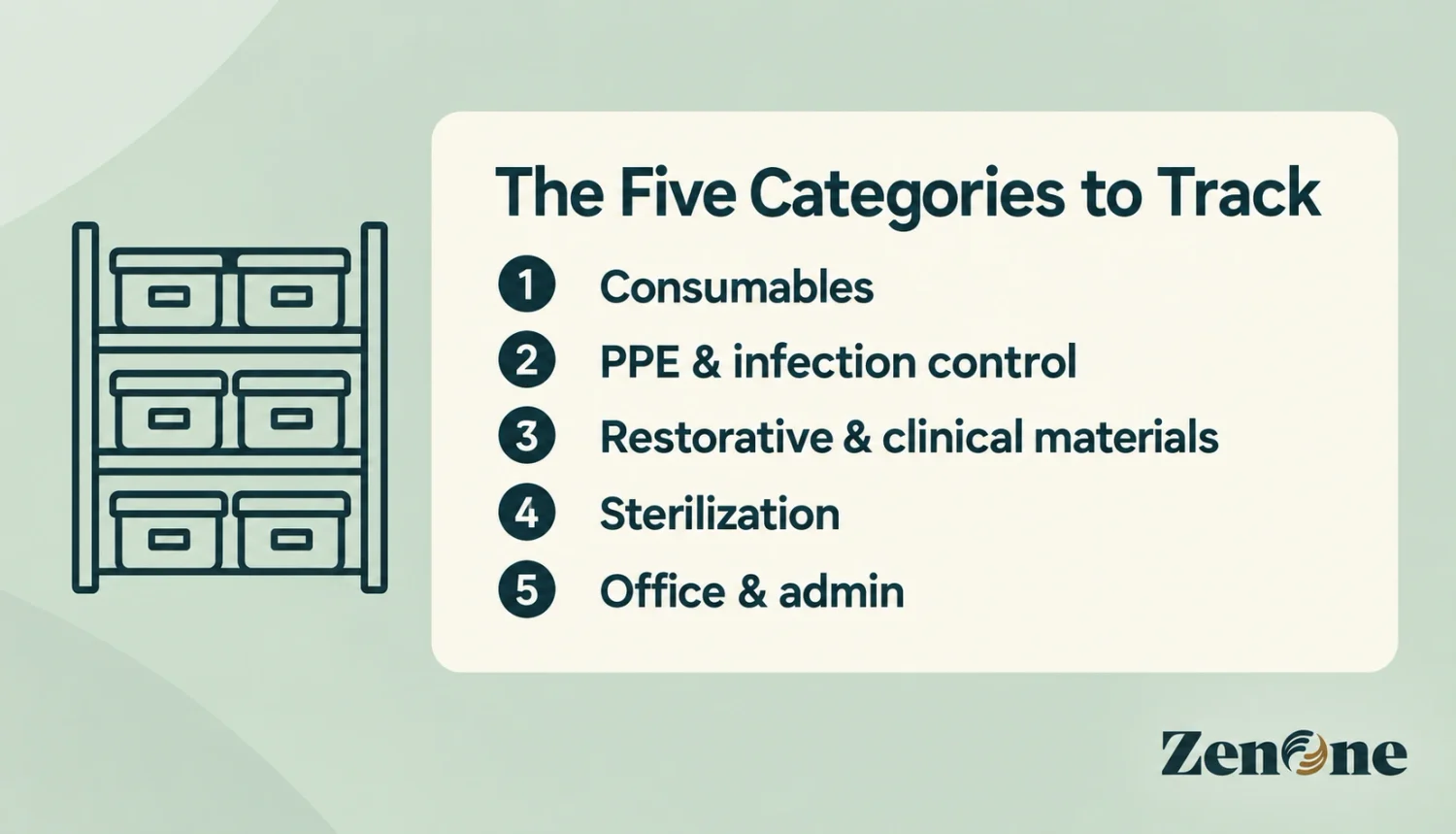
Here’s the whole list in one view. The point isn’t to track all five categories with equal rigor. It’s to spend your tracking effort where cost and risk actually live, which is the top three rows.
| Category | Example items | Track | Why it matters |
| Consumables | Gloves, gauze, cotton rolls, bibs, saliva ejectors, prophy paste | Par level, reorder point | Highest turn and a big share of spend; a stockout here stops a procedure |
| PPE & infection control | Masks, face shields, gowns, surface barriers, disinfectant | Par level, reorder point, single-use status | Running out halts patient care, and single-use rules leave no room to improvise |
| Restorative & clinical materials | Composites, bonding agents, impression material, anesthetic, cements | Par level, expiry, lot | Expiry-sensitive and cost-dense; expired clinical material is a pure write-off |
| Sterilization | Pouches, chemical and biological indicators, cassettes, solutions | Par level, expiry | Compliance-linked; indicators and solutions carry hard expiry dates |
| Office & admin | Printer supplies, front-desk paper goods, cleaning supplies | Light or none | Low cost, low risk; track loosely so the list stays focused |
One caution on the PPE row. The CDC is categorical on single-use devices: use them for one patient, then dispose of them, and if a device carries no reprocessing instructions, treat it as single-use no matter how it’s labeled. That’s why the “single-use status” field belongs in this category and not the others.
What to Track for Each Item
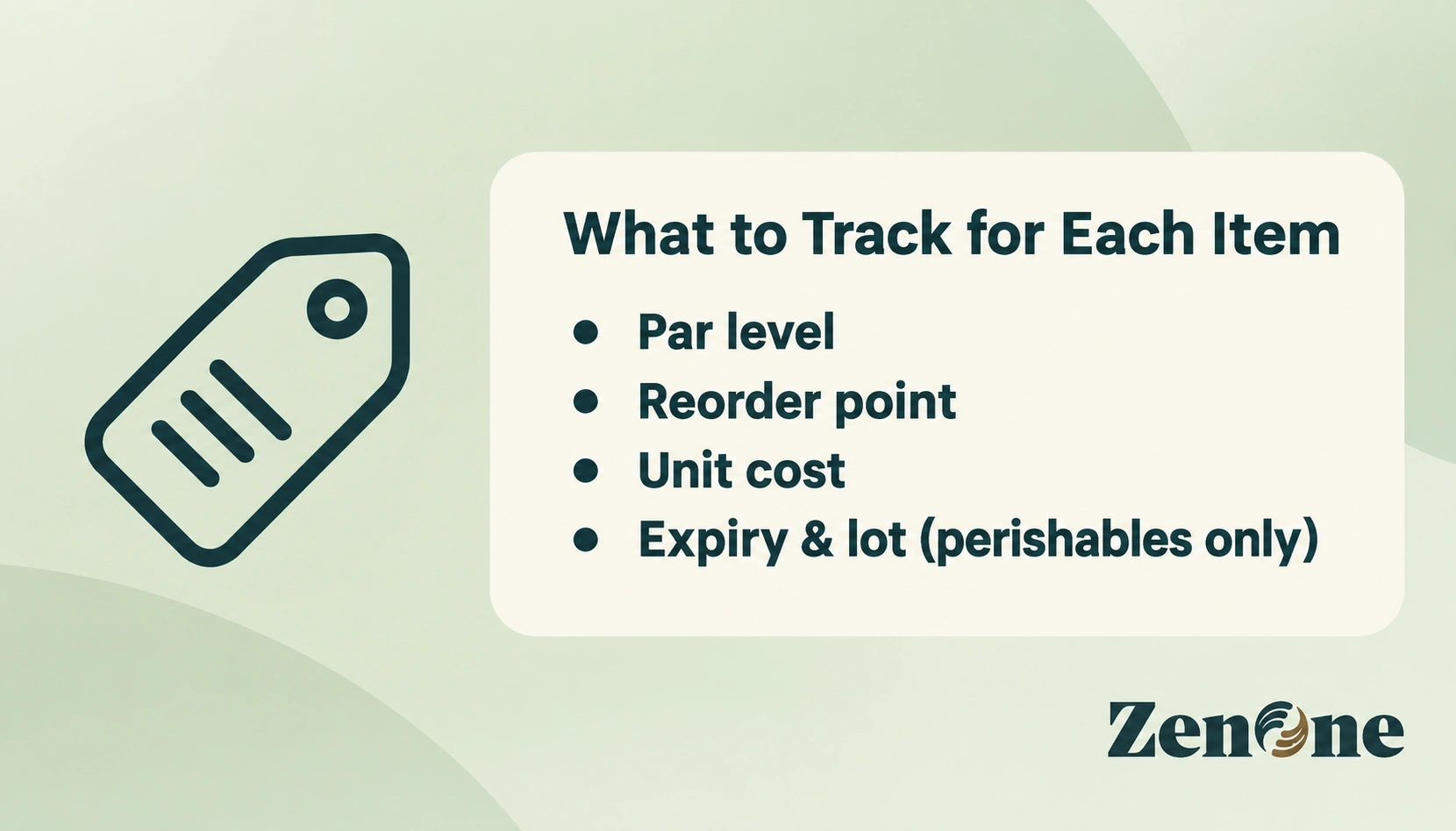
More fields don’t mean more control. They mean more maintenance, and maintenance is exactly what kills a list. So track the minimum that prevents a stockout, a write-off, or a compliance gap, and nothing beyond it.
- Par level is the quantity you want on hand.
- Reorder point is the count that triggers a new order, and you calculate it rather than guess it: average daily use times supplier lead time, plus a safety buffer.
- Unit cost earns its spot because it tells you where spend concentrates and which items are worth comparing across distributors.
- Expiry and lot apply only to perishable and regulated items, such as clinical materials, sterilization stock, and some PPE. Tracking an expiry date on cotton rolls is the kind of over-tracking that buries the dates that actually matter.
Par Levels: How Much of Each to Keep
Set par by how fast an item turns. High-turn consumables get tighter par levels and more frequent reorders. Slow movers get low par levels, so you don’t convert a cost problem into an expiry problem by stockpiling something you’ll never use in time.
Aim for four to six inventory turns a year, which works out to roughly 60 to 90 days on hand, according to Pearl. A practice ordering monthly sits nearer the 30-to-60-day end. The small-practice trap is setting par levels too high because shelf space is cheap and running out feels worse than overstocking. At low volume, overstock expires before you reach it, so keep the buffers honest.
What Often Backfires
The ways a list goes wrong are as predictable as the ways it helps.
Tracking every SKU equally, which turns the list into noise and guarantees abandonment. Skipping expiry tracking on perishables, so FIFO fails silently when the same item lives in three rooms and nobody dates it on receipt. Letting the list go static, so counts drift, reorder points go stale, and the document quietly stops matching the closet. And counting for its own sake, where the team tallies items but attaches no par level or reorder point, so the count produces data nobody acts on. A number you don’t act on isn’t inventory management. It’s a chore.
How ZenOne Fits Your Ordering
A list is only useful if it stays true, and staying true by hand is where most practices lose the thread. ZenOne closes that gap.
- A normalized catalog and live counts from barcode and QR check-in and check-out, so the list maintains itself instead of decaying. That’s the direct answer to the static-list failure mode.
- Expiry and reorder alerts, so perishable and compliance-linked items get flagged before they become a write-off or a shelf gap.
- Spend visibility that shows you which items actually deserve close tracking, so the list stays short and weighted instead of sprawling.
- Proof in a real practice’s numbers. Dr. Brandon Johnson at Brushy Creek Dentistry spends roughly $10,000 a month on supplies and saves about 20 percent, which you can read alongside the rest on the customer wall.
Frequently Asked Questions
What should be on a dental office supply inventory list? Group it into five categories: consumables, PPE and infection control, restorative and clinical materials, sterilization, and office and admin. Track the first three closely and the last two loosely.
How often should a dental office count inventory? Tie counts to your ordering cadence. A fixed monthly count works for most small practices, with high-turn consumables checked more often.
Which items need expiry tracking? Clinical materials, anesthetics, sterilization indicators and solutions, and some PPE. Anything with a hard shelf life or a compliance date belongs on expiry tracking; commodity disposables generally don’t.
How many items should a small practice track closely? Fewer than most expect. Focus on the top items by spend and anything perishable or compliance-linked, and let the rest sit on the list loosely.
Is a spreadsheet enough for a dental inventory list? It can work at low volume, but it goes stale fast because it depends on manual updates. The failure point is maintenance, not the format.
Conclusion
A good dental office supply inventory list is short, weighted, and alive. It tracks what carries cost or compliance risk and deliberately ignores what doesn’t, and the “why” behind every entry is the whole discipline. If running out or expiring costs you nothing, you don’t need to track the item closely. If it costs you a procedure or a write-off, it does.
ZenOne is dentist-owned, and founder Tiger Safarov built it so a private practice can keep that list true without turning it into a second job. Controlling what you own and what you use is a visibility problem, not a spreadsheet problem, and visibility is the part software actually solves.
Stop maintaining a list by hand.
Let live counts, expiry alerts, and reorder points keep your inventory list honest across every distributor you already use. Start your free trial with ZenOne.
Join 1400+ dental professionals, shop from your favorite
suppliers, compare prices instantly, and save over $17,000/year
Try our platform free for 14 days.
Get the latest ZenOne updates and product launches in your inbox
Don't miss the latest news!
Receive exclusive offers and news straight to your inbox!
Continue reading
09/23/2026
~ 7 minutes to read

09/11/2026
~ 7 minutes to read
09/01/2026
~ 9 minutes to read
Let's discover how we can help you

Tiger Safarov
Hi, I'm Tiger, the CEO at ZenOne, and I'm happy to personally ensure your success with ZenOne. Send me your latest invoice or a statement for a Free Savings Analysis.
Ask me a question:

