
Miranda Moore

RDA Lead Assistant, Beacon Dentistry
10/23/2026

Dental Supplies Isn’t One Budget: How to Allocate Practice Expenses the Right Way

~ 7 minutes to read

Why your supply number is probably wrong

Most practices I talk to have one line on the P&L for everything they buy from a dental distributor: Dental Supplies. Gloves, composite, a new autoclave, a handpiece repair, toner, CEREC blocks. It all goes in the same bucket because the check went to the same vendor.

That single habit causes three problems. Your supply percentage looks worse than it is, so you chase savings in the wrong place. Lab and repair costs disappear inside it, so you never see them growing. And equipment that should be depreciated or written off under Section 179 gets expensed as a consumable. Your fixed-asset list stops matching what’s in your operatories, and your CPA has to untangle it at year-end instead of planning around it.

The categories, and what goes in each

Split distributor spend into these seven lines. The benchmarks are rough comparison points as a percent of collections; your specialty and case mix will move them.

Category What belongs here Common mistake Rough benchmark
Dental (clinical) supplies Consumables used on patients: PPE, infection control, anesthetic, composite, impression material, burs, disposables Small equipment, repairs and lab materials mixed in 4–6%
Lab fees Outside lab cases, plus in-office milling blocks and materials (CEREC and similar) Milling blocks coded to supplies because they came from a distributor 6–8%
Office supplies Paper, toner, front-desk and breakroom consumables Computers, monitors and furniture coded here ~1–2%
Equipment repairs and maintenance Handpiece repair, service calls, compressor and vacuum maintenance, service contracts Coded to supplies because the distributor’s tech did the work Track on its own line
Small equipment (expensed) Tools under your capitalization threshold: curing lights, scalers, an instrument cassette set Mixed into supplies, which inflates the supply % in the month you buy Track on its own line
Equipment (capitalized) Chairs, delivery units, imaging, scanners, lasers, autoclaves, computers, cabinetry Expensed as supplies, so it never reaches the fixed-asset list Balance sheet, not overhead %
Software and subscriptions Practice management, imaging software, ordering and inventory platforms Lumped into office supplies Admin overhead

↔ On smaller screens, swipe to see all table columns.

Two of these come straight from experienced dental CPAs. Dental Economics has long advised that CEREC costs belong in lab fees, not supplies, and that computers and office furniture should never land in the office supply account (Dental Economics). Supply and lab ranges are the ones we use in our overhead benchmarks guide.
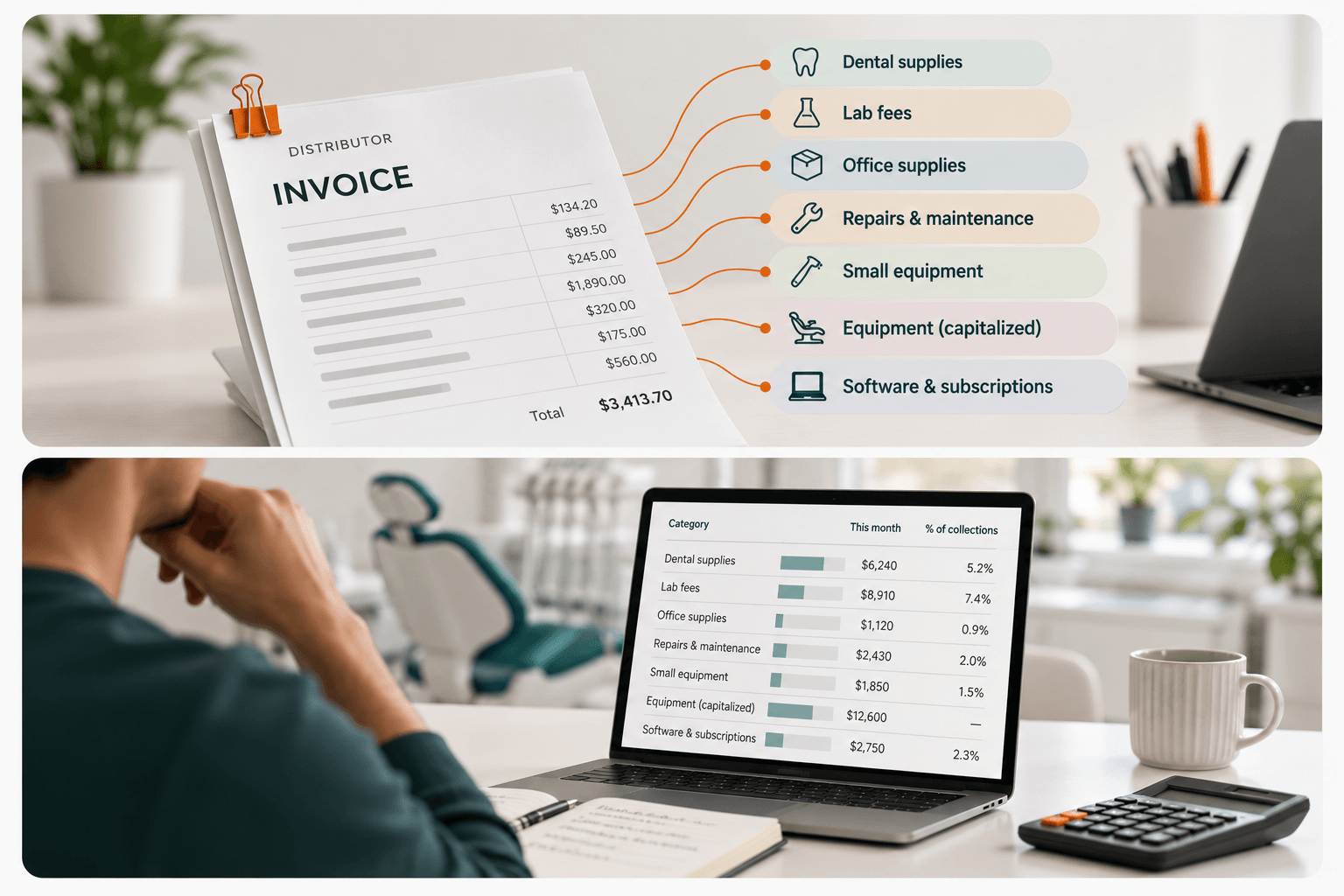
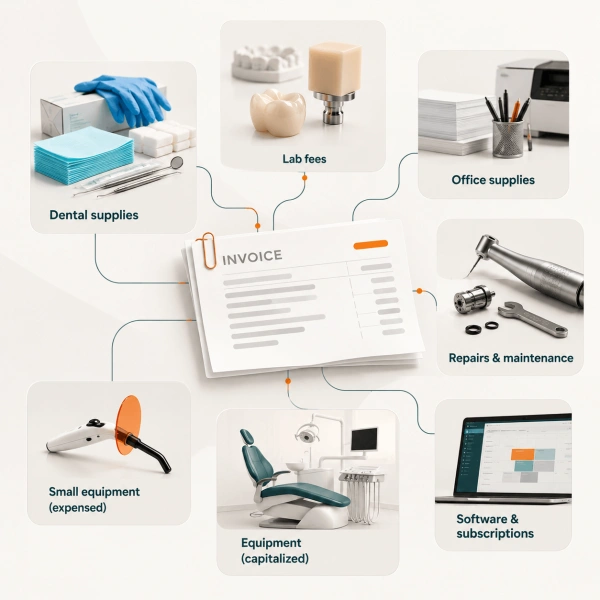
A dental distributor invoice divided into supplies, lab fees, repairs, equipment, and other practice expense categories
A single distributor invoice may contain purchases belonging to several different expense categories.

The tax rules that decide supplies vs. equipment

Where a purchase lands isn’t just a bookkeeping preference. Five federal rules decide whether it’s deducted now, deducted when used, or capitalized. All figures below are for tax years beginning in 2026.

Materials and supplies (Treas. Reg. §1.162-3).

An item counts as a supply if it costs $200 or less per unit or has an economic useful life of 12 months or less. Supplies you track with consumption records are deducted when used; supplies you don’t track are deducted when bought (26 CFR §1.162-3). Most clinical consumables fall here.

De minimis safe harbor (Treas. Reg. §1.263(a)-1(f)).

Without audited financial statements, you can elect to expense tangible property costing up to $2,500 per item or per invoice line; the limit is $5,000 with audited statements. The election is an annual statement attached to a timely filed return, it applies to every qualifying purchase that year, and the item must also be expensed on your books (explainer). This is why a $1,800 curing light can go to Small equipment rather than the asset list.

Section 179.

For 2026 you can elect to expense up to $2,560,000 of qualifying equipment. The limit shrinks dollar for dollar once total equipment placed in service passes $4,090,000 (IRS Publication 946). The equipment must be installed and usable by December 31, not just ordered. The deduction can’t exceed business taxable income; the excess carries forward. It’s claimed on Form 4562, and not every state follows the federal limits.

Bonus depreciation.

The 2025 tax law (OBBBA) made 100% bonus depreciation permanent for qualifying property acquired after January 19, 2025, with no dollar cap. It applies after any Section 179 amount and covers new and used equipment (summary). For most practices, the practical result is the same as 179: a new chair or scanner can be fully deducted in year one. Your CPA picks which tool to use.

Repairs vs. improvements.

A repair that keeps equipment working is deducted now. Work that betters the asset, restores it from a broken or worn-out state, or adapts it to a new use (the “BAR” test) must be capitalized. Routine maintenance you expect to repeat more than once during the asset’s class life is safe-harbored as a deduction (Journal of Accountancy). A handpiece turbine swap is a repair. Rebuilding a chair’s hydraulics and upholstery to like-new may not be.

The allocation process, step by step
Set up the accounts. Add the seven lines above to your chart of accounts, plus a fixed-asset account for dental equipment and one for office equipment. Your CPA may already have a dental template; use theirs so your numbers match their benchmarks.
Agree on a capitalization policy with your CPA. Write it down: for example, “items over $2,500 per unit with a useful life over one year are capitalized; everything else is expensed.” Confirm they’ll file the de minimis election each year.
Code every invoice by line item, not by vendor. One invoice from a full-line distributor can hold gloves, a repair and a new scanner. Each line goes to its own account. Run each line through this order, first match wins:
Lab work or milling material → Lab fees
Labor or parts to fix existing equipment → Repairs and maintenance (unless it betters, restores or adapts the asset)
Over your capitalization threshold → Equipment (capitalized)
A durable tool under the threshold → Small equipment
Used on patients → Dental supplies
Used at the front desk or in the office → Office supplies
Record placed-in-service dates. For every capitalized item, note the date it was installed and usable, not the order date. That date decides which tax year it belongs to.
Keep shipping with the item. Freight and installation on equipment are part of its cost. Shipping on a supply order belongs with the supplies.
Reconcile monthly. Compare each category to collections and to the same month last year. A one-month spike in supplies is usually a misclassified equipment purchase or a big stock-up, not a pricing problem.
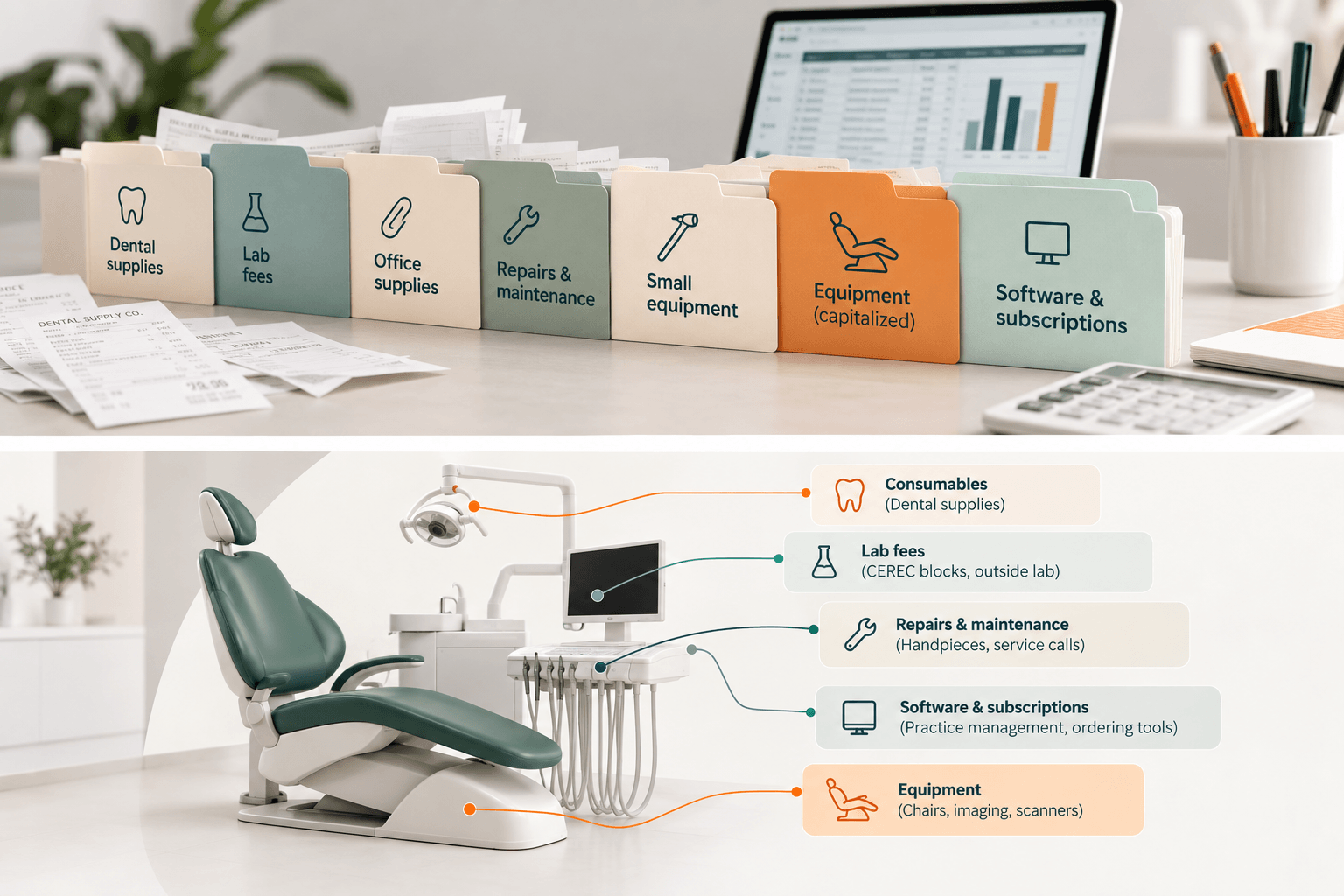
Dental practice purchases and accounting records organized by category, including supplies, repairs, and equipment
Classifying purchases by type helps practices track spending and prepare cleaner financial records.

Common miscodes and how to fix them

These are the lines I see buried in Dental Supplies most often. The examples assume a $2,500 capitalization threshold.

Invoice line Usually coded to Belongs in Adjustment
Intraoral scanner, $28,000 Dental supplies Equipment (capitalized) Reclass to fixed assets with placed-in-service date; CPA chooses Section 179 or bonus
Handpiece repair, $450 Dental supplies Repairs and maintenance Reclass to repairs
CEREC / milling blocks, $1,200 Dental supplies Lab fees Reclass to lab fees
Curing light, $1,800 Dental supplies Small equipment Reclass; expensed under de minimis
Laptop for front desk, $1,400 Office supplies Small equipment Reclass; expensed under de minimis
Annual sterilizer service contract, $900 Dental supplies Repairs and maintenance Reclass to repairs
Gloves and masks on the same invoice as the scanner Equipment Dental supplies Split the invoice by line

↔ On smaller screens, swipe to see all table columns.

For the current year, each fix is a simple reclass entry: debit the correct account, credit Dental Supplies, with the invoice number in the memo. Do it monthly, so your year-end package is clean before it reaches your CPA.

For prior years, don’t reclass on your own. A capital item that was expensed in a closed year is your CPA’s call. Often nothing needs to change, and sometimes it does.

Year-end checklist

Before you send the year to your CPA, run through this list:

Pull the Dental Supplies account for the year and sort by amount. Look at every line over your capitalization threshold.
Pull every invoice from full-line distributors and split mixed invoices by line.
List all equipment bought this year with cost, freight, install and placed-in-service date.
Confirm anything you want deducted this year is installed and usable by December 31.
Ask your CPA whether they're filing the de minimis election and whether Section 179 or bonus depreciation fits your situation, including your state.
Recalculate your true supply percentage once lab, repairs and equipment are pulled out.

This article is general information, not tax or accounting advice. Rules and limits change, and your CPA should confirm how they apply to your practice. Tax figures checked October 2026.

Sources

References cited in this article:
Back to top ↑

Join 1400+ dental professionals, shop from your favorite
suppliers, compare prices instantly, and save over $17,000/year

Try our platform free for 14 days.

Get the latest ZenOne updates and product launches in your inbox

Don't miss the latest news!

Receive exclusive offers and news straight to your inbox!


    Let's discover how we can help you

    Tiger Safarov

    Hi, I'm Tiger, the CEO at ZenOne, and I'm happy to personally ensure your success with ZenOne. Send me your latest invoice or a statement for a Free Savings Analysis.

    Ask me a question: