


Miranda Moore
RDA Lead Assistant, Beacon Dentistry
09/11/2026
Best Dental Supply Companies: 2026 Comparison Guide

~ 7 minutes to read
Search “best dental supply companies,” and you want one answer: a single distributor to standardize on and stop thinking about. The honest answer is that no such company exists, because the cheapest source changes by item, by order size, and by whatever’s in stock the week you order.
That isn’t a marketing line. Henry Schein tells the SEC, in its own annual report, that it sells to large group customers at lower gross margins because of their volume and to office-based practices at higher ones. As an independent practice, you’re structurally on the higher-margin side of that ledger, and you can read the language yourself in the company’s 10-K filing.
The pressure to get this right is well documented. Since January 2021, prices for dental equipment and supplies have risen 23 percent while reimbursement averaged across all payer types has risen 19 percent, according to the ADA Health Policy Institute. The ADA calls five straight years of costs outrunning pay a fiscal squeeze, and supply cost is one side of it that a private practice can still control.
So this guide does two things. It compares the major dental supply companies honestly, covering what each one’s genuinely best at and the catch that comes with it. Then it shows why the smartest practices don’t pick a company at all. They pick per item. ZenOne exists because of that second point, which is why we care about the distinction.
Also Read
- How to Compare Prices on Dental Supplies (Without Spending Hours Doing It)
- Average Markup from Dental Supply Companies: What Your Practice Is Actually Paying
- Dental Practice Overhead Benchmarks: Are You Spending Too Much?
The major dental supply companies each win on a different axis. The full-service nationals, Henry Schein and Patterson, win on breadth, equipment, and service. The discount and online options, Darby and marketplaces like Net32, win on line-item price. Benco competes on service and on helping practices stay independent. None of them is cheapest across a real item list, because distributor margins move by item and by the volume you bring. The practical answer isn’t to crown a winner but to price your actual top items across several sources, weigh total cost rather than unit price, and re-check at reorder. That method, not loyalty to one name, is what closes the price gap.
Key Points
- There’s no single cheapest distributor. The best price moves by item and by order size, so a one-time “who’s cheapest” exercise never holds.
- Independents pay more by design. Distributor margins run higher on low-volume office-based buyers, per Henry Schein’s own SEC filing.
- Full-service and discount are different tools. Breadth, equipment, and service on one side; line-item price on the other. Few practices need only one.
- Total cost beats unit price. Shipping, free-shipping minimums, and staff time can erase a lower sticker price.
- Lock-in is the hidden cost. A single-vendor discount trades away price transparency on everything else.
- The fix is a method, not a vendor. Compare your real top items across sources and re-check at reorder.
See what you’re actually paying. Comparing prices across the distributors you already use takes about as long to set up as reading this post. Start your free trial with ZenOne.
The Best Dental Supply Companies at a Glance
No single row here is a verdict. Each one’s a “best for,” and the rankings shift the moment you change the item in the cart.
| Company | Model | Best for | The catch |
| Henry Schein | National full-service | Breadth, equipment, service, financing | Office-based practices are charged higher gross margins than large groups (per its SEC filing) |
| Patterson Dental | National full-service | Equipment, technology, rep support | Premium, rep-driven pricing that’s less transparent |
| Benco Dental | Family-owned full-service | Service, independence-friendly relationships | Regional coverage and pricing vary |
| Darby Dental | Mail-order / discount | Lower consumable prices, no rep pressure | Thin equipment and service layer |
| Net32 | Online marketplace | Lowest line-item prices, easy comparison | Multi-vendor orders mean multiple shipping minimums and no service |
| Supply Clinic & other marketplaces | Online marketplace | Cross-vendor price shopping | Same fragmentation; you manage more relationships |
The Full-Service Nationals: Henry Schein and Patterson
These are the two names most practices already order from. Both are full-line distributors: supplies, equipment, service, and financing under one roof, with a rep attached to the account.
The convenience is real and worth something. One invoice, one relationship, equipment servicing, and emergency availability all cut friction. The trade-off is price. As an independent, you sit on the higher-margin side of the distributor’s book, which is exactly the gap a lower-volume buyer pays for the full-service model. For context on the band you’re negotiating inside, Henry Schein reported roughly a 25 percent gross margin across its global distribution segment in fiscal 2025. This figure spans far more than U.S. dental but still shows there’s room to move and a floor beneath it.
The verdict: they’re best when breadth, equipment, and hands-on service genuinely outweigh line-item price. For your highest-spend consumables, they’re rarely the cheapest source.
The Price Players: Darby and the Online Marketplaces
Darby runs a mail-order model with competitive consumable pricing and no rep overhead, but with a thinner equipment and service layer. Net32 is a marketplace of third-party vendors that often carries the lowest unit price on commodity items like gloves and disposables, with the trade-off that a single order can arrive from several vendors, each with its own shipping minimum and no service layer behind it. Supply Clinic and similar platforms build the whole product around comparing across vendors.
The reasonable question here is whether marketplaces are safe to buy from. They’re legitimate channels; the discipline is to vet individual sellers, watch shipping minimums, and check expiration dating on what arrives, the same caution you’d apply to any low-cost source.
The verdict: they’re best for commodity, high-turn, non-clinically-sensitive items where price is the whole story.
Benco and the Independence Angle
Benco is family-owned and positions itself on service and on helping practices stay independent, which makes it a natural fit for owners who want a full-service relationship without buying into consolidation. The verdict is straightforward: a full-service option worth a quote for practices that value the independence stance and the service that comes with it.
How to Pick the Best Company for Each Item
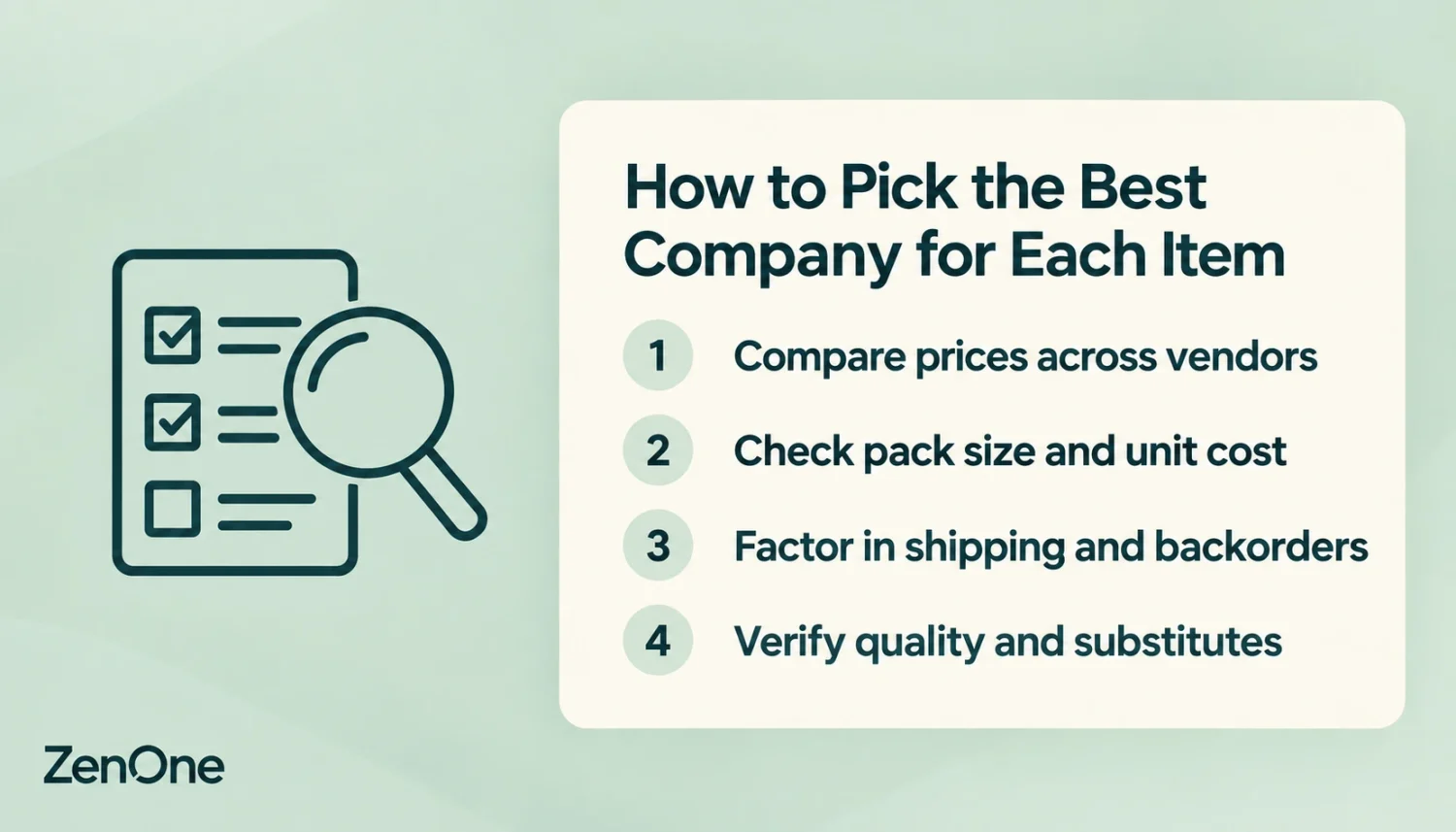
The reframe that resolves the whole question: stop asking which company and start asking which company for this item.
Pull 60 to 90 days of invoices and isolate your top 20 items by spend. Most of your supply budget concentrates in a small number of line items, so that short list is where the money actually is. Price each of those across three or more sources: one national, one discount, one marketplace. Then compare the number that matters: total cost, not unit price. Daniel Gordon, writing in Dental Economics, argues that the true cost of a purchase includes shipping, the staff hours spent shopping and tracking it, and the risk of receiving a poor-quality substitute for that great price. Free-shipping minimums and lead times belong in the same math.
Do this at reorder, not once a year, because prices drift. Run the exercise honestly, and it rarely returns a single winner, which is the entire point.
What Backfires
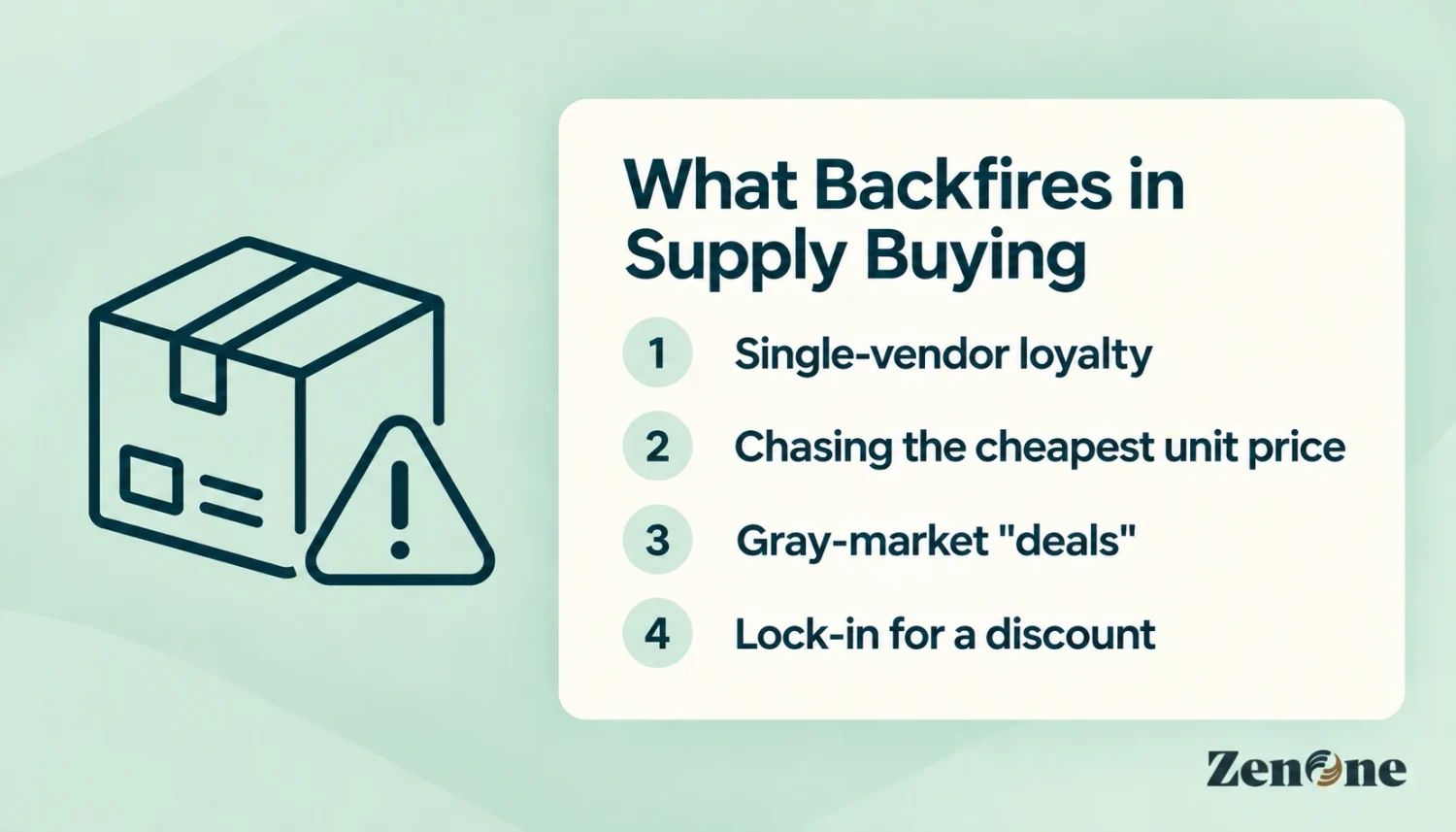
The main ways practices get this wrong remain pretty common.
- Single-vendor loyalty for the portal convenience, or a year-end rebate that turns out smaller than the price gap you ate all year.
- Chasing the cheapest unit price everywhere, which is a real trap: a win that adds four vendor relationships, four shipping minimums, and hours of staff time a month is a net loss with good optics.
- Gray-market “deals,” which the Ohio Dental Association warns may carry compromised quality from improper handling, fall outside manufacturer warranties, and end in patient complaints.
- Accepting lock-in for a discount: GPOs make money from vendor fees, member fees, or commissions on the savings they generate, as Dental Economics lays out, and the model you’re in determines what actually reaches your bottom line. We put that comparison side by side on the ZenOne versus GPOs page.
How ZenOne Fits Your Practice
ZenOne isn’t another company on the list. It’s the layer that compares across the companies you already use, which is the answer to a market where the best price keeps moving.
- Price comparison at reorder across your existing distributors, matched to more than 200,000 normalized SKUs so you’re comparing true equivalents instead of similar-sounding catalog names.
- No distributor lock-in. ZenOne routes each order to the best price and leaves your vendor relationships intact. You keep Schein, Patterson, Benco, and Darby.
- Collective volume as the mechanism. Pooled volume across more than 1,400 dental professionals gives an independent practice pricing power it can’t generate alone.
- Proof in a real practice’s numbers. Dr. Brandon Johnson at Brushy Creek Dentistry spends roughly $10,000 a month on supplies and saves about 20 percent, which you can read alongside the rest on the customer wall.
Frequently Asked Questions
Who are the biggest dental supply companies? Henry Schein and Patterson are the two dominant full-service national distributors. Benco, Darby, and online marketplaces like Net32 round out the field for most private practices.
Which dental supply company is cheapest? None consistently. The lowest price moves by item and by order volume, so comparing your actual line items across several sources beats committing to one vendor. CPA data already puts the average practice above the ADA’s supply benchmark, so most have room to recover.
Is Net32 legitimate and safe? Yes, it’s an established marketplace. Because orders can come from multiple third-party sellers, vet individual vendors, mind shipping minimums, and check expiration dating on arrival.
Should a small practice use one distributor or several? Several, or a comparison layer that prices across them. Single-vendor convenience usually costs more than it saves at small-practice volume.
Are GPOs worth it for dental supplies? It depends on how the GPO makes its money and whether membership restricts which distributors you can use. Ask who pays the organization, because vendor-funded, member-funded, and commission models produce different net results for you.
Conclusion
No single dental supply company is best, and chasing one is how practices lock in a price they could’ve beaten. The best option is a moving target that depends on the item in the cart, the order size, and the day. The durable advantage isn’t loyalty to a name. It’s visibility across all of them.
ZenOne is dentist-owned, and founder Tiger Safarov built it around collective volume for one reason: supply cost is among the few overhead lines a private practice can move without giving up ownership. Moving it should mean seeing your real prices, not sacrificing the relationships and service you already rely on.
Find the point you are leaving on the table!
Compare prices across every distributor you already use and see the gap on your own item list, not on someone else’s average. Start your free trial with ZenOne.
Join 1400+ dental professionals, shop from your favorite
suppliers, compare prices instantly, and save over $17,000/year
Try our platform free for 14 days.
Get the latest ZenOne updates and product launches in your inbox
Don't miss the latest news!
Receive exclusive offers and news straight to your inbox!
Continue reading
10/02/2026
~ 7 minutes to read
09/23/2026
~ 7 minutes to read
09/01/2026
~ 9 minutes to read
Let's discover how we can help you

Tiger Safarov
Hi, I'm Tiger, the CEO at ZenOne, and I'm happy to personally ensure your success with ZenOne. Send me your latest invoice or a statement for a Free Savings Analysis.
Ask me a question:

