


Miranda Moore
RDA Lead Assistant, Beacon Dentistry
08/24/2026
Dental Inventory Management Software for Small Practices: 7 Features That Actually Matter

~ 10 minutes to read
Dental inventory management software is sold as if every buyer runs a purchasing department. Most do not. A two operatory practice and a fifty location group buy the same box of gloves from the same distributor, and the two practices do not pay the same price for it.
That is not a rumor. Henry Schein says it out loud in its own annual report to the SEC, where the company explains that sales to large group customers are typically completed at lower gross margins as a result of higher sales volumes, while sales to office-based practitioners generally carry higher gross margins due to lower volumes. Lower margin for the distributor means a lower price for the buyer. Higher margin means you are the buyer paying it.
The squeeze on the other side is real too. Since January 2021, prices for dental equipment and supplies have risen 23 percent and staff wages have risen with them, while reimbursement averaged across all payer types has gone up only 19 percent, according to the ADA Health Policy Institute. Costs climbed faster than the money coming in, for five years running.
Here is the problem with this software category: nearly every product in it is built and priced for groups, then sold down to solo practices with onboarding sequences and approval chains a two person team will never touch. This post covers the seven features that earn their keep at 1 to 5 operatories, the four you are being upsold, and an honest test for whether you need software at all yet. ZenOne was built for the practice on the small end of that split, which is the whole reason we care about the distinction.
Also Read
- Switching From Dental Spreadsheets to Software: A Practical Guide for Private Practices
- The Top 5 Best Dental Inventory Management Software for 2026
- Dental Clinic Inventory Management Best Practices
Summary
Dental inventory management software is worth buying at small scale only if it does seven things: compares prices across every distributor you already use at the moment of reorder, runs barcode or QR check in and check out from a phone, fires reorder alerts calculated from real usage rather than memory, captures expiration and lot at receiving, reports spend against collections, installs without an IT person, and leaves your distributor relationships alone. The four features that get upsold are three way invoice matching, formulary enforcement with permission tiers, multi location stock rollup, and private label conversion targets. Every one of those is a control built for an organization with an accounts payable department. At 1 to 5 operatories the software is not replacing a purchasing department. It is replacing one person’s memory.
Key Points
- Price comparison is the only feature that attacks price. Everything else attacks waste, which is a different and smaller pot of money.
- Scanning is load bearing. Alerts, forecasting, and spend reporting all collapse if the on hand count is wrong.
- Reorder thresholds have to be calculated, not remembered. Average daily usage times lead time, plus a buffer.
- Expiration exposure is worse at low volume, not better. Slow turns collide with shipping minimums written for bigger buyers.
- The ADA benchmark is 5 to 6 percent of collections. One point on a $1 million practice is $10,000 a year.
- Your practice management software probably does not do this. Check before you pay for a second system, because there is one notable exception.
- Four common features are enterprise controls in disguise. They solve problems a two person team does not have.
- A spreadsheet is still fine under specific conditions. There is an honest test near the end of this post.
See what your practice is actually paying
Price comparison across your existing distributors takes about as long to set up as reading this post. Book a Demo with ZenOne.
Why Small Practices Are a Different Problem, Not a Smaller One
The instinct in this category is to treat a solo practice as a scaled down group. It is not. The constraints are different in kind, not just in size.
Nobody’s job is watching supply spend. The owner is chairside, the assistant orders between patients, and no one on the payroll is paid to notice the number drifting from 5.5 percent of collections to 8 percent. In a group, that person exists and has a title.
The margin for error is thinner too. Overjet, a dental AI company, puts practices collecting under $750,000 a year at 70 to 80 percent overhead, against below 60 percent for practices above $1.5 million. Overjet is a vendor rather than a research body, so treat those tiers as an industry estimate. The direction is not in dispute, though: a point of supply spend hurts more at the small end.
Duplication is the quiet version of the same problem. The California Dental Association walks through the math on patient bibs: one box in the treatment area plus a backup in the closet is $100 in inventory, and four extra colors with their own backups turns that into $500. That is $400 of cash sitting on a shelf, on one disposable item, in a practice that did nothing wrong other than never deciding to stop.
And this is not a niche audience. In 2024, 34 percent of US dentists practiced solo and another 39 percent worked in a single location practice with at least one other dentist, per the ADA Health Policy Institute’s workforce report. Roughly 73 percent of the profession sits in a single location, and the software is mostly built for the other quarter.
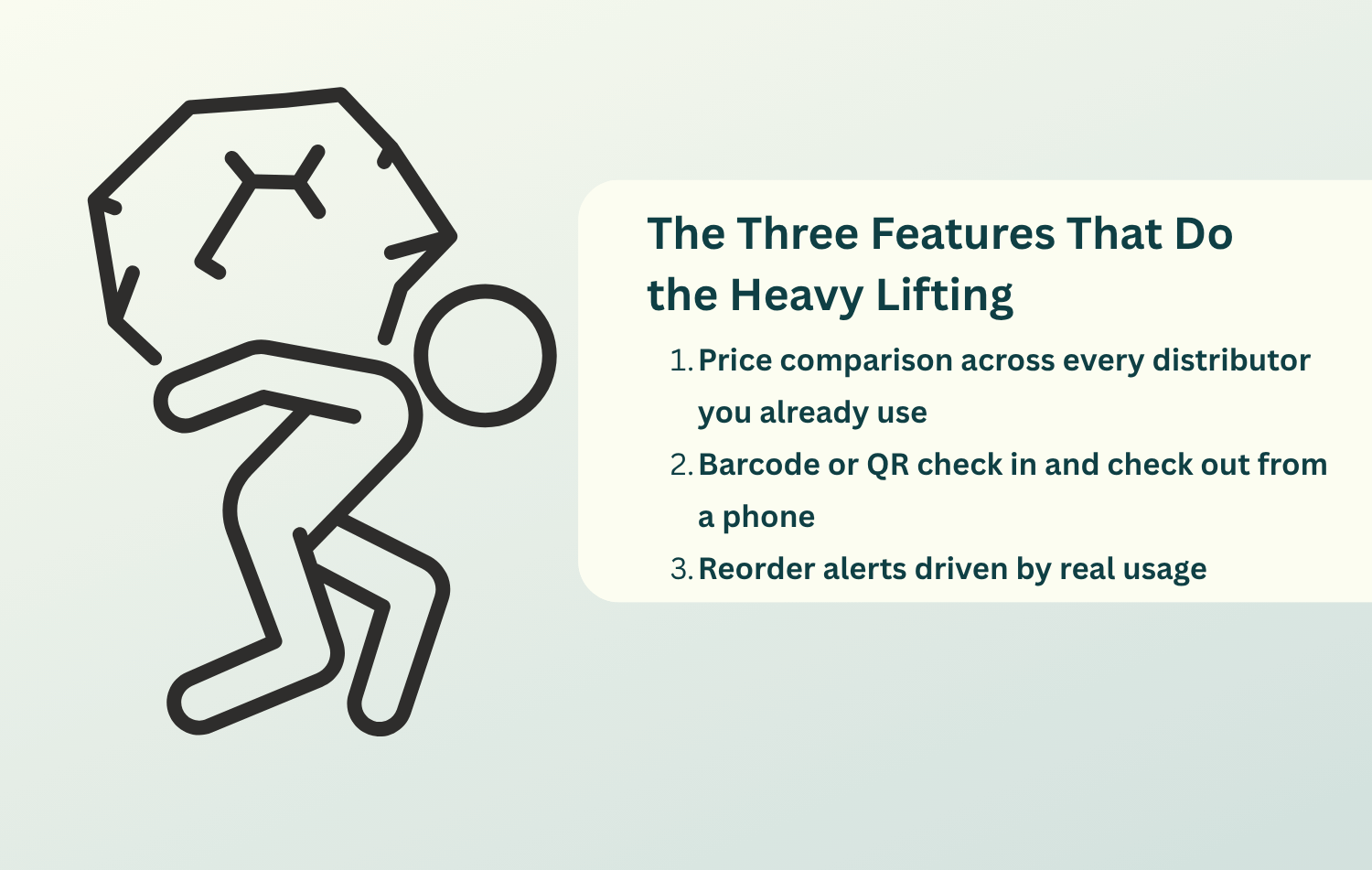
The Three Features That Do the Heavy Lifting
If you buy nothing else, buy these. They are the difference between software that changes your spend and software that organizes your closet.
1. Price comparison across every distributor you already use
When a reorder fires, the platform should price that item across every connected supplier instead of defaulting to whoever sold it to you last. This is the one feature that attacks price directly rather than attacking waste.
The trick underneath it is catalog normalization. Distributors use different names and different catalog numbers for identical products, so a real comparison has to match true equivalents line by line at the moment of reorder, not once a year at contract renewal. No single distributor wins on every item, which is exactly why an annual “who is cheapest” exercise never holds up.
2. Barcode or QR check in and check out from a phone
Scan on receipt to add, scan on use to deduct. That is the whole mechanic, and it is worth more than it sounds.
Manual entry is where inventory data goes to die. In a CDC study published in Applied Clinical Informatics, scanned product identifiers came through at 99.999 percent accuracy in a clinic pilot. In a separate analysis of 50 million manually entered vaccine records, 53 percent of the product codes were missing or inaccurate. Different setting, same human truth: people typing codes between patients get them wrong. A phone camera is enough to start, and a dedicated scanner runs $30 to $50 if the team prefers one.
3. Reorder alerts driven by real usage
The formula is not complicated. Reorder threshold equals average daily usage times supplier lead time in days, plus a safety buffer. Two anesthetic cartridges a day, a five day lead time, and a two day buffer gives you 14.
Set a maximum as well as a minimum so the fix for stockouts does not become overstock, then recalculate every 90 days as your case mix moves. Most practices should be aiming for four to six inventory turns a year, which works out to roughly 60 to 90 days of supply on hand, according to Pearl. Anything slower than that is cash sleeping on a shelf.
The Four Features That Are Easy to Undervalue
These do not sell the demo, and they are the ones practices miss when they are gone.
4. Expiration and lot capture at receiving. Dates go in when the box is opened, and anything 60 to 90 days from expiring gets flagged while you can still use it. Small practices are more exposed here, not less, because shipping minimums built for bigger buyers push you to order $350 of product when you needed $180.
5. Spend reporting against a benchmark. Spend by category and by vendor, measured against collections. Keep supply costs separate from equipment maintenance and repair, because that is where the number quietly inflates. Add supply cost per patient visit as a second metric, since percent of collections improves on its own when you raise fees, and cost per visit does not.
6. Setup you can finish without an IT person. Ask three questions before you sign: is there an implementation fee, is pricing published, and can you export your own data if you leave. If the sales process needs a scoping call before anyone will quote you a number, the product is priced for a group.
7. No distributor lock in. You keep Henry Schein, Patterson, Benco, and Darby, and the software routes each order to whoever is cheapest that week. A single vendor discount feels like buying power. What it trades away is price transparency on everything else, which is the thing you were trying to buy in the first place. Check any platform’s distributor coverage before you commit to it.
The Feature Scorecard for 1 to 5 Operatories
Here is the whole buying decision on one screen.
| Feature | What it does at your scale | Worth paying for? |
|---|---|---|
| Price comparison at reorder | Attacks the price gap directly, every order | Yes, this is the reason to buy |
| Barcode or QR scanning | Makes every other number trustworthy | Yes, nothing works without it |
| Usage based reorder alerts | Ends rush orders and dead stock at once | Yes |
| Expiration and lot capture | Stops write offs you currently never see | Yes |
| Spend reporting vs collections | Turns the benchmark into a monthly habit | Yes |
| Self serve setup | Keeps you out of a six week implementation | Yes |
| Distributor freedom | Preserves the leverage you are paying for | Yes |
| Three way invoice matching | Controls an approval chain you do not have | No |
| Formulary with permission tiers | Polices buyers you do not employ | No |
| Multi location rollup and transfers | Moves stock between locations you do not own | Only with a second location |
| Private label conversion targets | Requires volume you cannot generate alone | No |
The Four Features You Are Being Upsold
Every item in the bottom half of that table is a legitimate feature. None of them is shaped like your practice.
Three way invoice matching is an accounts payable control that reconciles the purchase order, the receipt, and the invoice. If one person opens the boxes and the same person approves the invoice, there are not three independent parties to match.
Formulary enforcement with permission tiers exists to stop dozens of buyers across dozens of locations from going off list. It works: an eight location group, Empire Dental Arts, saved over $200,000 in a year using a formulary with distributor side spending limits, monthly profit and loss review, and a quarterly leadership review. That is a real result at eight locations. When two people order supplies, a written list taped inside the closet door does the same job for free.
Multi location stock rollup and transfers only creates value when there is somewhere to transfer stock to.
Private label conversion targets push large groups toward house brands across a substantial share of spend. That takes volume you do not have, and for clinical materials it is a doctor’s decision, not a purchasing one.
The pattern worth naming: several products in this category are sold identically to a one location practice and a hundred location group, and at least one is built specifically for the largest groups. Both are honest businesses. Neither is designed around your constraints.
Built for the small end of the split
ZenOne is trusted by more than 1,400 dental professionals and normalizes over 200,000 SKUs so you compare true equivalents, not similar sounding catalog names. See how it works.

When a Spreadsheet Is Still Good Enough
Nobody selling software will tell you this, so here it is. A spreadsheet is genuinely fine if every one of these is true at once:
- You track fewer than roughly 100 items.
- You order on a fixed schedule rather than when someone notices a gap.
- Your supply spend sits inside 5 to 6 percent of collections, and you know that because you check monthly.
- You have not written off expired product in the last year.
- One named person owns ordering, and a trained backup could cover them tomorrow.
Miss one of those and you are not running a system, you are running a spreadsheet that agrees with you. The ADA’s inventory control guidance is blunt about why the last point matters: supply management is often one of the easiest targets for fraud and abuse in a practice, because most dentists are too busy to fully monitor what is being used, ordered, and walking out the door. A designated owner and a trained backup are the control, with or without software.
The tipping points are specific and you will recognize them. The first rush shipping charge nobody can explain. The first expired composite. The first month you cannot say what you spent. The first time the person who orders takes two weeks off. If you want to see the two approaches side by side, we wrote a ZenOne versus spreadsheet comparison that does not pretend the spreadsheet is useless.
One warning before you assume you are covered: most practice management platforms do not include supply inventory at all. Dentrix Ascend and CareStack publish no inventory module in their feature sets, and Patterson does not advertise one for Eaglesoft. Open Dental is the real exception, with a built in Supply Inventory tool that tracks suppliers, quantities, reorder points, and purchase orders. Check your own system before you pay for a second one.
How ZenOne Fits the Small Practice
- Price comparison at reorder across the distributors you already use, matched against more than 200,000 normalized SKUs so you are comparing true equivalents rather than similar names.
- Barcode and QR check in and check out for live counts, run from a phone in the supply closet rather than from a workstation nobody walks past.
- Reorder alerts that fire on threshold, with spend reporting tied to the percent of collections benchmark so the number is in front of you monthly.
- Your distributors stay yours. ZenOne routes each order to the best price instead of replacing the vendor relationship, which is the opposite of the lock in trade.
- Collective volume is the mechanism. Every practice that joins adds to the pooled volume used to negotiate better pricing, which is how a small practice gets buying power it cannot generate on its own.
- The proof is on the customer wall. Dr. Brandon Johnson at Brushy Creek Dentistry spends about $10,000 a month on supplies and saves roughly 20 percent. Dr. Nikki recovered a full day a month that had been disappearing into ordering.
Questions Practices Ask Before They Buy
What should dental supplies cost as a percentage of collections? The ADA puts inventory costs at no more than 5 to 6 percent of collections, with office supplies as a separate bucket of about 2 percent. It also recommends that no single month allocate more than 6 percent of the prior month’s collections to supplies.
Is dental inventory management software worth it for a solo practice? It depends on which features you are buying. Price comparison and scanning pay for themselves at any size because they attack cost and accuracy. Approval workflows and formulary permissions do not, because they govern a purchasing organization you do not have.
What counts as a supply versus equipment? The ADA’s line is $500 per item, not per invoice. Anything above that is equipment, and lumping equipment repairs in with supplies is the most common reason a practice’s supply percentage looks worse than it is.
How long does it take to get running? The software is the fast part. The honest timeline is a week or two for storage consolidation, a culled item list, and a real baseline count, then a quarter of scanning before your reorder thresholds reflect actual usage instead of somebody’s estimate.
Do I have to leave my current distributor? No, and you should be suspicious of any platform that asks you to. Keeping multiple distributors is what makes price comparison possible in the first place.
Conclusion
The price gap between a two operatory practice and a fifty location group is not a law of nature. It is an information gap, and information gaps are exactly the kind of thing software closes. Seven features replace one person’s memory. Four replace a department you do not have. Sorting one group from the other is most of the buying decision.
ZenOne is dentist owned and built around a single conviction: private practices should be able to stay private, and controlling supply cost is one of the few levers an owner can pull without giving up any of that ownership. Founder Tiger Safarov built the platform on collective volume, so the buying power grows as more independent practices join rather than being handed to whoever signs the biggest contract.
Find out what you are actually paying
Compare prices across every distributor you already use, and see the gap on your own item list rather than on someone else’s average. Book a Demo with ZenOne.
Join 1400+ dental professionals, shop from your favorite
suppliers, compare prices instantly, and save over $17,000/year
Try our platform free for 14 days.
Get the latest ZenOne updates and product launches in your inbox
Don't miss the latest news!
Receive exclusive offers and news straight to your inbox!
Continue reading
10/02/2026
~ 7 minutes to read
09/23/2026
~ 7 minutes to read
09/11/2026
~ 7 minutes to read
Let's discover how we can help you

Tiger Safarov
Hi, I'm Tiger, the CEO at ZenOne, and I'm happy to personally ensure your success with ZenOne. Send me your latest invoice or a statement for a Free Savings Analysis.
Ask me a question:

